Ego sum vitis vera: Mary and the Branch That Bears Fruit
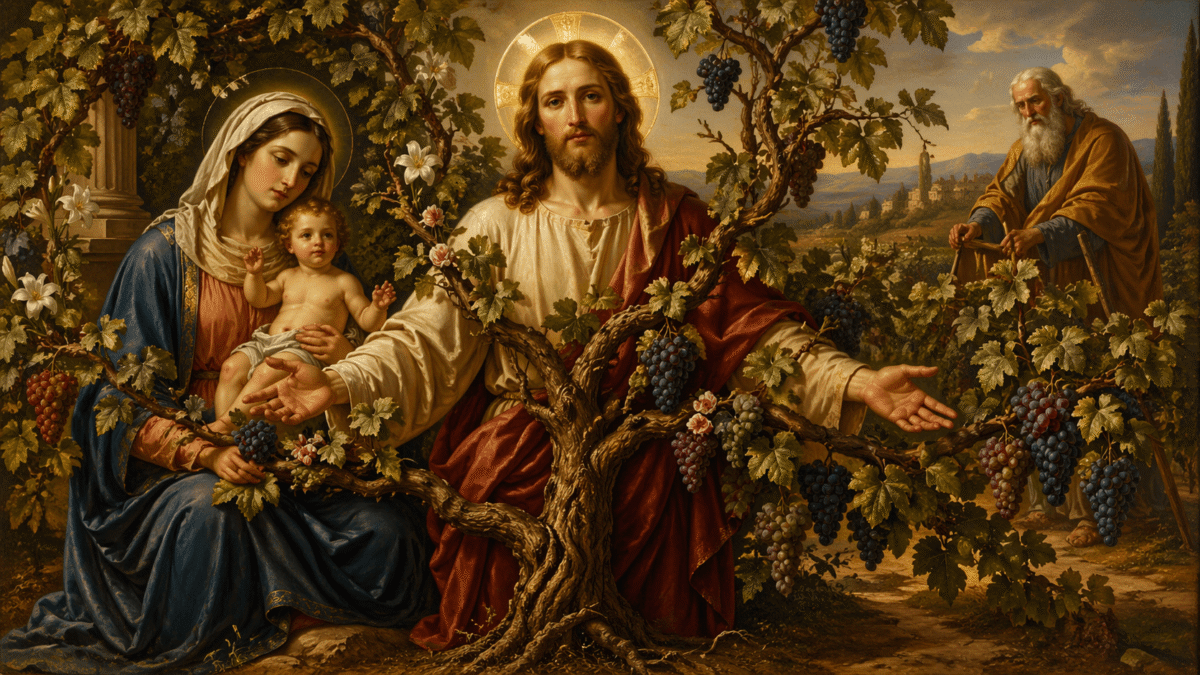
Ego sum vitis vera et Pater meus agricola est.
Jn 15:1
The discourse on the vine, unique in the whole New Testament, presents Jesus as the “true vine” and the Father as the “vinedresser.” The disciples are the branches: they remain joined to the vine and bear fruit, or they are cut off and wither. This image, rooted in the prophetic tradition of Israel (cf. Is 5:1-7; Jer 2:21; Ezek 15), acquires a new depth in John, and Mariology finds a specific place in it: Mary is the most fruitful branch of the true vine.
I. The vine of Israel and its fulfillment in Christ
In the Old Testament, Israel is God’s vine: planted with love, tended with care, yet yielding wild grapes instead of the grapes that were expected (Is 5:2). The prophet laments Israel’s infidelity as the failing of the chosen vine. Jesus declares Himself to be the “true vine,” the faithful Israel who accomplishes what historical Israel could not: to bear the fruit the Vinedresser expects.
Mary, the faithful Israelite who sums up in herself the faith of the whole chosen people, is from this perspective the “flower of Israel” that preceded the Fruit of the vine. Patristic tradition called Mary the “flower of the field” (Song 2:1) from which the Fruit of the Redemption sprang. In her the promise of the vine of Israel is fulfilled before it is fulfilled in Christ: she is the branch on which the Fruit ripened, the place where the promise of Israel found its faithful response before bursting into the world as Salvation.
The typology of the vine has a long history in patristic theology. Cyprian of Carthage saw in the vine of Jn 15 the figure of the Church’s unity: branches separated from the vine die. Branches united to it bear fruit. This ecclesiology has a Mariological dimension: Mary, as Mother of the Church, stands at the center of this unity. She who did not separate herself from the vine at Calvary, even when all the others did, is the model of the abiding that Jn 15 requires.
Medieval exegesis, in particular that of Bonaventure and Thomas Aquinas, developed the distinction between the vine as the human nature of Christ (of which Mary is the origin) and the vine as the whole communion of the redeemed (of which Mary is the first and most perfect member). This twofold dimension, Mary as the origin of the vine and as its most perfect branch, aptly captures Mary’s singular position in Mariology: she is at once the point of departure and the model of arrival.
II. “Abiding” in the vine: Mary’s contemplation
“Abide in me,” meinate en emoi, is the central imperative of the discourse on the vine (Jn 15:4, 5, 6, 7). Johannine “abiding” is not static: it is a vital, dynamic communion, like that of the branch in the vine. Without this union, nothing is possible. With it, “you bear much fruit” (Jn 15:5).
Mariology identifies in Mary the supreme model of this “abiding.” She abided in the Son when the disciples fled. She abided beside the Cross when all had scattered. She abided in the Upper Room in prayer as she awaited the Spirit. Mary’s “abiding” is not the inertia of one who has nowhere to go: it is the active fidelity of one who knows where life is to be found.
Saint John of the Cross, in his commentaries on the Spiritual Canticle, developed the idea of “abiding” as the core of the contemplative life: not a multiplicity of actions and words, but the deep dwelling in God that makes all actions spring from that center. For John of the Cross, Mary is the model of this contemplative “abiding”: all her activity (the Visitation, Cana, Calvary) springs from a center of silence and of communion with the Son.
The Orthodox hesychast tradition, the tradition of Saint Symeon the New Theologian and of Gregory Palamas, developed the contemplation of Mary as the model of “hesychasm,” the inner stillness that is not passivity but the utmost openness to the divine. Mary “abided” in the vine not in spite of the turmoil of the world but from a center of stillness that no turmoil could disturb. This model is equally valid for Western and Eastern spirituality: the peace that comes from “abiding” in Christ is transcultural and transhistorical.
III. The fruit that “abides”
Jn 15:16 specifies the nature of the fruit that is expected: “fruit that will abide.” Fleeting fruit (momentary enthusiasm, superficial conversion, fashionable devotion) does not satisfy the Vinedresser. The fruit He expects is lasting, deep, transforming.
Mary’s fruit is, in the primordial sense, Christ Himself: she gave the world the Fruit that abides eternally. And in a derived sense, Mary’s fruit is her spiritual motherhood over each disciple: she who intercedes, who guides, who sustains, produces in her spiritual children a growth that “abides” beyond circumstances.
The history of the great Marian conversions, from Bartholomew of Braga to Paul Claudel, from Saint Francis de Sales to Blessed Marthe Robin, shows the fruit “that abides”: not passing enthusiasms, but deep and lasting transformations that changed lives and histories. Mary, the most fruitful branch of the true vine, produces in the hearts of her spiritual children the same fruit that she brought forth in her flesh: the fruit of holiness, of charity, of configuration to Christ.
The tradition of contemporary Marian movements, from the Legion of Mary to the Schoenstatt Movement, from the Charismatic Renewal to devotion to the Immaculate Heart, bears witness to the continuing fruitfulness of the “Marian vine” in the Church. Every movement that places itself under Mary’s patronage produces, insofar as it remains united to the true vine that is Jesus, the fruit that abides: living communities, exemplary lives of holiness, fruitful mission.
IV. The pruning: Mary and Purification
Jn 15:2: “Every branch that bears fruit, the Father prunes, that it may bear more fruit.” Pruning is painful but fruitful; spiritual theology has identified it with the trials, sufferings, and purifications that God permits in order to deepen union with Christ.
Mary was “pruned” in the most radical way possible: the sword of Simeon (Lk 2:35), her not understanding her adolescent Son (Lk 2:50), the apparent distance during the public ministry (Mk 3:21, 31-35), and above all, Calvary. Each of these “prunings” produced more fruit: the Mary of Calvary is incomparably more fruitful than the Mary of the Annunciation, not because the Annunciation was lesser, but because the pruning deepened the union.
Medieval spiritual theology, in particular that of Tauler, Eckhart, and Ruysbroeck, developed the idea that suffering (divine “pruning”) is the path to the greatest spiritual fruitfulness. Mary is the supreme model of this pedagogy: she who was “pruned” the most was also the most fruitful, the Mother of all the redeemed, the Queen of all saints. The logic of pruning is the logic of the Cross: the grain of wheat that falls into the earth and “dies” bears much fruit (Jn 12:24).
Contemporary Marian spirituality has recovered this dimension with the concept of Mary’s “co-redemption”: not in the sense of a redemption parallel to that of Christ, but in the sense of an active participation, marked by suffering, in the redemptive work of the Son. Mary was not a passive spectator of the Cross; she was a real participant, “pruned” together with the Son so that the fruit of the redemption might be more abundant. This participation is the foundation of her spiritual motherhood: she who was “pruned” together with the Son can intercede for all who pass through the pruning.
Mary, the most fruitful branch of the true vine, invites each disciple to “abide” in Christ and to accept the pruning that the Father carries out so that the fruit may be lasting.
References
- John Paul II, Redemptoris Mater, no. 45 (1987).
- Second Vatican Council, Lumen Gentium, no. 65 (1964).
- Saint Bonaventure, Lignum Vitae.
- R. Laurentin, Traité de Théologie Mariale (1953).
- X. Léon-Dufour, Lecture de l’Évangile selon Jean, vol. III (1993).
Postgraduate Program in Mariology
Would you like to deepen your formation in Mariology? Discover the Postgraduate Program in Mariology of Locus Mariologicus, an academic formation that unites theological rigor, spiritual life, and the living tradition of the Church.
Would you like to study Mariology seriously?
This article grows out of the works in the Locus Mariologicus library. The Postgraduate Program in Mariology takes you to the same source, with academic guidance: Scripture, the Fathers of the Church, and the Magisterium, from the first dogma to contemporary questions.




Responses