The Face of Jesus in the Face of Mary

Introduction
This reflection is inspired by the second part of John Paul II’s apostolic letter Novo Millennio Ineunte (nn. 16-28): “A face to contemplate”. In particular, let us keep the following text in mind:

“The men of our time, perhaps not always consciously, ask believers today not only to “speak” of Christ, but in a certain sense to make them “see” him. We do not reach the full contemplation of the Lord’s face by our own powers alone, but by letting ourselves be led by the hand of grace. Only the experience of silence and prayer offers the proper horizon in which the truest, most faithful and most consistent knowledge of that mystery can mature and develop, a mystery which has its culminating expression in the solemn proclamation of the Evangelist John: “The Word became flesh and came to dwell among us, and we have seen his glory, glory as of the Only Begotten of the Father, full of grace and truth”, (Jn 1:14)”, (John Paul II, Apostolic Letter Novo Millennio Ineuntenn. 16 and 20).
I wish to show that, in the mystery of the Incarnation, the Word of God, after assuming a human face in Mary’s womb, gives a new face first of all to his Mother and, through her and with her, to every human being born of woman: the face of Jesus in the face of Mary and in the face of every human being. That is why, at the last judgment, Jesus will say to us: “As often as you did these things to one of the least of these my brothers, you did it to me. And as often as you did not do these things to one of the least of these my brothers, you did not do it to me”, (Mt 25:40, 45).
Let us develop the theme in four reflections: on the symbolism of the face; on the truth of the face of Jesus; on the transfiguration of the face of Mary, the mother of Jesus; and on the face of Mary in the individual imagination and in the present culture dominated by the visual.
The symbolism of the face
The face is the visible and personal identity of every human being; it is a “passport photo” for recognition. All the external senses of the human being are concentrated in it, including touch, present in a particular way in the lips. The face, seen frontally, has a physical meaning even before a psychological and spiritual one. Indeed, if we leave aside the lower internal opening of the skull, which allows the spinal cord to pass through, all the other openings are frontal and lateral. Through them pass the cranial nerves and the blood vessels that serve the sense organs. The openings for the optic nerves serve the sense of sight; the cribriform plate of the ethmoid serves the sense of smell; the lateral auditory canals for the auditory and facial nerves serve the sense of hearing; the lateral openings for the glossopharyngeal nerves serve the sense of taste. This anatomical configuration of the face accounts for the particular significance of frontality, which brings together the most expressive parts of the body: the eyes, the ears, the nose, the mouth and the lips. It becomes clear, then, why the forehead is the symbol of wisdom in the iconography of every age, and why art likes to give a broad forehead to the faces of the old and the wise. A curious detail: the nose, which seems to descend from the forehead to divide the face in two, is often taken as a unit of measurement by modular anthropometries. And, according to some iconographers, the nose in the face of Jesus would be a symbol of God’s Incarnation, because it unites what is most spiritual (the eyes) to what is most sensory (the mouth) and would thus form, together with the brow ridges, the sign of the cross.
The most aesthetic, most spiritual senses are sight and hearing, the eyes and the ears. Face and voice, light and sound make up the privileged field of our experience. The eyes and the ears, moreover, are integral parts of our face and dispose it frontally toward whatever we look at or listen to. And this frontality of the face also expresses the vulnerability of our person, for the eyes may cover themselves, but they cannot lie, and the ears cannot close themselves to sounds. A person cannot help revealing himself in his gaze and cannot help being impressed upon in hearing. Now, upon this vulnerable psychophysical fabric, sight and hearing act for the spirit as two openings onto the totality of the real. And in order to use them, a person must expose himself to it and run the risk of wounding and of being wounded. That risk becomes high when sight becomes gaze and sound becomes word. Yet such a risk is more easily overcome if gaze and listening take place in a complementary way: “Blessed are your eyes, for they see, and your ears, for they hear. Truly I tell you: many prophets and righteous people longed to see what you see and did not see it, and to hear what you hear and did not hear it”, (Mt 13:16-17).
The eyes are the bodily opening of our spirit. That is why they are able to see and to “speak”, to look and to give. In a certain sense, the eye is the whole person: the iris recapitulates the eye; the eye, with the eyelids and the eyebrows, recapitulates the face; the face recapitulates the body, just as the body recapitulates the entire universe. When the eyes receive light, they make the face luminous: “if your eye is sound, your whole body will be in the light, but if your eye is diseased, your whole body will be in darkness”, (Mt 6:22-23). And this holds in a physical and in a spiritual sense. One might say that the eyes give off a light of their own. Just as sunlight allows things to be seen, so the luminosity of the eyes allows things to be interpreted and to acquire meaning for us.
For this reason, the gaze reveals the thoughts of the heart, that interpretation of reality on which our relationship with the world of things and of persons depends. We can therefore say that the eyes express the person in his interior truth, for the gaze is kindled precisely by that spiritual interiority, becoming the organic translation of the intentionality of the personal self: “in the human being, the eye is the place of the greatest nakedness before the infinite”, (O. Clément, Il volto interioreJaca Book, Milano 1978, 44). In the gaze is the whole person who, with his historical reality, always seeks another gaze. We know, in fact, that two people meet with their eyes long before any physical contact.
The gaze expresses everything about a person, the positive and the negative, his expectations and his disappointments. Hence there is the life-giving and pure gaze that radiates vitality and joy, the gaze of the fully realized person or of the saint, which is all welcome, positive presence, silent transparency. There is also the faithless gaze, cold as death, which expresses an insatiable greed. Existentialist philosophers speak of the gaze that petrifies and steals the world, in which the movement of the face is reversed: no longer from above downward, the heavenly illuminating the earthly, but from below upward, the earthly extinguishing the heavenly.
To perceive is to look, and to catch a gaze is not to perceive a gaze-object in the world (unless that gaze is directed at us), but to realize that we are being looked at. The gaze, which eyes of whatever kind reveal, refers me purely back to myself. What I feel when I hear branches creaking behind me is not that someone is there, but that I am vulnerable, that I have a body that can be wounded, that I occupy a space and that in no case can I escape from the space where I stand defenseless. In short, that I am seen. Thus the gaze is above all an intermediary that refers me from myself back to myself. It is shame or pride that reveal to me the other’s gaze and myself at the limit of that gaze. They make me live, not know, the situation of being looked at. Now, shame is shame of oneself, it is the recognition of the fact that I am precisely the object that another looks at and judges. I can be ashamed only of my freedom insofar as it escapes me to become a given object. Thus, originally, the bond of my unreflective consciousness with my looked-at self is a bond not of knowing but of being. I am, beyond any knowledge, this self that another knows. And this self that I am, I am it in a world of which another has dispossessed me. (cf. J.-P. Sartre, L’essere e il nullaIl Saggiatore, Milano 1972, 328.331).
On the face, a person marks the stages of his life, from birth to death: the serenity or the traumas of childhood, the vicissitudes of adolescence, the adventures or the daring of youth, the pauses of adulthood and the meditations of old age. Yet the most striking transformations that the face of every age can undergo come from tears and from smiles. Tears say that the human being is not made for the inevitable; they express the strength of the weak, they show a life stronger than death and a love that overcomes hatred. The smile translates onto the face a trusting gesture, a bold offer of communion, a tenacious will to begin again. Often a smile or a tear unlocks a relationship that a river of words would not help.
In an analogous way a person uses his ears, which are capable of a certain reflexivity denied to the eyes. The ears, in fact, hear and can hear themselves, whereas the eyes see but cannot see themselves. The first sounds that hearing picks up are those of one’s own body giving signs of life. And this phenomenon leads us to reflect on how the human being comes to emit sounds and to speak. The word is an articulated sound charged with meaning. Therefore, in order to speak, as in order to produce a sign or a sequence of signs, an effort must be made, sounds must be emitted. It is the same effort with which we try to communicate.
It is in interpersonal communication that gaze and listening, image and word, meet and attain their fullness of meaning. And the full meaning of the image is that the eyes express the person in his interior truth, for the gaze is kindled precisely by that spiritual interiority, so as to become the organic translation of the intentionality of the personal self: “in the human being, the eye is the place of the greatest nakedness before the infinite”, (O. Clément, Il volto interioreJaca Book, Milano 1978, 44).
And if the word is sound, its “light” is music. In the liturgical action, “the music interior to the word and the light interior to the image make aesthetic beauty burst forth in a flash of light and point to the ineffability of the Spirit who ceaselessly descends and remains upon Christ and upon his ecclesial body”, (O. Clément, I visionari: saggio sul superamento del nichilismoJaca Book, Milano 1987, 223).
The face of Jesus
In the face of Jesus we can discover the beauty and the dignity of the human face. Through the Incarnation, God gives himself a human face so that man (imago Dei) may find again his true face (similitudo Dei).
Jesus Christ, Son of God and Son of Mary, makes God visible in the flesh, in his whole person and his whole history. Yet the face accomplishes, as for every human being, the privileged expression of his personality and therefore also of his divinity, since in him “the whole fullness of divinity dwells bodily” (Col 2:9). For this reason the iconodules frequently cite Jesus’ answer to Philip, who asked him: “Lord, show us the Father”. And Jesus replied: “Have I been with you so long, and you have not known me, Philip? Whoever sees me sees the Father” (Jn 14:8-9). According to this way of understanding, we can affirm that the face of Jesus is the face of God. He whom the heavens cannot contain circumscribed himself in the body of flesh that the Word of God took from the womb of Mary. The kontákion of the Sunday of Orthodoxy, in the Byzantine liturgical year, reads as follows:
“The indescribable Word of the Father became describable by taking flesh in you, O Mother of God. And, having restored to its ancient dignity our image disfigured by sin, he united it to the divine beauty!”.
Jesus is the fulfillment of God’s revelation and gift to man, for in him God takes on a Face in order to make himself seen and takes on a Voice in order to make himself heard.
“In the face of Jesus there comes about what we see sketched in every human face: the assumption of the whole of humanity and of the universe […]. The Word dwelt in all through one alone so that, from the one authentic Son of God, this dignity might pass to all humanity through the sanctifying Spirit”, (O. Clément, Il volto interioreJaca Book, Milano 1978, 30).
During his earthly life, in the episode of the Transfiguration, with the sound of his voice and the light of his face, Jesus accomplished upon all and upon everything a dazzling and divine radiation of the vital energy of the first and only day of creation (cf. Gen 1:5).
All Christian sacred art finds precisely in the Transfiguration of Jesus the beauty that brings it into being. From the earliest centuries, Christians sought to reconstruct the face of Christ. Yet they often did so symbolically, with features taken from the faces of the pagan gods, in order to exalt certain essential aspects of his personality. Only in the fourth century did a typology of the face become established: frontality framed by a circle, hair parted in the middle, deep brow ridges, a long bridge of the nose, pointed moustaches turned downward, a forked beard that is not too thick. We may recall the bust of Christ between the alpha and the omega in the catacombs of Commodilla and Christ enthroned between Saints Peter and Paul in the catacombs of Saints Peter and Marcellinus in Rome,
Now, this typology of the face of Jesus seems to take up the typology of the face of the man of the Shroud of Turin, of which specialists in sindonology have defined the following characteristic features.
- a transverse line on the forehead
- a space bounded on three sides, between the brow ridges, in the shape of a V
- a second V shape where the nose ends
- the right eyebrow, from the viewer’s standpoint, higher than the other
- very pronounced cheekbones
- the left nostril, from the viewer’s standpoint, wider than the right
- a well-marked line between the nose and the upper lip
- and another like it between the lower lip and the beard
- the mouth closed and slightly protruding
- the beard in two points
- a transverse line on the throat
- large, wide-open eyes, recalling those of an owl
- two locks of hair descending from the top of the forehead
These particularities of the face of the Shroud are found, all or nearly all, in the faces of Christ, especially from the sixth century onward, a fact hardly explicable as mere fancy or pure coincidence. Indeed, many recent studies in this field tend to unify the face of the Mandylion of Edessa (cf. Patrologia Graeca CXIII, 423-454) with the face of the Shroud of Turin, at times even identifying them. It is in any case certain that the face of Jesus on the Shroud of Genoa, preserved in the church of Saint Bartholomew of the Armenians,
“corresponds exactly to the dimensions of the face of Christ on the Shroud of Turin, and the proportions between the various parts of the two faces, that is, the facial anthropometric measurements, remain exactly constant”. (G. Ciliberti, Il Santo Sudario e la chiesa di S. Bartolomeo degli ArmeniPadri Barnabiti, Genova 1987, 12).
It therefore seems justified to speak of a typology of the face of Jesus, or of a “canonical face” that determines, to a greater or lesser degree, the future representations of Christ, including the inculturated ones, whose features have been harmonized with the various human races. Thus the face of Jesus, easily recognizable, became a Byzantine or Roman face, a Spanish or Arab one, a Germanic or Slavic one:
“The face of Christ therefore constitutes “the common face” of humanity: the face of faces. Not because it eliminates the others in order to replace them, but because its radiance penetrates them, making them transparent to its own light, to its secret incandescence, which is that of the Spirit. When we stand before a being of goodness, of peace, of blessing, we feel that he envelops us, welcomes us within himself, associates us with the immensity that wells up in him. How much more, then, does meeting Jesus mean being in him. His face is neither a frontier nor a fascinating magic; it is an opening of light in which separation is abolished and difference is confirmed. Jesus does not compete. In that opening which he is, in that light which he communicates, we discover the true face of the other, freed from masks, reunified, the secret of a person and, at the same time, the place of God. All races, all cultures, all forms of adoration find their space and their ultimate meaning in that opening. The face of Christ in the icons, the color of earth mingled with light, does not belong to the white race. It is the abyssal face of the human race, before all differentiations and also through them”, (O. Clément, Il volto interioreJaca Book, Milano 1978, 30-31).
The representation of the face of Jesus therefore brings about a presence of his person. And the person of Jesus is divine; it is that of the one who is “Son of God, begotten of the Father before all ages, light from light, true God from true God” (Niceno-Constantinopolitan Creed).
By reason of creation there is a presence of the Word of God in every finite reality: “all things were made through him, and without him nothing was made that has been made” (Jn 1:3). The apostle Paul is even more explicit:
“He is the image of the invisible God, begotten before every creature. For in him all things were created, those in the heavens and those on the earth, the visible and the invisible: Thrones, Dominions, Principalities and Powers. All things were created through him and for him. He is before all things, and all things subsist in him”, (Col 1:15-17).
Yet, through the mystery of the Incarnation of the Word of God, the face of Jesus also brings about his human presence. The Word of the Father and Jesus of Nazareth are the one single person of the Son of God and Son of Mary. And presence always refers to the person, even though titles and forms may vary. Indeed Jesus, living in glory, brings about various forms of presence, that is, a presence motivated in different ways: he is present in the Word of God recognized and welcomed, in order to speak to us. In the person to whom we make ourselves neighbor, in order to draw near to us and open our hearts to that love which becomes service. In the invocation of his Name, in order to come to our aid. In the image of his face, in order to look at us. In the assembly of his disciples, in order to gather them together. In the holy eucharistic gifts of his Body and his Blood, in order to assimilate to himself those who feed on him.
The various purposes of his presence find their full motivation and fulfillment in the eucharistic presence, the supreme moment of mutual personal gift in the unity of the Holy Spirit. In an analogous way, every word of revelation is ordered to and understood in the one eternal Word made Voice, and every icon is ordered to and understood in the one consubstantial Image of the Father made Face, (cf. Heb 1:1-3).
The conclusion of this section is that the icon of the face of Jesus, also according to the constant testimony of the Fathers of the Church, is the mother-icon of all icons, of the Blessed Virgin Mary and of the saints. The face of Jesus “is the living seal of the synergy between God and man; it is the word in which God expresses himself totally, the Word made flesh, while remaining at the same time a silent word, hidden, never exhausted. We shall never cease to walk in the light of this face”, (cf. Ps 88 [89]:16).
For this reason, in Christian sacred art the one true icon of God is the face of Christ. All other icons are icons by participation in the icon of Christ, insofar as they reproduce his features of holiness: “And we all, reflecting as in a mirror the glory of the Lord, are transformed into that same image, from glory to glory, according to the action of the Spirit of the Lord”, (2Cor 3:18). If this holds for all the disciples of Jesus, it holds with the greatest splendor and energy for her who, of all creatures, is the most united to Jesus: in her womb and by her consent, the only begotten Son of God became man and the firstborn of many brothers.
The face of Jesus in the face of Mary
The face of Jesus is present in the face of Mary, as the face of a son is present in the face of his mother, inasmuch as it reproduces her likeness. The cause of the likeness between Mary’s face and the face of Jesus is natural and supernatural: it is Mary’s divine motherhood. It is therefore fitting to reread a short text from the Council of Ephesus (431):
“We confess that our Lord Jesus Christ, the only begotten Son of God, is perfect God and perfect man, composed of a rational soul and a body. He is begotten of the Father before the ages according to his divinity, and born, for us and for our salvation, at the end of the ages, of the Virgin Mary according to his humanity. He is consubstantial with the Father according to his divinity and consubstantial with us according to his humanity, the union of the two natures having taken place. For this reason we confess one Christ, one Son, one Lord. In accordance with this notion of union without confusion, we confess that the holy Virgin is Mother of God, since the Word of God became incarnate and was made man and united to himself, from the very conception, the temple taken from her”, (Council of Ephesus, Formula of Unionin Documents of the Ecumenical Councils, UTET, Bologna 1978, 148).
Mary gave us “the image of the invisible God” (Col 1:15), cooperating in an ineffable way with the Incarnation of the Word of God through her consent to the will of the Father. Now, as the New Eve and truly blessed among all women, she shines with the glory of God in all the fullness that is possible in a creature, in whom the Father’s plan of divinizing man in Christ Jesus was entirely fulfilled:
“Those who love God were called according to his purpose. Those whom he foreknew from all eternity he also predestined to be conformed to the image of his Son, so that he might be the firstborn among many brothers. And those whom he predestined, these he also called. And those whom he called, these he also justified. And those whom he justified, these he also glorified”, (Rom 8:28-30).
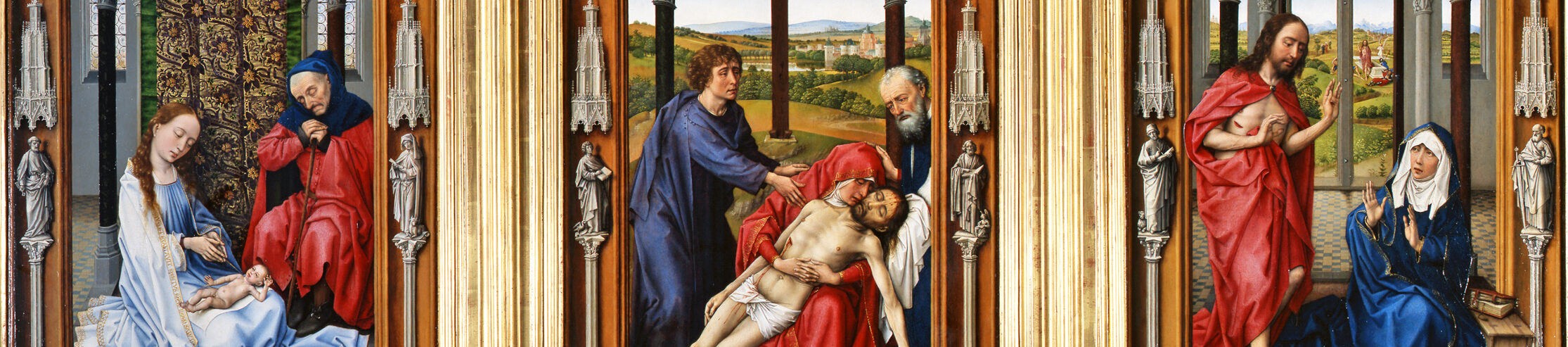
Mary is therefore the one perfect icon of the incarnate Word, an image fully conformed to the image of the Son of God. And this because of her holiness, a holiness that does not annul the human relationship of a mother with her son, but exalts it, indeed glorifies it. For this reason, in the face of Mary the face of Jesus is reflected, precisely because the face of Mary left its mark on the face of Jesus. The face of the son and the face of the mother merge in a relationship of incandescent likeness created by the action of the Holy Spirit, a relationship of fullness of humanity and of divinity: “In Christ the whole fullness of divinity dwells bodily, and in him we share in his fullness”, (Col 2:9-10). Therefore, if all of us share in this fullness of Christ, how much more will the Mother of the Lord share in it, she who conceived in perfect virginity the Son of God, allowing him to become man by being born of a woman.
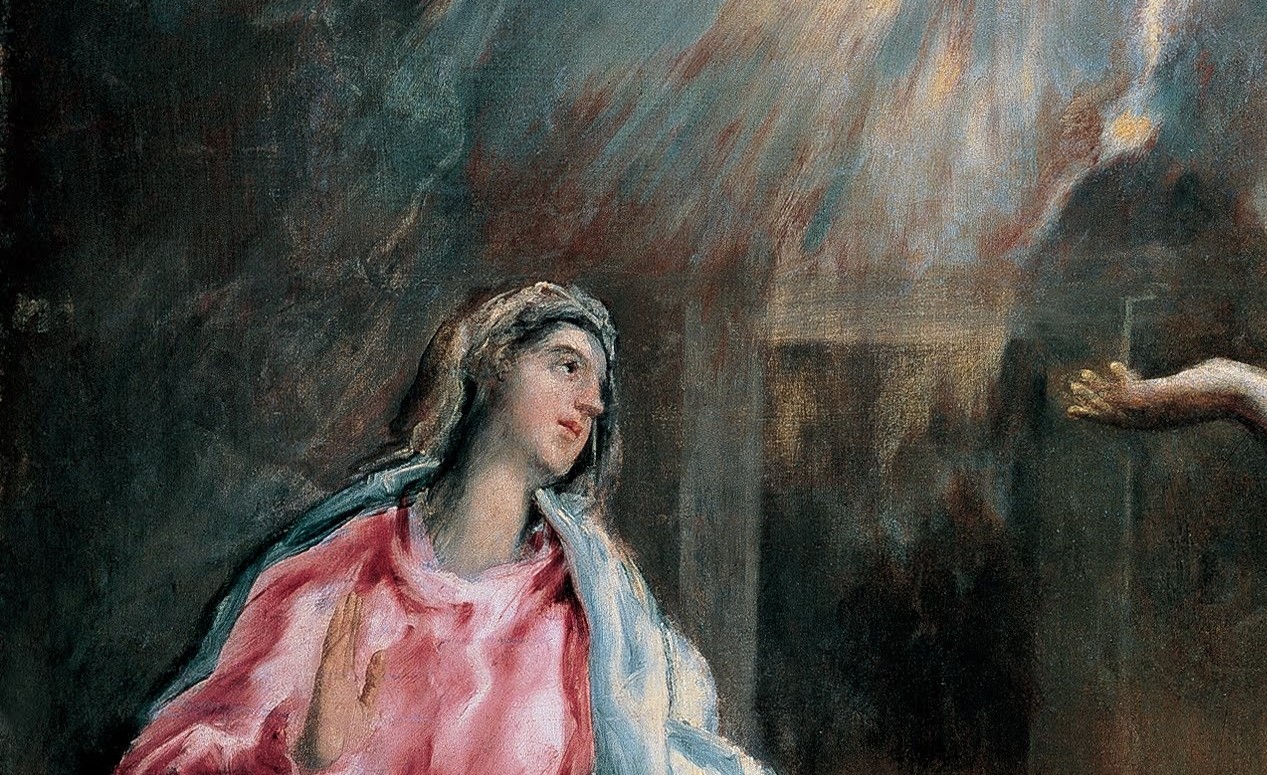
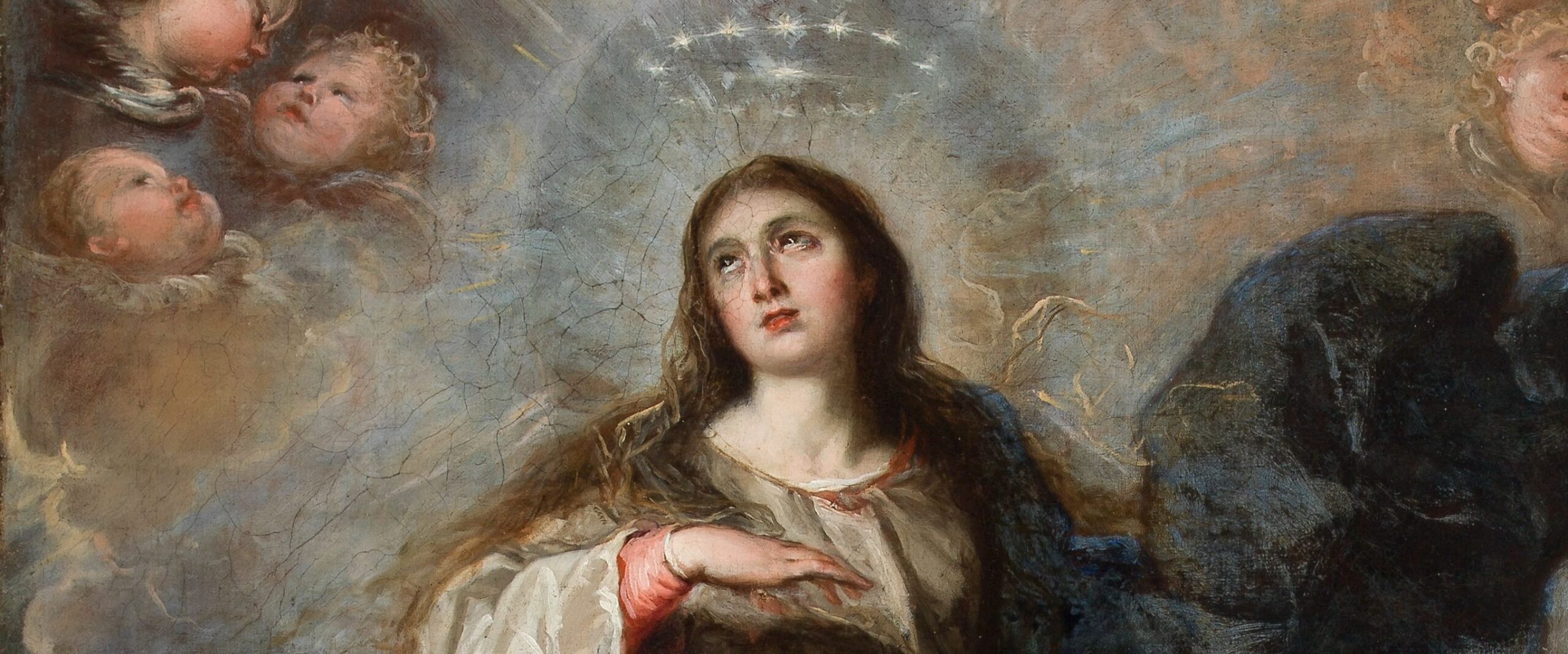
The face of Mary too, like the face of Jesus, presents its own canonical form: the head veiled and crowned with a star (the Lady)a luminous and maternal face (the Virgin Mother)a compassionate gaze (the Mother of Mercy).
The Lady
The face of Mary is always presented framed by the veil that covers her head, with a star on her forehead. The veil signifies Mary as the “handmaid of the Lord”, and the star signifies her perfect and perpetual virginity.
Mary always lived in submission to the will of the Father, to the point of deserving Jesus’ praise. One day “a woman raised her voice from the midst of the crowd and, addressing Jesus, said: “Blessed is the womb that bore you and the breasts that nursed you”. Jesus answered: “Blessed rather are those who hear the word of God and keep it””, (Lk 11:27-28). By her consent to the conception of the Son of God, Mary takes part in a unique way in the accomplishment of our salvation, of the “mystery kept secret for endless ages”, (Rom 16:25). The veil could therefore also signify this full revelation of the mystery of our salvation, just as the face emerges uncovered from the veil.
By her loving obedience, Mary is involved not only in the Incarnation of the Word of God, but also in his passion, death and resurrection. Just as the Son “became obedient unto death on a cross”, (Phil 2:8), so Mary too, the obedient handmaid, lets her soul be pierced by the sword of sorrow (cf. Lk 2:35) and accomplishes, as a consenting mother, full participation in the passion and death of Jesus (cf. Rom 8:17), so that she can say, before and even more than the apostle Paul: “I have been crucified with Christ, and it is no longer I who live, but Christ who lives in me”, (Gal 2:20).
For this reason, the design of glory willed by the Father is fulfilled in her as well: just as he exalts Jesus, so he also exalts the Mother, recognizing her and proclaiming her Queen beside Jesus the Lord, “at whose name every knee bends in heaven, on earth and under the earth”, (Phil 2:10). From this glorious association with her risen and glorified Son, Mary, having become the Lady, receives all the power a creature can receive, above every creature and, in particular, above the creatures that rebel against God. From this derives her powerful protection against the spirits of evil.
The Virgin Mother
The face of Mary is wholly luminous, because it is wholly turned toward the face of Jesus: “look to him and you will be radiant”, (Ps 34 [33]:6). Mary, the undefiled virgin, is preserved from all impurity: evil is rendered inoperative in her by the purifications of her parents, by the action of the Holy Spirit, who always keeps her under his shadow, and by her own free choice. For this reason she shares in the luminosity of the Face of the Son: by divine grace, there is no darkness in her. Her light is the glory of fruitful virginity. We therefore need to understand in depth the meaning of the virginal conception of Jesus by Mary.
Every human being, as a creature, comes into existence created by God. In this work of creation a cooperation takes place between the love of the parents (the conjugal union) and the love of God the Father. This is not the case with the conception of Jesus: it is not a matter of a creature coming into existence, but of the Son of God assuming flesh in Mary’s womb. There is only the cooperation of two wills: Mary’s yes and the yes of God the Father. We do not pre-exist our conception in our mother’s womb. Jesus did pre-exist, as the Son of God, in the bosom of the Father. It follows that the Incarnation itself, the virginal conception of the Word of God, is Mary’s glory.
Moreover, Mary carried out her motherhood perfectly not only in conceiving and giving birth to Jesus, but also in her educational work. We can catch a small glimpse of her educational style when, together with Joseph, she finds Jesus again in the temple, “sitting in the midst of the teachers, listening to them and questioning them”, (Lk 2:46). She speaks, but only to say: “Son, why have you done this to us? Behold, your father and I have been searching for you in anguish”, (Lk 2:48). Mary puts the father in the foreground. It is certainly easy to see in this detail a simple cultural custom. Yet we may also consider that she did so consciously, following an educational style of her own. Today we know that a child’s psychological health requires a good relationship with his father. We have good reason to think that Mary fostered this relationship of Jesus with Joseph. Thus Mary fully accomplished her motherhood in bearing, raising and educating her son Jesus.
For this reason too Mary now presents a maternal face, one of universal motherhood, through the intervention of the Holy Spirit, who makes supernatural what in her would be natural: it is the face of the woman, of the New Eve. Divine motherhood kindles in her all the charisms of femininity, of welcome and of intercession. Now we know that charisms pass away, but that “charity will never end”, (1Cor 13:8-10). Therefore, through her charity, Mary still exercises her motherhood toward all the faithful and toward all the children of Adam. Still more: Mary’s motherhood humanizes the fatherhood of the Father, who gives us the Son. The Mother expresses the hesed of the Father, his love of mercy, or better, of tenderness, a love that is the Son Jesus. This expression of tenderness is heightened when the face of Mary is joined to that of the Child Jesus, as in the typologies of the Virgin Eleusa.
The Mother of Mercy
Mary’s gaze is compassionate. In the antiphon “Salve Regina”, the liturgy uses these expressions: “mater misericordiae, vita, dulcedo et spes nostra […]. illos tuos misericordes oculos ad nos converte! [mother of mercy, our life, our sweetness and our hope […]. turn those merciful eyes of yours toward us!]”.
The Virgin of Guadalupe addresses Juan Diego, still a neophyte, with these words: “I am the perfect ever-virgin holy Mary, the mother of the one most true God. I ardently desire that in this place my little sacred house be built, that a temple be raised for me, in which I wish to show him, to make him manifest, to give him to the peoples with all my personal love, with my compassionate gaze (en mi mirada compasiva), with my help and my salvation, for in truth I am your merciful mother: yours, and of all who dwell in this land, and of all those people who love me, call upon me, seek me and place in me all their trust”, (Nican Mopohuapp. 26-31).
This compassionate gaze of Mary, the constant feature of all Marian icons, expresses God’s compassion for Adam and for every child of Adam: God the Father “so loved the world that he gave his only begotten Son, so that everyone who believes in him may not perish but may have eternal life” (Jn 3:16). In Marian icons, the eyes of the Virgin, which fix upon whoever contemplates her, and her hand, which points to the Savior, offer, to whoever lets himself be looked at and guided, the faith of Mary, of the same temper as the faith of Abraham. Mary’s motherhood becomes the expression of the astonishing and incomprehensible love for humankind of the Father, “who did not spare his Son”, (Rom 8:32).
I like to conclude this section by emphasizing that Mary’s universal motherhood is translated, iconographically, into her inculturated face, which takes on the features of every race, the color of every land, the sound of every language. This dimension of faith finds expression in the art of every people, which gives Mary’s face the features of a European, African, Japanese or Latin American face. Yet what is most surprising is that the Virgin Mary, when she manifests herself visibly according to the inscrutable designs of God, who wills the salvation of all men, carries out the same operation of inculturation. A particularly striking example is the face of Our Lady of Guadalupe: it takes on the features of a mestizo face when mestizo faces were not yet known, for her face was imprinted on the tilma of Juan Diego on December 12, 1531, ten years after the conquest of Mexico City. We can truly conclude that Mary gives a face to those who have none, and continues to do so, for individuals and for peoples.
The face of Mary in the world of the image
The image refers to the function of seeing and is realized in spatiality. The word refers to the function of hearing and is realized in duration: the visual (televisual) is spatial (planetary), sound is temporal. The image presents reality. The word pronounces upon reality and raises a question of truth that goes beyond the world of our perception. For this reason, in our present culture dominated by the visual and the televisual, a radical opposition between image and word seems to force itself upon us, analogous to the one that exists between the senses and the intellect, between perception and truth.
Nevertheless, it is everyone’s experience that it is impossible to think without imagining and without speaking to oneself. Image and word work together for the activity of thought and of knowledge, for every spiritual activity of our personal self, which they enable to express itself even beyond sensible experience. Image and word have a common point in the activity of the spirit, which unites space and time in knowledge, perceived reality and truth in thought. This presupposes that the image too is capable of introducing us to a true knowledge. And this is the case with sacred images, because they represent reality not as it is seen, but as it is revealed and known, in the manner of children in their drawings.
Therefore, in Christian anthropology, image and word are complementary and not contradictory. And what the Fourth Council of Constantinople (869-870) defined always remains timely: “We prescribe that before the sacred icon of our Lord Jesus Christ prostration be made in the same way as before the book of the holy Gospels. Indeed, just as all of us obtain salvation through the letters contained in it, so too all of us, the lettered and the unlettered, receive our share of benefit from the iconic energy of the colors that is at our disposal. For what the word proclaims and makes present through sounds, the drawing proclaims and makes present through colors”, (Council of Constantinople IV, can. 3).
For this reason, the conjunction of word with image, brought about in the incarnate Word, constitutes the heart of Christianity, and is indeed its central affirmation: “the Word became flesh and pitched his tent among us. Since then, we have contemplated his glory, that glory which an only Son receives from the Father, full of love and of faithfulness”, (Jn 1:14). It must then be recognized that there is complementarity between seeing and speaking, in the human spirit and in Christian revelation. In this complementarity, the image receives clarity and definiteness from the word, and the word receives from the image the capacity to address the mind and the heart of the human person.
We are thus led to reflect with greater circumspection on the relationship between sight and hearing, between image and word, in relation to the expressive activity of the human person. The image will thus recover its meaning within the context of the expressiveness of the spirit and will show itself capable of making known and of giving room for thought, fostering reflection and opening the way of gratuitousness and of beauty.
Two concrete applications thus open up from what we have highlighted about the meaning of the face of Jesus in the face of Mary, two fields of action of Mary’s face: in the life of personal faith and in the present culture dominated by the visual.
The face of Mary in the life of personal faith
The icon of Mary’s face has a therapeutic efficacy in those who discover themselves being looked at and let themselves be looked at by her compassionate eyes. Mary’s gaze reorders and heals each person’s relationship with his own mother. We know that many psychological ills are a cause (in the children) and an effect (of the mother herself) of a wrong relationship with the mother. Motherhood, in fact, an inestimable gift of God, has been stained by sin and therefore needs to be redeemed and lived under the lordship of Jesus. The face of Mary, pure woman and perfect mother, acts upon the human imagination by reorganizing it, and such reorganization has beneficial effects: direct ones on disturbances of a psychic nature, indirect ones on physical illnesses, insofar as it prompts the sick person to discover the meaning of his own infirmity. Along this path, Mary, mother of mercy, offers an opportunity of salvation to every person who seeks to carry his own burdens without being crushed by them.
In order to make use of the icon of Mary’s face, some essential information about sacred Christian iconography is important. The icon is essentially an image and, precisely as an image, it is charged with emotion and prompts action. And the action of the Holy Spirit travels this iconic path: grace travels the ways of nature, following the universal law of the economy of salvation.
In the Semitic vision, the human being is composed of spirit, psyche and body. The icon, being charged with the energy of the Holy Spirit, acts upon the psyche and upon the spirit (upon our capacity for decision), because “the Spirit of God comes to the aid of our weakness” (Rom 8:26), and this action has repercussions on the body as well.
In looking at the icon, sooner or later, the inversion of the gaze takes place: the one who looks perceives that he is being looked at. If he decides to let himself be looked at, he slowly opens himself to the other, not as to a double of himself, but to the other in his otherness. With this conversion of the gaze, the icon enters the imagination and begins to restructure it ever more deeply.
Every icon is composed of drawing and color. The drawing acts above all upon our logoswhile color, an energetic vibration, acts upon the eros. And a healed person achieves a right balance between logos and erosbetween rationality and emotion. The sign of such health is self-mastery.
In the authentically Christian tradition, the icon, before being an event of beauty, is a revelation of the Word of God. In every icon there is always a revealed truth that guides us toward the whole Truth (cf. Jn 16:13). It is this truth, discovered and interiorized, that “verifies” the human person.
Yet this truth revealed by the icon demands an attentive and patiently prolonged reading. Its energetic light is given in the silence of welcome, like seed in fertile ground or like water in arid ground, and it enters into the one who lets himself be looked at, in order to heal his mind (thoughts and convictions) and his heart (the imagination). What is required, therefore, is an essentially contemplative attitude, one of deep listening, in which one remains available to welcome the Gift of the icon, without imposing any condition upon it, open to the newness of the mystery that might be revealed. From this perspective one understands why the icon demands silence and prayer.
When icons are contemplated, their intrinsic dynamism is striking: they say, in their stillness, what images today ordinarily say through their movement. For us, accustomed to this explicit and at times illusory dynamism, it is somewhat tiring to fix a welcoming and disarmed gaze upon the icon: “eye to eye”. That is why we must distance ourselves from the modern conception of images: the icon is not a window through which we may enter the world represented, but a place of presence of the mystery represented, which radiates toward the one who opens himself to receive it.
Now, if we carry out this kind of visual prayer before an icon of the face of Mary that looks at whoever looks at it, with perseverance (a few minutes every day), our relationship of faith with Jesus will be reactivated and our spiritual life will improve. Mary, virgin and mother, will heal each person’s relationship with his own mother, with his own body and with his own emotional sensibility.
The dualism of soul and body covers a range of situations that goes from body-worship (which opts for the body) to super-spiritualism (which opts for the soul), and it provokes negative and even burdensome attitudes toward the joy of fully living the humanity that we are, because it forgets that “everything created by God is good and nothing is to be rejected when it is received with thanksgiving” (1Tim 4:4). In situations of this kind, the face of Mary slowly reveals the importance of the body to those who try to live like angels, and the importance of the spirituality and immortality of the soul to those who try to live like rational animals.
The undervaluing of emotional sensibility, often combined with a falsification of eros reduced to sex, covers a range of situations that goes from an exacerbated introspective closure to a psychedelic openness. The common defect is the lack of a mature interiority capable of making itself a gift, because the sources of human eros are polluted, and from them no authentic relationships are born that would allow the individual to live in true communion with his fellow human beings. The action of the icon of Mary upon the emotional sphere is particularly effective and brings about a new harmony between emotion and rationality. It makes us capable of enjoying happy realities and events with a joy that knows no bitter traces, and of suffering in adverse situations without losing interior peace. One might say that Mary introduces us into the poetry of life.
In the face of situations of distress or of illness, provoked by the dramatic rupture of the harmony existing between the components of individual life (bodiliness, psyche, emotions, values, lifestyles) and the components of social life (economy, environment, culture, society and services), the face of Mary, which looks at us and by which we let ourselves be looked at, makes us discover new ways of self-management, even when the limits imposed by an infirmity make us suffer. Finally, by opening us to true relationships, it also brings about a change in medical care, in the direction of making medicine evolve from a medicine of the organ to a medicine of relationship.
The face of Mary in the culture of the visual
I like to open this last reflection with a wish expressed by John Paul II:
“The rediscovery of the Christian icon will also help to raise awareness of the urgency of reacting against the depersonalizing and at times degrading effects of the many images that condition our lives in advertising and in the mass media. It is, in fact, an image that brings upon us the gaze of an invisible Other and gives us access to the reality of the spiritual and eschatological world”, (John Paul II, Duodecimum saeculumn. 11).
The present culture, dominated by the visual, is built upon the immediacy of images that leave no time to reflect, upon the association of events that does not allow one to argue, upon the generalization that simplifies everything, and upon the seduction of images and of concrete proposals. According to the Holy Father’s indication, Christian iconography can help the people of today to overcome the idolatry of self-referential images, to discover a human life worth living, and to appreciate the reality of the spiritual and eschatological world of the Christian faith. In this work of detoxification from illusory seductions, of humanization of interpersonal relationships and of evangelization, the icon of Mary’s face plays a decisive role, for it presents anew the image of woman and of mother, and it does so not by entering into competition, but by proposing and proposing again a new mentality, according to the imperative: “Do not conform yourselves to the mentality of this age, but be transformed by the renewal of your mind, so that you may discern the will of God, what is good, pleasing to him and perfect”, (Rom 12:2).
In the present culture, which asserts itself as a global superstructure capable of homogenizing all regional cultures, scientific knowledge, technological development, economic relations and an idolatrous worldview prevail. This means that univocal knowledge prevails over the other forms of knowledge, and that technology and the economy determine scientific research and politics. All of this within a self-referential worldview in which man contemplates and satisfies only himself. In this context, the values of the family, of politics, of art, of altruism in the logic of gratuitousness and of gift become difficult to live and to sustain, for they meet ever stronger opposing obstacles.
The world of the visual is essentially tele-visual, and the patina that makes everything glitter is idolatry, of which one must be aware. For this reason, a brief clarification is needed about the meaning of the idol as opposed to the icon of Mary’s face.
A thing becomes an idol when, to the gaze of the one who admires it, it gives everything he expects. The gaze finds everything admirable in what it sees and therefore settles and rests in it. That is why “the gaze makes the idol, and not the idol the gaze, which means that the idol fills the intention of the gaze with its own visibility”. (J.-L. Marion, Dio senza essere24).
The icon, on the contrary, summons the gaze into its visible in order to show it the unreliability of what it itself shows, and in order to correct it and prompt it to look still further and beyond what it manages to see in it. The icon thus becomes a manifestation of the invisible, in the sense of relativizing its own visible, in a certain way frustrating the gaze’s expectation. In this way the icon does not fix the gaze upon itself, but refers it to the depth of what transcends every vision and every knowledge. And this holds also for the sacred images of Mary’s face. An icon displayed as a mere ornament and appreciated for its formal aesthetic value is degraded to an idol. Now, the operations of television culture are essentially self-referential.
The icon of Mary’s face offers a strongly corrective response to this “phosphorescent” world, inasmuch as it is the face of the woman, of the mother and of the woman at prayer.
As a woman, she makes it possible to recover the warmth of intuition, which transcends the dominant functional and instrumental rationality, and she fosters interpersonal relationship. She herself is an incomparable model in the gesture of hastening to serve her cousin Elizabeth. As a mother, she offers a love of tenderness to every human being born of woman. With her real psychological motherhood, she can lead to freedom all those others born of woman who did not receive from their mothers the affection needed for their own personal growth. And just as she knew how to accompany her Son Jesus in his public life, so she knows how to accompany every human being in his private life and in his social relationships.
But the strongest contribution of Mary’s face lies in faith. A woman who knows how to marvel, as before the angel’s greeting at the Annunciation. A woman who knows how truly to listen to the Word of God, carrying it out step by step. A woman who knows how to persevere in following Jesus, her Lord and Master, all the way to Calvary. A woman who knows how to await the fulfillment of the promises until the day of Easter.
In conclusion, we may observe that the imago Deiaccording to which man is created, is the constitutive principle of the human being; it is the gift of a being wholly turned toward its divine Source and one that allows it constantly to return to that Source. For this reason, the image that ontologically orients man toward God is the face of Jesus, God made man. But the face of Mary, the Lady and Mother, gently and with maternal tenderness introduces every “one born of woman” to the decisive encounter with the Lord Jesus. The face of Jesus in the face of Mary opens for us a simple, easy and pleasant path, which allows us to rediscover our human dignity, our vocation to be children of God in Christ Jesus and to be holy with the very holiness of God.
“The paths of holiness are many, suited to the vocation of each individual”, (Novo Millennio Ineunten. 31). Nevertheless, the face of Mary, true icon of the face of Christ, can bring together all the paths of holiness and contribute decisively to the working out of the “pedagogy of holiness”, offering the sober sweetness of the contemplative life, which values silence and prayer.
To deepen the contemplation of the face of Christ through Mary, John Paul II’s apostolic letter Rosarium Virginis Mariae invites us to contemplate the face of Jesus with the eyes of Mary.
Deepen your studies: explore MariologyMarian TheologyMarian apparitions and the Postgraduate Program in Mariology.
Continue your Marian formation: Explore our resources on MariologyMarian Theology and Marian apparitions. Discover the Postgraduate Program in Mariology of the Locus Mariologicus Institute.
To deepen the theological reflection on the face of Mary and her relationship with Christ, consult the Encyclical Redemptoris Mater of Pope John Paul II.
Postgraduate Program in Mariology
Would you like to deepen your formation in Mariology? Discover the Postgraduate Program in Mariology of Locus Mariologicus, an academic formation that unites theological rigor, spiritual life and the living tradition of the Church.
Discover the oldest Marian image in the Catacomb of Priscilla.
Would you like to study Mariology seriously?
This article is born of the works held in the Locus Mariologicus library. The Postgraduate Program in Mariology takes you to that same source, with academic guidance: Scripture, the Fathers of the Church and the Magisterium, from the first dogma to contemporary questions.


Responses