Mary in the Old Testament: prefigurations and typology
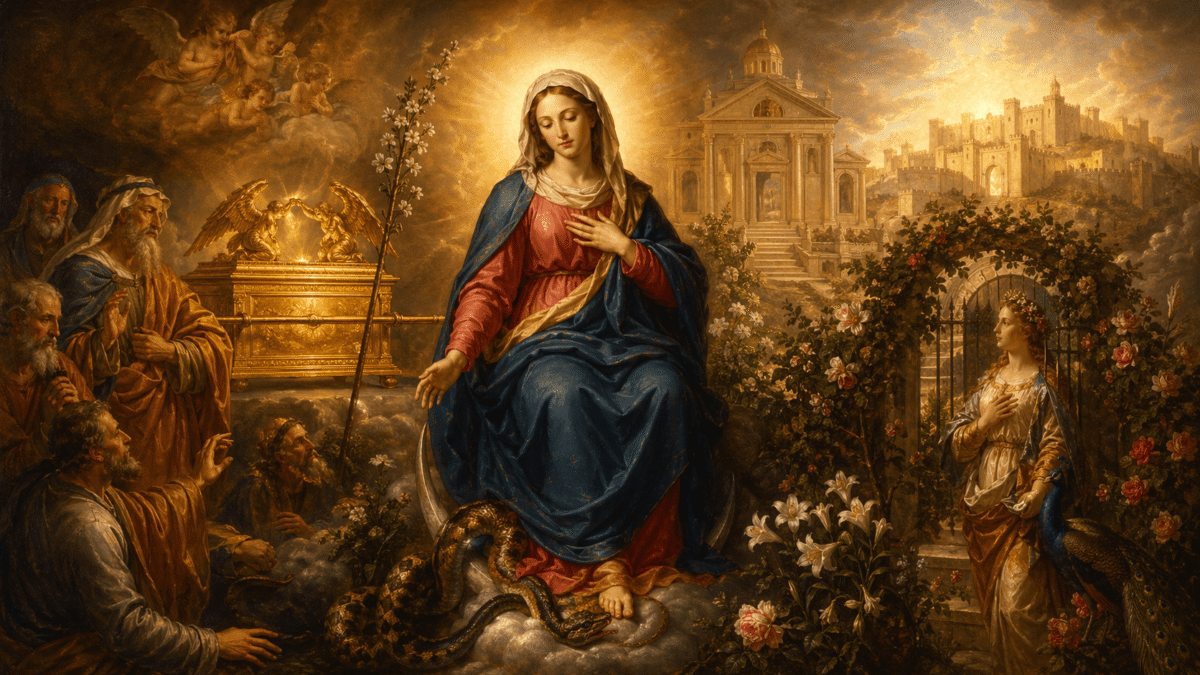
Mary in the Old Testament: prefigurations and typology
The presence of Mary in the Old Testament is not direct, but typological and prophetic. Christian Tradition has identified in the Hebrew Scriptures numerous figures, images, and prophecies that anticipate Mary’s unique role in the history of salvation.
The Protoevangelium (Genesis 3:15)
The first messianic announcement, “I will put enmity between you and the woman,” is read by Catholic tradition as an implicit reference to Mary, the New Eve who cooperates in Christ’s victory over evil. This reading, developed by Justin and Irenaeus, is the foundation of the Eve-Mary typology.
The Ark of the Covenant
The Ark that contained the tablets of the Law, the manna, and the rod of Aaron is a figure of Mary, who received the very Word of God in her womb. The parallel between David’s visit to the Ark (2 Samuel 6) and Mary’s Visitation to Elizabeth is striking: the same words, the same gesture of joy.
The Daughter of Zion
The prophets (Zephaniah, Zechariah, Micah) address oracles of messianic joy to the Daughter of Zion. These texts find their fulfillment in Mary, who represents the best of Israel and receives the Messiah in her womb. The Second Vatican Council underscored this collective dimension of Mary as the personification of the faithful people.
Other prophetic figures
Sarai, Rebecca, Rachel, Deborah, Judith, Esther: these strong women of the Old Testament are seen as prefigurations of Mary. The Magnificat echoes the canticle of Hannah (1 Samuel 2), confirming this continuity between the two Testaments.
Deepen your studies: explore Mariology, Marian Theology, Marian apparitions, and the Postgraduate Program in Mariology.
Magisterium of the Church
Haec autem Sanctorum Patrum unanimitas declarat: ab antiquis temporibus haec Virgo praefigurata est in multis: in Heva, in arca Noe, in scala Iacob, in rubo ardente.
Second Vatican Council, Dogmatic Const. Lumen Gentium, no. 55
📚 Literal translation: This unanimity of the Holy Fathers declares: from ancient times this Virgin has been prefigured in many things: in Eve, in Noah’s ark, in Jacob’s ladder, in the burning bush.
Postgraduate Program in Mariology
Would you like to deepen your formation in Mariology? Discover the Postgraduate Program in Mariology of Locus Mariologicus – an academic formation that unites theological rigor, spiritual life, and the living tradition of the Church.
Would you like to study Mariology seriously?
This article grows out of the works in the Locus Mariologicus library. The Postgraduate Program in Mariology takes you to the same source, with academic guidance: Scripture, the Fathers of the Church, and the Magisterium, from the first dogma to contemporary questions.





Responses