Hail, Holy Queen: the Marian antiphon for the end of the day
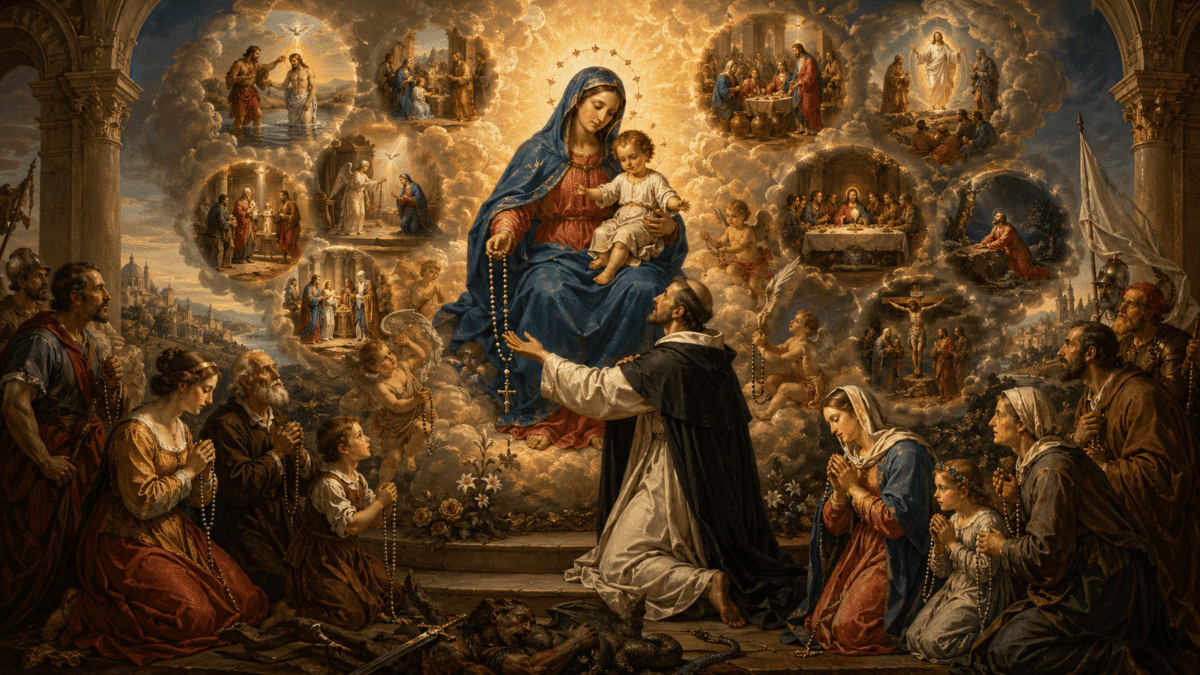
Hail, Holy Queen, the Marian antiphon for the end of the day
The Hail, Holy Queen (Salve Regina) is one of the four Marian antiphons of the Liturgy of the Hours and one of the most beloved and most widespread Marian prayers in the Christian tradition. Prayed at the end of the day and after the Rosary, it is a prayer of filial confidence in the Mother. For the full article: Hail, Holy Queen.
The text
“Hail, Queen, Mother of mercy, our life, our sweetness and our hope, hail. To thee do we cry, poor banished children of Eve. To thee do we send up our sighs, mourning and weeping in this valley of tears. Turn then, our Advocate, those merciful eyes of thine toward us. And after this exile show unto us Jesus, the blessed fruit of thy womb. O clement, O loving, O sweet Virgin Mary.”
Origin and history
The Salve Regina dates from the eleventh century. Its authorship is disputed among Adhémar de Monteil, Hermann of Reichenau (Hermannus Contractus), and Peter of Compostela. The Cistercians and the Dominicans adopted it early on in their daily liturgy. The final addition, “O clement, O loving, O sweet Virgin Mary,” is attributed to Saint Bernard of Clairvaux.
Deepen your studies: explore Mariology, Marian Theology, Marian apparitions, and the Postgraduate Program in Mariology.
Magisterium of the Church
Salve, Regina, Mater misericordiae. Vita, dulcedo et spes nostra, salve. Ad te clamamus, exsules filii Evae. Ad te suspiramus, gementes et flentes in hac lacrimarum valle.
Antiphon Salve Regina (traditio monastica, saec. XI, Hermanno Contracto attr.)
📚 Literal translation: Hail, Queen, Mother of mercy. Our life, sweetness and hope, hail. To thee we cry out, O banished children of Eve. To thee we sigh, groaning and weeping in this valley of tears.
Postgraduate Program in Mariology
Would you like to deepen your formation in Mariology? Discover the Postgraduate Program in Mariology of Locus Mariologicus – an academic formation that unites theological rigor, spiritual life, and the living tradition of the Church.
Would you like to study Mariology seriously?
This article grows out of the works in the Locus Mariologicus library. The Postgraduate Program in Mariology takes you to the same source, with academic guidance: Scripture, the Fathers of the Church, and the Magisterium, from the first dogma to contemporary questions.



Responses