Marian prayer: Mary’s model of prayer and the devotion of the Church
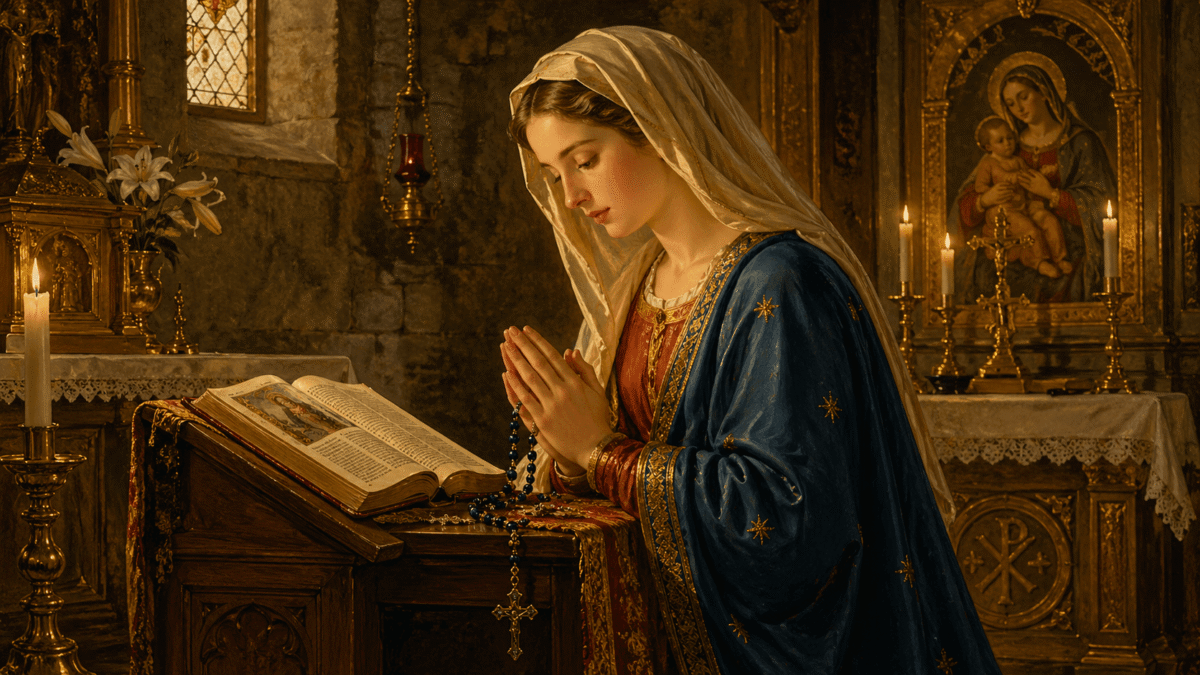
Marian prayer, Mary’s model of prayer and the devotion of the Church
Marian prayer has two inseparable dimensions: Mary as a model of prayer for the Church, and the prayer addressed to the Mother of God by the Church across the centuries. The Second Vatican Council restored Marian devotion to its liturgical source, “where it always appears indissolubly united to the worship of the Christological-Trinitarian mysteries” (LG 67), overcoming both sentimentalist exaggerations and reductionisms that impoverish genuine Marian piety. [Marian liturgy. Marian devotion]
Mary, model of prayer for the Church
The biblical witnesses reveal four dimensions of the prayer of Mary. Prayer in familiarity and availability: the Annunciation marked the decisive moment, “Let it be done to me according to your word” (Lk 1:38), expressing filial docility to the will of God. Prayer on the journey of faith: the Second Vatican Council describes Mary as a pilgrim in faith (LG 58), and the Magnificat is the summit of this prayer of praise of the poor (anawim) who await true liberation from God. Prayer of sacrificial offering: from the Presentation in the Temple (Lk 2:22) to Cana (“my hour has not yet come”: Jn 2:4) and to Calvary (Jn 19:25-27), the prayer of Mary is a progressive co-offering to the Father, in union with her Son. Prayer in ecclesial communion: in Acts (1:12-14), Mary appears at the heart of the first nucleus of the nascent Church, in “persevering and unanimous prayer” to invoke the Holy Spirit, a model of all Christian communal prayer.
The origins: Sub tuum praesidium and the anaphora of Hippolytus
The oldest prayer addressed to Mary is the Sub tuum praesidium, preserved on an Egyptian papyrus (third-fourth century) and later spread through all the Eastern and Western rites. The text already uses the technical title Theotokos and affirms the mediation of Mary as a “refuge of mercy.” Even earlier, the Apostolic Tradition of Hippolytus (third century) associates Mary with the eucharistic thanksgiving: “sent from heaven into the bosom of the Virgin, conceived in her womb, He was made flesh and manifested Himself as her Son.” The Church cannot give thanks to God for the sacrifice of the Son without radically associating Mary with it, because in her the economy of salvation began.
Medieval development and the great antiphons
The medieval development of Marian devotion produced the great antiphons still in use: the Hail, Holy Queen (Salve Regina, attributed to Hermann of Reichenau or to Bernard of Clairvaux), the Alma Redemptoris Mater, the Ave Regina Coelorum and the Regina Caeli. The Litany of Loreto (fifteenth-sixteenth century, approved by Sixtus V in 1587) expresses the patristic tradition that greeted Mary as “mother of all” (Ephrem), “mother of salvation” (Ambrose) and “mother of the living” (Epiphanius). The reformed Missal of Paul VI (1970) celebrates Mary under a threefold aspect: Mother of God and ever Virgin, the excellent fruit of the redemption and archetype of the Church.
Foundations and purpose of Marian prayer
Marian prayer has biblical foundations in the two greetings of the angel and of Elizabeth: “full of grace” (Lk 1:28) and “mother of my Lord” (Lk 1:43). From there the technical title Theotokos was made explicit, the basis of all veneration of Mary. Prayer to the Mother of God is, in the first place, a confession of faith in the Incarnation (Mother of God) and in the Redemption (New Eve at the foot of the Cross). In the second place, it is a hymn of praise to the divine magnificence: “in Mary the fidelity, the wisdom and the tenderness of the Father become transparent.” In the third place, it is an invitation to imitation of the evangelical virtues, above all “the listening to the Word in faith: ‘Blessed are you who believed’ (Lk 1:45).” The patristic tradition teaches us to pray “like” Mary before praying “directly” to Mary, because Mary is the most qualified witness of the praying nature of the Church before the Father, in the Son, through the Holy Spirit.
Deepen your studies: explore Mariology, Marian Theology, Marian apparitions and the Postgraduate Program in Mariology.
Magisterium of the Church
In omni oratione mariana fides, spes et caritas erga Mariam exprimuntur, et per eam ad Christum et ad Patrem tenditur.
Paulus VI, Exh. Ap. Marialis Cultus, n. 20 (2 februarii 1974)
📚. Literal translation: In every Marian prayer faith, hope and charity toward Mary are expressed, and through her one tends toward Christ and the Father.
Postgraduate Program in Mariology
Would you like to deepen your formation in Mariology? Discover the Postgraduate Program in Mariology of Locus Mariologicus – an academic formation that unites theological rigor, spiritual life, and the living tradition of the Church.
Learn what the Church teaches about Mary, Mediatrix of All Graces.
Would you like to study Mariology seriously?
This article is born from the works in the library of Locus Mariologicus. The Postgraduate Program in Mariology takes you to the same source, with academic guidance: Scripture, the Fathers of the Church, and the Magisterium, from the first dogma to contemporary questions.




Responses