Holy Week: Mary by the Cross of the Lord

Mary by the Cross of the Lord
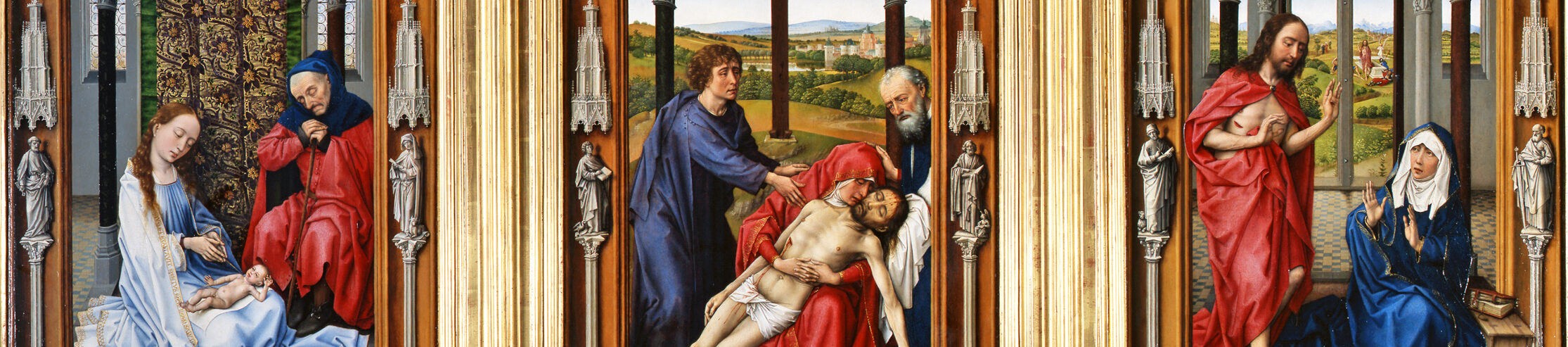
In the season of Lent, especially in its final phase, the gaze of the faithful turns resolutely toward the cross. And it is precisely by looking at Calvary that we discover another aspect of the mystery of the Virgin, who shares in the sacrifice of the Son also near the cross.
This mystery highlights this particular moment of salvation through a series of biblical texts, in two ways:
- contemplating the Mother at the Cross of the Son (Jn 19:25-27) and rereading this sorrow in the light of Rom 8:31-39: God did not spare his own Son.
By accepting this logic, we understand the faith of the Church of all times, which, beside the daily crosses of all her children, sings: In my anguish I call upon you: save me, Lord, and invokes Mary, sorrowful near the cross, Queen of Heaven and Lady of the world. - Jdt 13:17-20 helps us, through the figure of Judith, to see Mary as the one who radically raised up the destiny of the people with the “courage” that comes from God.
All this as a gift of the “tenderness” of the Lord, which “extends over all creatures,” and above all in Mary, who “stood by the cross, steadfast in faith, strong in hope, ardent in charity.”
If we now turn to the praying voice of the Church, we see a contextual picture emerge that explicitly emphasizes the sorrow of the Virgin and, at the same time, her role of participation in the redemptive mission of the Son.
The passion of the Son immediately brings to the fore the compassion of the Mother. The Church prays to the “Mother of Sorrows at the foot of the cross,” or rather, “beside the cross of the Son.” This mysterious sharing is expressed in prayer by the frequent use of the terms compatiens, compassio, and socia passionis. Mary in fact appears as the “generous companion of the Passion,” as the “sorrowful” Mother and “Mother of Sorrows,” as the one who was “associated (with the Son) in a single martyrdom.” The Church acknowledges and contemplates the mystery, singing: “Happy are you, Virgin Mary, who without dying merited the palm of martyrdom beneath the cross of the Lord.”
Sharing in the passion of Christ makes Mary a mysterious and real participant in the saving work of the Son. In contemplating Mary “associated with the redemptive passion of Christ,” several elements emerge:
- Mary is presented as the New Eve, who accompanies and shares in the sacrifice of the new Adam for the redemption of the human family.
The two aspects highlighted above, the compassion of the Mother and her decisive role in the plan of salvation, bring out new aspects of the Virgin’s exemplarity. Her fidelity in the hour of trial and her sharing in the Father’s saving plan set Mary forth as a renewed model of the Church.
Some Conclusions
In contemplating “the Mother by the cross of the Son,” the Church is aware that she is entering a new school of life: just as Mary is a guide for life, so the Church, contemplating in the Virgin her own image as Bride, keeps intact the faith pledged to the Bridegroom despite threats and persecutions.
In every age, the passion of the Son continues in the wounded members of His body, which is the Church. And like Mary and with Mary, the Church pleads that her eyes may be open enough to recognize and serve Christ, suffering in His brothers and sisters, with solicitous love.
Like Mary, the Church too is in a position to collaborate in the Father’s saving plan through fidelity in the hour of the cross. To carry the cross every day is to prolong the work of Christ, the high priest, so that every person may experience ever more fully the fruits of redemption. Only in this way is it possible to participate fully in the renewed creation, when all those who have been gathered by virtue of the blood of Christ attain the perfection of their own filiation in Christ, and God is all in all.
Mary’s presence by the Cross is explored in depth in John Paul II’s encyclical Redemptoris Mater, which reflects on Mary’s spiritual journey and her participation in the redemptive mystery of Christ.
Deepen your studies: explore Mariology, Marian Theology, Marian apparitions, and the Postgraduate Program in Mariology.
Postgraduate Program in Mariology
Would you like to deepen your formation in Mariology? Discover the Postgraduate Program in Mariology of Locus Mariologicus—an academic program that unites theological rigor, spiritual life, and the living tradition of the Church.
Would you like to study Mariology seriously?
This article grows out of the works in the Locus Mariologicus library. The Postgraduate Program in Mariology takes you to the same source, with academic guidance: Scripture, the Fathers of the Church, and the Magisterium, from the first dogma to contemporary questions.




Responses