The ten virgins and the wisdom of the oil: Proverbs 6, 1 Thessalonians 4, and Matthew 25
By Prof. Dr. Daniel C. Afonso · Updated
Quoting Scripture:
“Vigilate, therefore, for you do not know the day nor the hour.” (Matthew 25:13)
The thirty-second Sunday of Ordinary Time, Year A, weaves together three texts about vigilance and eschatological hope. Wisdom (Proverbs 6:12-16) is described as one who anticipates revealing herself to those who love and seek her: there is no weariness in rising early for her. Paul (1 Thessalonians 4:13-18) assures that the dead in Christ are not lost; they will rise first, and then the living will be caught up to meet the Lord. Matthew 25:1-13 tells the parable of the ten virgins: five wise with enough oil, five foolish without oil. When the bridegroom arrived in the middle of the night, the foolish virgins were sent to buy oil, and the door closed. The three texts converge: wisdom consists in being prepared for the coming encounter, in having the oil of vigilance and hope that is not improvised at the last moment.
I. The First Reading: Proverbs 6:12-16
Wisdom is described with luminous traits: “Wisdom is radiant and does not grow dim; she is easily found by those who seek her, but those who ignore her will pay the penalty” (v. 12). She is not a hidden reality that resists being found; she anticipates revealing herself to those who desire her: “She anticipates revealing herself to those who love and seek her. Those who rise early for her will never be weary. Those who keep watch for her will soon be at ease, for she herself goes about, seeking those who are worthy of her, and appears to them in a vision of peace” (vv. 13-15). Wisdom goes out to meet those who seek her: she walks the streets and finds those who desire her. “The vigilance for her is the perfection of prudence, and those who watch for her will soon be free from care, for she herself walks about, seeking those who are worthy of her, and appears to them in a vision of peace” (v. 16). The vigil of the wise virgins in Matthew 25 is the vigilance described in Proverbs: not the effort of one who runs after the unattainable, but the availability of one who remains alert to what comes to meet them.
II. The Second Reading: 1 Thessalonians 4:13-18
Paul addresses a concern of the Thessalonian community: what happens to those who have died before the Lord’s coming? “Brothers, we do not want you to be ignorant about those who have fallen asleep, so that you do not grieve like the rest, who have no hope” (v. 13). The foundation is Christ’s resurrection: “If we believe that Jesus died and rose again, so too God, through Jesus, will bring with him those who have died” (v. 14). The order of the event: the Lord will descend from heaven with a cry. The dead in Christ will rise first. Then the living will be caught up with them in the clouds to meet the Lord. “And thus we will always be with the Lord” (v. 17). “Encourage each other with these words” (v. 18). The parable of the virgins illuminates this teaching: vigilance is not out of fear of death, but because the Lord is coming, and the encounter will happen. The dead in Christ are the virgins who fell asleep but have oil: they will be awakened at the right time.
III. The Gospel: Mt 25:1-13
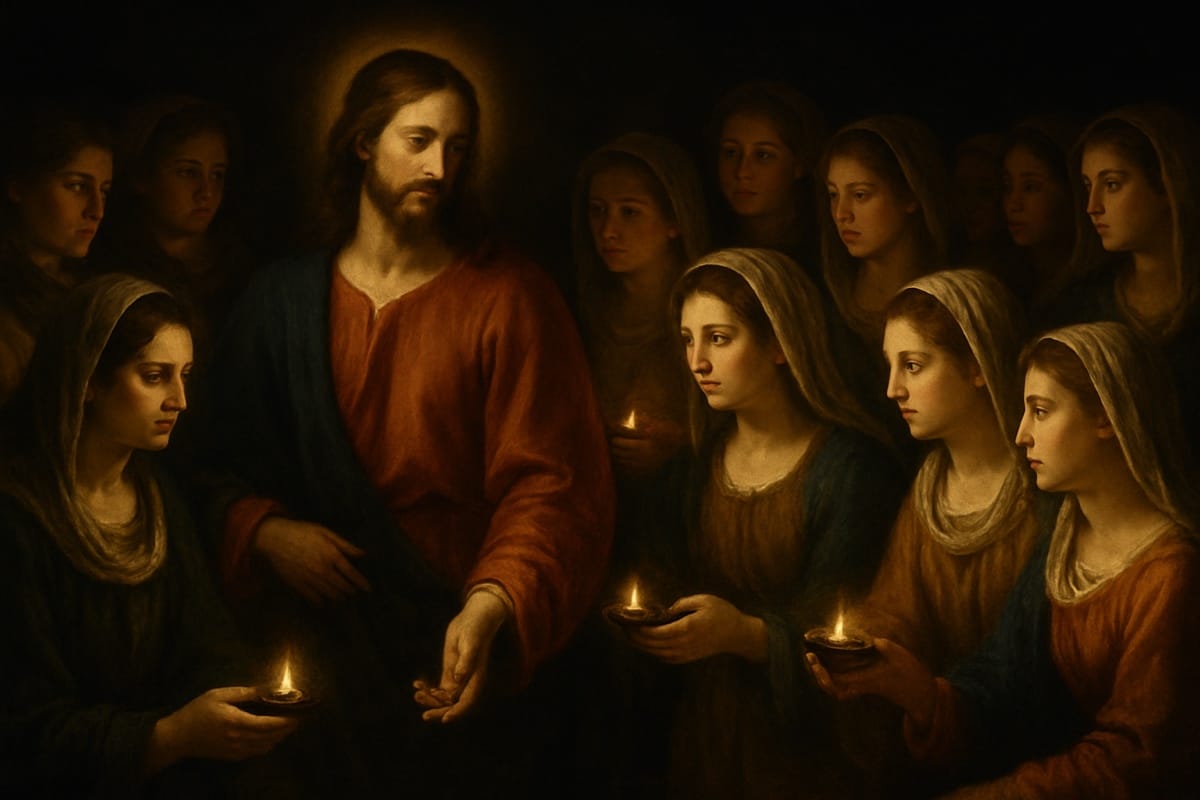
Jesus tells the parable of the Kingdom of Heaven: ten virgins go out to meet the bridegroom with their lamps. Five are wise and bring extra oil. Five are foolish and do not bring any. The bridegroom tarries. All fall asleep. At midnight, a cry: “The bridegroom is coming! Go out to meet him” (Mt 25:6). The foolish virgins ask the wise for oil. The wise refuse: there might not be enough for all. The foolish go to buy oil. Meanwhile, the bridegroom arrives. Those ready enter with him to the feast, and the door closes. The others come and beg: “Lord, Lord, open to us” (v.11). The response: “Truly, I say to you, I do not know you” (v.12). And the conclusion: “Therefore keep watch, because you do not know the day or the hour” (v.13). The parable does not teach that vigilance is possible at any moment; it teaches that there is a moment when it is no longer possible to improvise. Oil is not lent: each one has their own. Faith, hope, charity, prayer, vigilance, are not transferable. They are the result of a lifetime of faithfulness that no one else can live in our place.
IV. Mary and the Oil of Vigilance
Wisdom is described in Proverbs 8 as walking the streets seeking those who are worthy. Tradition has called Mary “Sedes Sapientiae”, Seat of Wisdom, because she was the creature where God’s Wisdom chose to dwell in a unique way. Mary had the oil: not the improvised oil, but that which was accumulated in a lifetime of vigilance, prayer, and openness to God. The parable of the ten virgins has its fulfillment in Mary: when the bridegroom came into the world at the Annunciation, Mary was ready. Not because she prepared herself at that moment, but because she had lived her entire previous life in availability. 1 Thessalonians 4 assures that the dead in Christ will rise. Mary is the first to have risen fully: the Assumption is the anticipation of what 1 Thessalonians 4 promises for all. She is the wise virgin already within the feast, with the door open, interceding for those still watching outside to enter in time.
Postgraduate specialisation in Mariology
Would you like to deepen your formation in Mariology? The Locus Mariologicus postgraduate programme is a specialisation that brings together theological rigour, spiritual life and the living tradition of the Church. The next class begins in 2027.
Responses