Mary, Star of Hope when human hopes waver
By Prof. Dr. Daniel C. Afonso · Updated
“Sign of a certain hope and consolation” (Sign of sure hope and consolation)
Vatican Council II, Dogmatic Constitution Light of the Nations, number 68
“Small hopes and great hope, in the light of the Mother standing at the Cross”
Mariological meditation for times of fatigue and uncertainty
There are moments in the life of a people when many wake up with the feeling that something has broken. Some feel frustration, others relief, almost everyone feels fatigue. Projects in which much energy was invested seem to crumble, and others, celebrated with enthusiasm, already carry the silent question: what if these too disappoint us? The experience is ancient. The psalmist knew it, and the Church still prays it in her psalms.
Christian faith does not respond to this experience with indifference, as if nothing that happens in history matters. It responds with a deeper question: On what, after all, is my hope founded? And to answer, the Church points to a woman. The Council calls Mary “a sign of sure hope and consolation” for the People of God who are still on the journey (LG 68). It is not a pious ornament. It is a theological thesis, and it is worth taking seriously precisely when human hopes waver.
I. Small hopes and great hope
Benedict XVI dedicated an entire encyclical to this question. “For Salvation”It distinguishes the many hopes that sustain us day after day, great or small, and the great hope, that which, as the Pope says, cannot be destroyed even by the failures of historical achievement (SS 30-31, 35). The first are legitimate and necessary. We hope for a good job, the health of our children, a more just society, honest rulers. It would be inhuman not to hope for these things.
The problem arises when we ask a small hope for what only the great can give. The Pope warns that the search for proper orders for human realities is the task of every generation and can never be considered complete: good structures help, but they are not enough by themselves, because freedom is always new and each generation is “a new beginning” (SS 24-25). Whoever puts all his soul into a historical project condemns himself to oscillate between euphoria and despair, according to the outcome of the day.
The great hope, teaches “For Salvation”It can only be God, and not any god, but the God who has a human face and who loved us to the end (SS 31). It is this hope that gives the other hopes their proper place: neither idolized nor scorned.
“Do not trust in princes”
The Psalm 146 contains a warning that spans the centuries: “Trust not in princes, in mortals, who cannot save” (Ps 146:3). The Vulgate is even more direct: in quibus non est salus
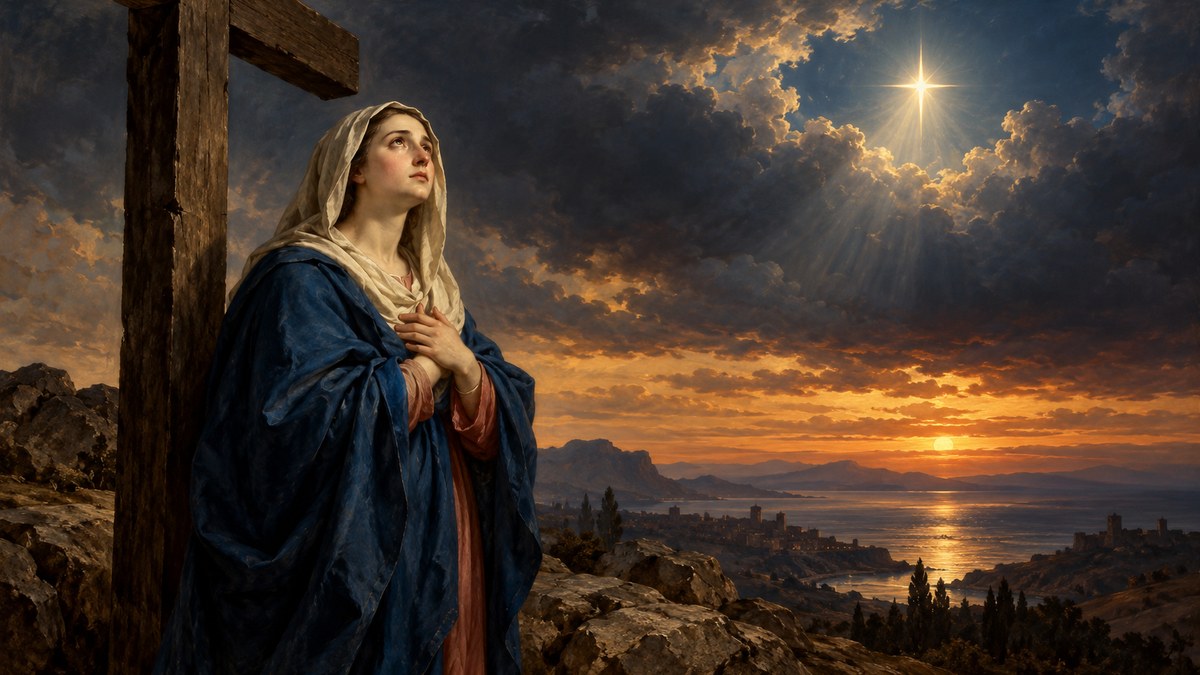
Where the Scriptures show this great hope in its purest state? At the Cross. “Standing by the cross of Jesus was his mother” (John 19:25). No moment in history seemed so definitively lost. The Messiah, in whom Israel’s hope had been placed, dies condemned among two criminals. The disciples flee. The plan appears to be over.
Mary does not flee, nor does she despair. John Paul II describes this moment as perhaps the deepest kénosis (self-emptying) of faith in human history: at the foot of the Cross, Mary participates, through faith, in the mysterious and disconcerting mystery of the Son’s stripping (Rom 18). She does not understand everything. She does not yet see the resurrection. But she remains, because her hope was not based on the visible success of the Son, but on the Father’s fidelity who had spoken to her at the Annunciation.
Tradition has called this attitude of faith on the Sabbath Holy the “faith of the Church.” When all fell silent, the faith of the Church remained, as it were, gathered in the heart of the Mother. This is the lesson for those who feel defeated today, and for those who feel victorious: Christian hope does not depend on the score of history. It stands when everything falls, and remains humble when everything seems to be going well.
IV. Ave, maris stella: The star that guides on the stormy sea
Benedict XVI concludes Spe Salvi by recalling that the Church greets Mary, with a hymn over a thousand years old, as “star of the sea”: Ave, maris stella (Hail, star of the sea). He writes, life is like a voyage on the sea of history, “often foggy and stormy,” in which we seek the stars that show us the way. Jesus Christ is “the light par excellence,” but to reach Him, we also need “neighboring lights,” people who reflect His light. And the Pope asks: “Who else but Mary could be for us a star of hope?” (SS 49-50)
It’s not about running away from the sea. The sailor stays on the boat, holding the rudder, facing the waves. The star does not calm the storm, but prevents the ship from losing its course. Similarly, Mary’s presence in the life of the Christian during turbulent times is not a dispensation from historical responsibilities, but prevents us from confusing the port with the crossing.
In practice, this has very concrete consequences. Pray before commenting. Turn off the screen before bed and hand over the day in the hands of the Mother. Refuse to despise those who think differently. Return to the Rosary when anxiety tightens. Small gestures that put the great hope back at the center and return the small to their proper place.
* * *
Mary is not a sign of hope because everything went well in her life, but because her hope survived the Cross. She is therefore the most secure companion for all who, on either side of the disputes of this world, need to learn to hope in God again.
The Locus Mariologicus invites you to make the Mother of God the star of your crossing. Deepen the faith that sustains hope: study Mary with rigor, pray with her in confidence, and discover, in the school of Mariology, why the Church calls her “sign of sure hope and consolation.”
Prof. Dr. Daniel Cerqueira Afonso
President of the Locus MariologicusRome, October 25, 2026
Key References
BENEDICT XVI. Encyclical Letter Spe Salvi: On Christian Hope. Vatican: Libreria Editrice Vaticana, 2007.
Vatican Council II. Dogmatic Constitution Lumen Gentium: On the Church. Vatican, 1964.
Vatican Council II. Pastoral Constitution Gaudium et Spes: On the Church in the Modern World. Vatican, 1965.
JOHN PAUL II. Encyclical Letter Redemptoris Mater: On the Blessed Virgin Mary in the Life of the Church which is on the Way. Vatican: Libreria Editrice Vaticana, 1987.
Responses