When the family table is divided
By Prof. Dr. Daniel C. Afonso · Updated
Hi omnes erant perseverantes unanimiter in oratione cum mulieribus et Maria matre Iesu
“All these persevered in prayer with one accord, including certain women and Mary, the mother of Jesus.”
(Acts 1:14, Vulgata)
“Mary, Mother of Unity, and the Christian art of staying together without thinking alike.”
Mariological meditation on communion in times of polarization
Few wounds hurt as deeply as division within the home. Brothers who have stopped speaking, parents and children avoiding certain topics at the dinner table, family groups on the cell phone turned into battlefields. Many Catholics know this pain firsthand. And often, the rupture did not arise from a personal offense, but from differing opinions about the country’s direction.
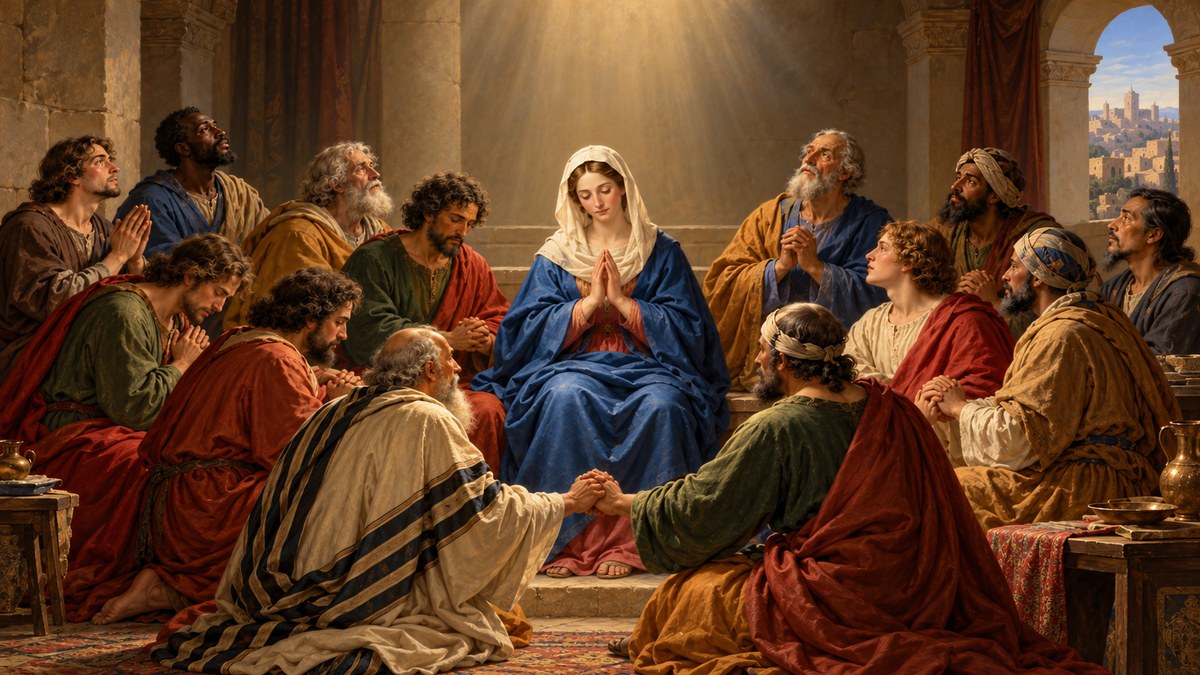
The Scripture does not ignore this drama. On the contrary, it shows us a nascent community composed of very different men gathered in one place, awaiting the Holy Spirit. And among them, discreet yet decisive, stands the Mother of Jesus. Contemplating the Cenacle, we learn that Christian unity is not uniformity of thought, but communion of heart around Christ.
I. The Cenacle was not a place of equal opinions
When Luke lists the Eleven gathered after the Ascension, the list contains a surprising detail. There are Matthew, the former tax collector in the service of Roman power, and Simon, called the Zealot (Acts 1:13), a name associated with those who resisted foreign domination. It is hard to imagine, in first-century Palestine, two political positions more distant.
Yet Jesus called both of them. He did not require one to convince the other before following Him. He placed them side by side, sharing bread, roads, and finally the same room in Jerusalem. What united them was not a common reading of the situation, but the person of the risen Lord.
This is the first lesson for our families. Difference of opinion, even profound, is not in itself a sin against unity. Sin begins when opinion becomes more important than the brother, when political conviction takes the place that only charity can hold.
II. HomothymadonUnity of heart, not of opinion
Luke uses a precious Greek word to describe that group. Homothymadon (Agreeing in common, with one spirit). The Vulgate translated as Unanimity“But the original sense is not ‘all thinking the same thing’. It is ‘all having the same [mind]'” thymos“The same inner impulse, the same heart turned in the same direction.”
And what was that direction? Prayer. “All these were persistent in prayer” (Acts 1:14). The unity of the Cenacle was not built on a debate won by anyone, but on a shared supplication. The Council emphasizes that before the day of Pentecost, Mary was among the Apostles imploring, “with her prayers, the gift of that Spirit who had already descended upon her at the Annunciation” (Lumen Gentium 59).
The Mother’s presence is not accidental. John Paul II observes that she who is present in the mystery of Christ as Mother “continues to be a maternal presence” also in the Church, and shows herself among the Apostles, imploring the gift of the Spirit (Acts 24-26). Where the Mother is, the children learn to sit at the same table.
She is not a judge of disputes, but the heart that brings together.
III. Cana: The Mother who perceives the lack before the rupture
Jesus’ first sign occurred at a family feast. And it was Mary who noticed the problem before everyone else: “They have no more wine” (Jn 2:3). In a culture where family honor was at stake, the lack of wine threatened to turn joy into shame and perhaps discord.
Mary does not accuse anyone. She does not look for culprits among the bridegroom and the servants. Instead, she simply takes the lack to Jesus and directs the others: “Do whatever he tells you” (Jn 2:5). This is the Marian method for family crises. First, perceiving the lack with a maternal gaze. Then, presenting it to the Son. Finally, obeying his word, even when it seems strange, like filling jars with water.
How many families today “have no more wine”! There is a lack of joy in encounter, lightness in conversation, and tenderness among siblings. The Mother remains vigilant. She perceives the lack and intercedes. It is up to us, like the servants of Cana, to do what the Son asks: “Blessed are the peacemakers, for they will be called children of God” (Mt 5:9).
IV. Concrete paths to reconciliation in Mary’s school
Theology only becomes life when it descends to actions. That’s why some simple steps, inspired by Marian pedagogy, can help those who suffer from divisions at home.
The first is to pray together again. John Paul II recalls the famous slogan in pastoral family work: “A family that prays united stays united” (RVM 41). A mystery of the Rosary prayed in common is worth more than many won discussions. The second is Mary’s silence, who “kept all these things, meditating on them in her heart” (Lk 2:19). Not everything needs to be said, especially at the table. The third is taking the first step. The Apostle reminds us that Christ “is our peace” and that he broke down the dividing wall (Eph 2:14). Those who are in Christ do not wait for the other to make the first move.
None of this requires renouncing one’s own convictions. It only requires placing them in their proper order: below Christ, below charity, below the brother for whom He died.
* * *
The Cenacle shows that the Church was born from very different men, gathered in prayer with the Mother of Jesus. So too can peace be reborn in our homes: not when everyone thinks alike, but when everyone prays together.
The Locus Mariologicus invites you to place your family under the gaze of the Mother of Unity. Gather your family around a Rosary this week, offer Mary the reconciliation that seems impossible, and delve, with us, into the mystery of him who was in the heart of the nascent Church.
Prof. Dr. Daniel Cerqueira Afonso
President of the Locus MariologicusRome, October 25, 2026
Key References
Second Vatican Council. Dogmatic Constitution Lumen Gentium: on the Church. Vatican, 1964.
JOHN PAUL II. Encyclical Letter Redemptoris Mater: on the Blessed Virgin Mary in the life of the Church which is making her way. Vatican: Libreria Editrice Vaticana, 1987.
JOHN PAUL II. Apostolic Letter Rosarium Virginis Mariae: on the Rosary. Vatican: Libreria Editrice Vaticana, 2002.
Responses