Mary’s universal spiritual motherhood (1987): the demonic testimony according to Father Giovanni Bamonte
The doctrine of the spiritual motherhood of Mary constitutes one of the most developed and at the same time most disputed chapters of dogmatic Mariology. It is not a pious metaphor nor a peripheral devotion: it is a theological affirmation of ontological weight that has its foundation in the words of the crucified Christ, in the patristic reflection on Mary as the New Eve, and in the contemporary papal Magisterium.
Its most unusual confirmation comes from a source that no academic Mariological treatise would summon on its own initiative: the records of exorcisms documented by the Italian priest Giovanni Bamonte, in which demonic entities were compelled to reveal, against their own will, the reality and the scope of Mary’s spiritual motherhood over every human being.
I. The spiritual motherhood of Mary: biblical and theological foundation
The scriptural foundation of the spiritual motherhood of Mary is found in the Calvary episode narrated in Jn 19:26-27: “When Jesus saw His mother and, near her, the disciple whom He loved, He said to His mother: ‘Woman, behold your son.’ Then He said to the disciple: ‘Behold your mother.’” The exegetical tradition, from Origen to John Paul II, interprets this passage not as a private arrangement of a family nature, but as an act of theological foundation: the beloved disciple receives the mother as the representative of all redeemed humanity. Mary, for her part, acquires at this moment her universal spiritual motherhood, extended to all who belong to the Son.
Patristic Mariology identified early on the connection between divine motherhood and spiritual motherhood. Irenaeus of Lyons, in formulating the Eve-Mary antithesis, already implies that the obedience of Mary which brought forth the Savior is continued in a motherhood of the spiritual order: just as Eve, being the mother of carnal humanity, became a cause of death through disobedience, so Mary, being the mother of the Savior, becomes a cause of life through her consent. What the theory of recirculation affirms on the historical-salvific level is what the doctrine of the spiritual motherhood of Mary affirms on the existential level: every human person is the object of the same maternal care that Mary exercised over her Son.
II. Spiritual motherhood on the cross: the expansion of the maternal bond
The theological tradition progressively identified a precise moment at which the spiritual motherhood of Mary reaches its full extension: the instant of Christ’s death on the Cross. In the first phase of Jesus’ life, Mary’s motherhood, being already the motherhood of one who had conceived the Savior of the world, was concretely centered upon the historical person of the Son. On the Cross, at the moment when Jesus gives up His spirit to the Father and His historical mission is consummated, Mary’s motherhood is not extinguished: it dilates. The maternal bond that had been focused on Jesus expands to embrace all the humanity that Jesus recapitulated in Himself.
This theological datum has a classical formulation in the doctrine of Co-redemption, which Mariology proposes with different levels of development. But it also has a simpler and deeper expression in the recognition that Mary’s motherhood toward every human being is not an analogical extension of her divine motherhood: it is its consummation. The dead Son whom she would mourn beneath the Cross is the same one who handed over to the world the motherhood that had been wholly His own. The spiritual motherhood of Mary is, in this sense, the legacy of Calvary.
III. The demonic testimony of Father Giovanni Bamonte on the motherhood of Mary
The Italian priest Giovanni Bamonte, an exorcist with long and documented pastoral experience, recorded throughout his ministry a set of statements wrested from demonic entities in the contexts of exorcism. Among those most significant for Mariology are the ones that bear directly on the spiritual motherhood of Mary. One of them, obtained during an exorcism session while the exorcist was invoking Mary, formulated the ontological opposition between Mary’s maternal presence and demonic action with a precision that theological treatises themselves rarely attain: “She is called queen and mother. That ruined us. Humanity was reborn in that womb of hers. But humanity does not know”.
The statement has three distinct theological moments: the affirmation of the title of Queen and Mother as a real title, not merely an honorific one; the confession of the harm that this reality causes to the operation of evil; and the paradoxical observation that humanity remains ignorant of what was accomplished in Mary.
In another record from the same sessions, the demon was compelled to reveal Mary’s closeness to every human being in a language of hatred that is at the same time a confession of impotence: “You think she is up there, but she is not up there. She is near you. And when you die, she is there”. This inverted testimony confirms, in a way that the adversary cannot falsify for any motive whatsoever, the doctrine of Mary’s maternal presence beside the soul of each of the faithful throughout life and at the moment of death, which the pastoral tradition of the Church expresses in the prayer of the Hail Mary: “now and at the hour of our death”.
IV. Mary’s mantle as a symbol of destruction for the demon
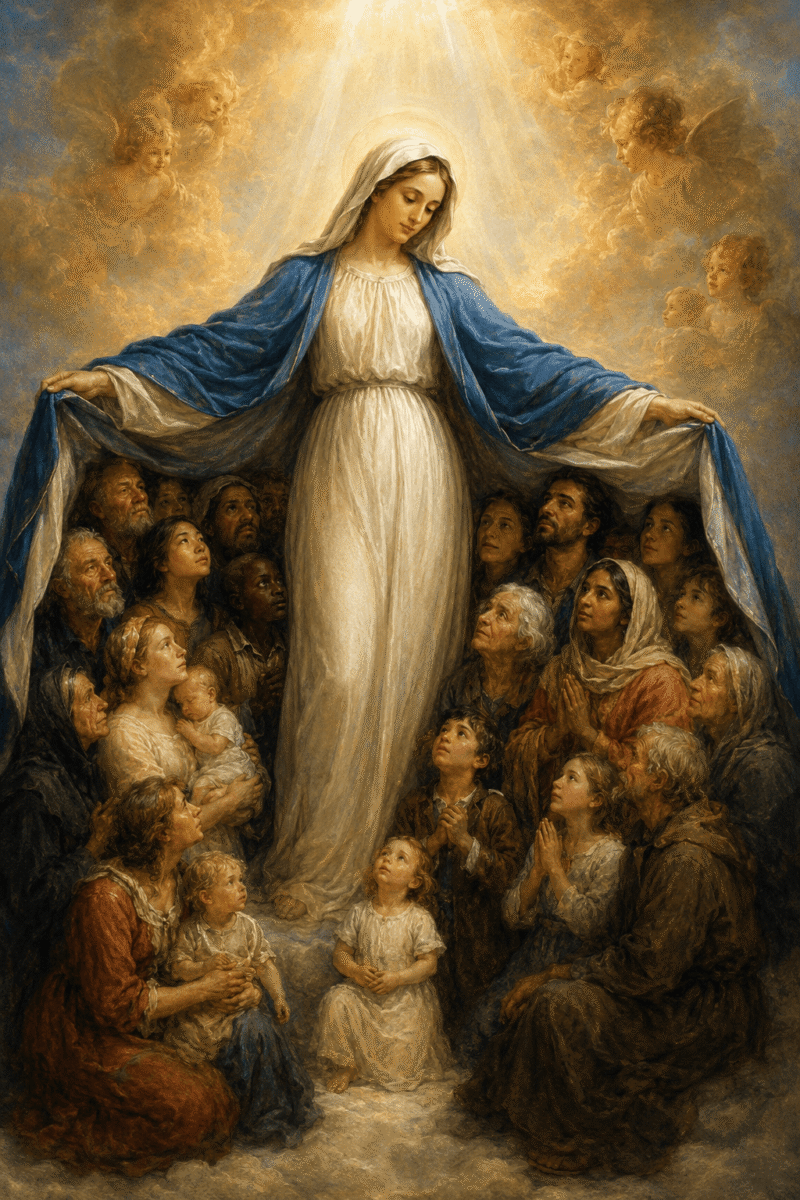
The records of exorcisms documented by Bamonte also include a testimony about the power of Mary’s intercession, formulated in the bodily and symbolic language of the maternal touch: “Her hands, so sweet, so cool, are incandescent for us. Whenever she touches one of you, she destroys one of us”. And about the white and blue mantle that Marian iconography associates with Mary’s protection: “That white and blue mantle. If you merely say ‘Ave’, she comes running. That is my ruin”.
The theological density of these statements surpasses what their origin might suggest. Mary’s touch as the destruction of the adversary points back to Gen 3:15 and the radical enmity between the woman and the serpent. The mantle as a symbol of protection points back to the iconography of the Madonna della Misericordia, in which Mary shelters beneath her mantle all who have recourse to her. The simple invocation “Ave” as the trigger of her presence points back to the theology of intercession that the Second Vatican Council formulated in chapter VIII of Lumen Gentium.
The statement about the Nativity of Mary obtained in the same sessions has a theological beauty that surpasses the demonological register: “He prepared her from on high. The beautiful one, clean, clear with the dew, the splendid one like the light that passes through water. When she was born, the world stopped for a moment. All creation stopped to look at her. I knew who she was and I could do nothing. I could not touch her. She was pure, pure”.
This involuntary description of the Nativity of Mary as a cosmic event finds a parallel in Saint Bernard of Clairvaux and in the contemplative tradition that reads Mary’s coming into the world as the dawn of salvation. The spiritual motherhood of Mary begins, in the logic of this involuntary witness, before history: in the eternal pre-election of God who prepared her as the mother of the Savior and, in Him, mother of all redeemed humanity.
V. The theological legacy of the spiritual motherhood of Mary
The doctrine of the spiritual motherhood of Mary received a magisterial formulation progressively consolidated from Leo XIII to John Paul II. The encyclical Redemptoris Mater (1987) devotes a developed reflection to it, situating spiritual motherhood within the logic of Mary’s maternal mediation, which is distinct from the unique mediation of Christ but subordinate to it and dependent on it in its entire exercise. The Magisterium affirms that Mary “with maternal love cooperates in the birth and education” of the faithful, making her spiritual motherhood operative not only at the moment of death but throughout the whole of Christian existence.
The testimony wrested by Giovanni Bamonte neither replaces nor completes this Magisterium. It does, however, confirm it in a way that no rational argument could reproduce: with the voice of the adversary who acknowledges, with hatred and dismay, what faith professes with love and hope. The statement “if you merely say Ave she comes running” is the exact demonological translation of what the liturgy and Christian prayer affirm about the readiness of Mary’s intercession. Cf. Redemptoris Mater (John Paul II, 1987) and Lumen Gentium, no. 61. In-depth study of the spiritual motherhood of Mary forms part of the curriculum of the Postgraduate Program in Mariology at Locus Mariologicus.
Postgraduate Program in Mariology
Would you like to deepen your formation in Mariology? Discover the Postgraduate Program in Mariology at Locus Mariologicus – an academic formation that unites theological rigor, spiritual life, and the living tradition of the Church.





Responses