Ego et pater unum sumus: Mary and the Unity of the Son with the Father
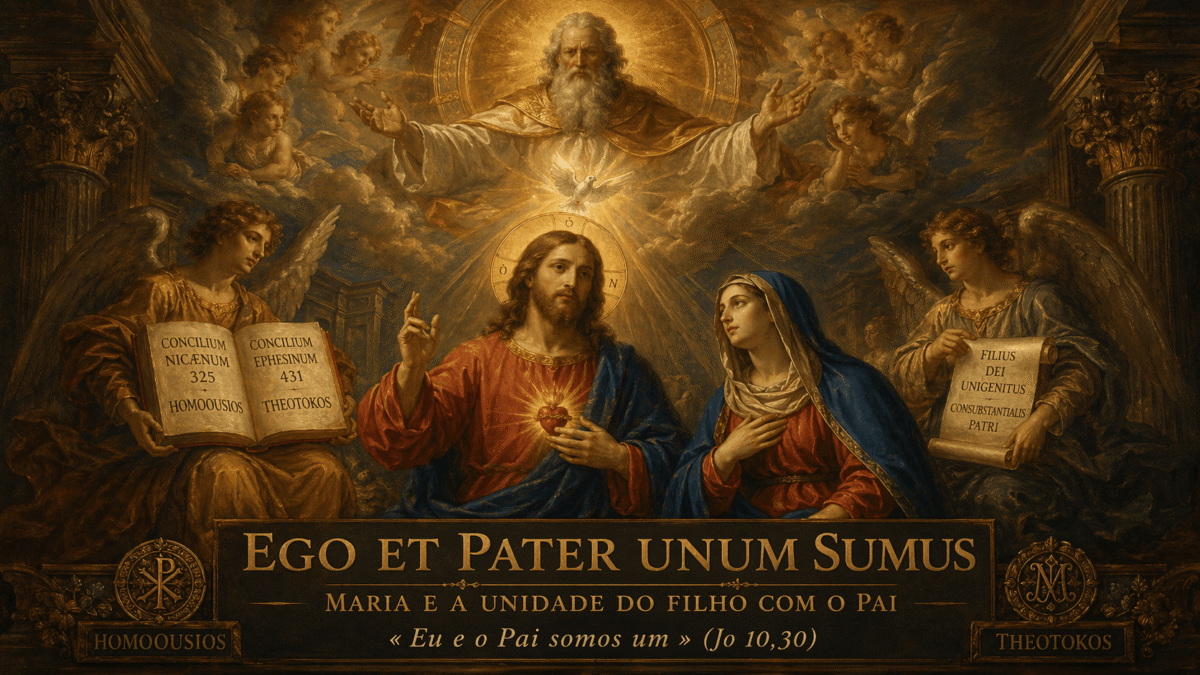
Ego et Pater unum sumus.
Jn 10:30
“I and the Father are one.” This very brief statement of Jn 10:30 is, in Christian theology, one of the cornerstones of the doctrine of the Trinity and of the divinity of Christ. At once, His hearers pick up stones to stone Him: they understand that Jesus is asserting His equality with God (Jn 10:33). Mariology finds in this statement the deepest foundation of the title Theotokos: if the Son is one with the Father, then Mary, who gave birth to the Son, is in some way bound up with the most intimate mystery of the divine life.
I. “Unum sumus”: the unity of the Father and the Son in Trinitarian theology
The Greek neuter hen, “one thing,” in Jn 10:30 is theologically precise: it does not say “we are one” in the sense of a personal identity, but “we are one thing,” a single nature, a single divine essence. The distinction of the Persons (Father and Son are distinct, “I” and “the Father”) coexists with the unity of nature (they are “one thing,” the same essence, the same divinity, the same being).
The Council of Nicaea (325) formulated this insight with the term homoousios, “consubstantial”: the Son is of the same substance as the Father. This definition, which might seem a philosophical technicality, has enormous practical and spiritual implications: whoever sees the Son sees the Father (Jn 14:9). Whoever honors the Son honors the Father (Jn 5:23). And, for Mariology, whoever gave birth to the Son gave birth to Him who is consubstantial with the Father.
Athanasius of Alexandria, the great defender of Nicaea, was also one of the first theologians to explore explicitly the connection between homoousios and Theotokos. The argument is simple but powerful: if the Son is consubstantial with the Father (the definition of Nicaea), and if Mary gave birth to the Son (a fact of the Gospel), then Mary is Theotokos, Mother of God. To deny the Theotokos would be equivalent to denying the homoousios: a Son who is not consubstantial with the Father cannot have a Mother of God.
The Council of Ephesus (431) formally defined the title Theotokos precisely in this context: not to define Mary, but to defend faith in Christ. What was at stake was not the greatness of Mary; it was the unity of the Son with the Father. Nestorius proposed calling Mary only Christotokos, Mother of Christ, thereby separating the human Christ from the divine Person of the Son. Ephesus replied: Mary is Theotokos because the Son she conceived is one with the Father; He is God.
II. The divine motherhood as participation in the Trinitarian life
The definition of Mary as Theotokos does not imply that she is “mother of the Trinity,” nor that she begot the divinity as such, which would be absurd. It implies that the Person she begot is divine: the eternal Son of God took His humanity from the Virgin and was born in time as man, without ceasing to be God. Mary is mother of the Son as Person, and this Person is divine, consubstantial with the Father.
The implication for Mary’s dignity is immense. John Damascene expressed it with an eloquence that tradition has enshrined: “The holy Virgin is higher than all the Cherubim and Seraphim and every creature, visible and invisible, because she was made the Mother of the Creator Himself.” This “elevation” of Mary is not devotional hyperbole; it is a logical consequence of the Theotokos: if the Son is consubstantial with the Father, then the dignity of being the Mother of such a Son surpasses the entire created order.
The theological tradition, in particular the Franciscan school of Alexander of Hales and St. Bonaventure, and later the Thomist school as reformulated by Cajetan and Domingo de Soto, developed the idea that Mary participates in the intra-Trinitarian life in a created, but real and analogical, way. Her relationship with the Father (as chosen daughter), with the Son (as Mother), and with the Holy Spirit (as spouse) is not a participation equal to that of the divine Persons among themselves, but it is a real participation, one that raises her above every creature.
St. Louis-Marie de Montfort, in the Treatise on True Devotion to the Blessed Virgin, developed these relationships in a way that profoundly influenced modern Catholic spirituality: “God the Father gathered all His waters (…) in Mary, so that rivers of graces might spring forth from there.” The metaphor points to Mary’s role in the “distribution” of the Trinitarian life to humanity: she who received the fullness of grace is the channel through which that grace reaches all the children.
III. “That they may all be one”: Mary and the unity of the Church
Jn 17:21 places in the priestly prayer of Jesus the desire that His disciples be “one” as the Father and the Son are “one”: “that they may all be one. As you, Father, are in me and I in you, may they also be in us.” The unity Jesus asks for is not external uniformity; it is the unity of love and of communio that characterizes the intra-Trinitarian life, and that the Church must reflect in the world.
Mary, as Mater Ecclesiae, stands at the heart of this ecclesial unity. The scene in the Upper Room in Acts 1:14, “All these persevered with one accord in prayer, with Mary, the Mother of Jesus,” presents Mary as the center of gravity of the apostolic community before Pentecost. She does not lead in an outward or institutional way: her presence creates a space of unity, of prayer, of openness to the Spirit.
The contemporary ecumenical movement has progressively recognized the ecumenical dimension of Mary. It is no accident that the ecumenical document of the Groupe des Dombes (Marie dans le dessein de Dieu, 1998) devoted an entire chapter to Mary as “figure of unity”: she who is venerated, in different ways, by the Catholic and Orthodox Churches and by many Reformed communities can be the point of convergence around which the lost unity of the Church is gradually being rebuilt.
This ecumenical dimension of Mariology is not a pragmatic strategy; it is a theological consequence. If Mary is the figure of the Church, and if the Church is called to be “one, holy, catholic and apostolic,” then the veneration of Mary must be, by its very nature, a factor of unity and not of division. Where Mariology divides, it is because it has been denatured with respect to its Christological and Trinitarian foundation. Authentic Mariology, rooted in the “Ego et Pater unum sumus,” is necessarily ecumenical.
IV. “No one shall snatch them out of my hand”: Trinitarian security and the Assumption
Jn 10:29: “My Father, who has given them to me, is greater than all, and no one can snatch them out of the Father’s hand.” The security of the Good Shepherd’s sheep has a Trinitarian basis: it rests in the “hand of the Son” and in the “hand of the Father,” which are “one thing” (Jn 10:30). The unity of the Father and the Son is the ultimate guarantee of the salvation of the sheep: not because the divine Persons are confused with one another, but because their saving will is one and their power is absolute.
The Assumption of Mary is the most visible fulfillment of this Trinitarian promise for a member of the human race. Mary, who was always in the “hands” of the Father and the Son, from her Immaculate Conception to her faithful service, received the Trinitarian promise in her body and in her soul: she was “assumed” (taken up, gathered in) into the full life of God. No one “snatched” her away, because she was in the hands of the Father and the Son.
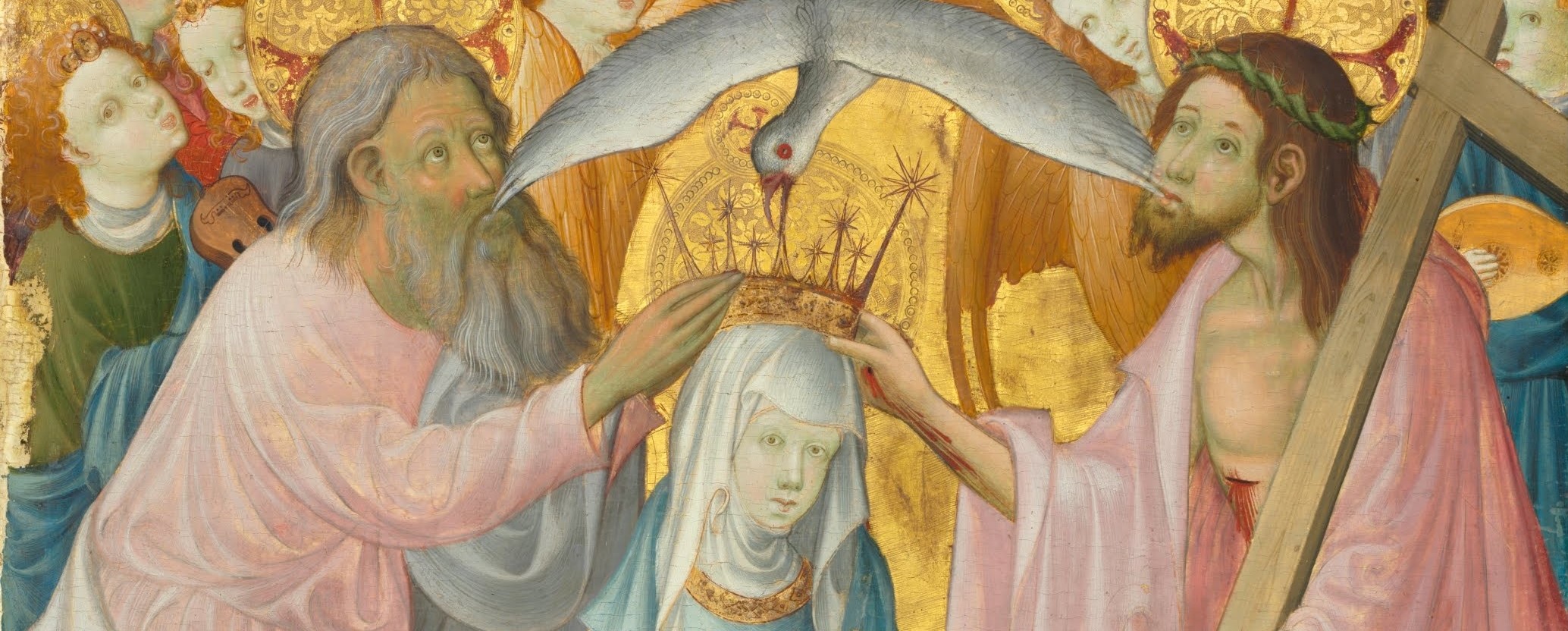
The iconography of the Coronation of Mary, one of the most frequent Mariological themes in Western Christian art, depicts the Father and the Son (and often the Holy Spirit as a dove) crowning Mary in the glory of Heaven. This image sums up visually what theology formulates abstractly: Mary’s participation in the Trinitarian life is not merely functional or instrumental; it is a real communion, which the Assumption definitively confirmed. Mary is “within” the Trinitarian life, not as a fourth Person, but as the creature who most fully received and responded to the love of the three Persons.
Devotion to the Most Holy Trinity and devotion to Mary are thus inseparable in Catholic spirituality. To honor Mary is to honor the work of the Trinity in the creature. To contemplate Mary is to contemplate what the three Persons accomplished together in the history of salvation. Jesus’ “Ego et Pater unum sumus” opens the horizon within which Mariology is to be understood: not as a devotion running parallel to Trinitarian faith, but as an expression of that faith in the contemplation of the creature who most profoundly reflects it.
“I and the Father are one”: this statement is the foundation of the Theotokos and the horizon within which Mary’s divine motherhood finds its full theological and spiritual meaning.
References
- Council of Ephesus, Acts (431).
- John Damascene, De Fide Orthodoxa, IV, 14.
- St. Louis-Marie de Montfort, Treatise on True Devotion, nos. 23-25.
- Groupe des Dombes, Marie dans le dessein de Dieu et la communion des saints (1998).
- H. U. von Balthasar, Theodramatik, III, “Die Handlung” (1980).
Postgraduate Program in Mariology
Would you like to deepen your formation in Mariology? Discover the Postgraduate Program in Mariology at Locus Mariologicus – an academic formation that unites theological rigor, spiritual life, and the living tradition of the Church.
Would you like to study Mariology seriously?
This article springs from the works in the Locus Mariologicus library. The Postgraduate Program in Mariology takes you to the same source, with academic guidance: Scripture, the Fathers of the Church, and the Magisterium, from the first dogma to contemporary questions.
Responses