Qui diligit me, sermónem meum servábitat: Mary and the Word That Dwells
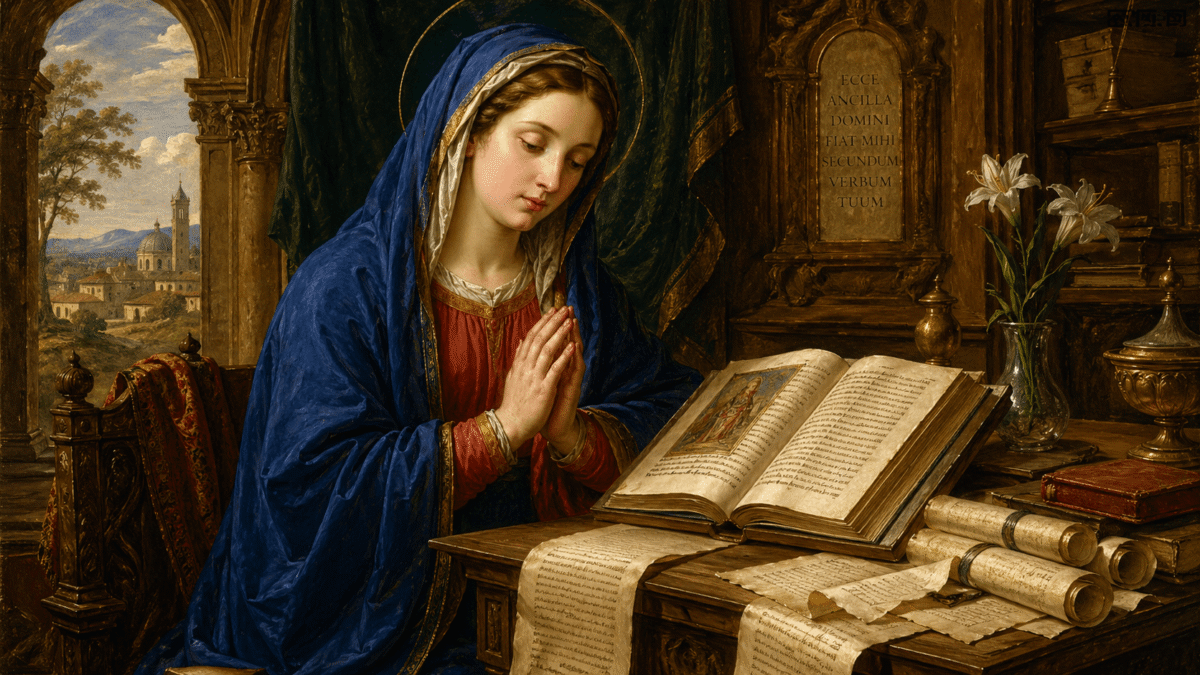
Qui diligit me, sermonem meum servabit, et Pater meus diliget eum, et ad eum veniemus et mansionem apud eum faciemus.
Jn 14:23
“If anyone loves me, he will keep my word, and my Father will love him, and we will come to him and make our dwelling in him.” Jn 14:23 is one of the densest verses of the farewell discourses: love for the Son, a love that keeps His Word, is the condition for the indwelling of the Trinity in the soul. The Father and the Son, and implicitly the Spirit, “make a dwelling” in the believer who loves and keeps. Mariology finds in this verse the foundation of Mary’s interior life: she who “kept and pondered” the Word (Lk 2:19, 51) was the first and most perfect “tabernacle” in which the Trinity made a dwelling.
I. “Keeping the word”: love and obedience in John
The condition that John attaches to love, “he will keep my word,” is specific. The verb terein, “to keep,” “to preserve,” denotes not merely an outward obedience but an inner custody: keeping as a treasure, preserving as something precious. To “keep the word” of Jesus is not to fulfill a list of rules; it is to make the word of Jesus the orienting center of one’s own life, the inner norm that illuminates one’s choices.
This distinction between legalistic obedience and “keeping the word” as a form of love is central to Johannine spirituality. John never uses the vocabulary of the law (nomos) to describe the Christian life; he uses the vocabulary of love and relationship. The “commandments” of Jesus are not external laws imposed from outside; they are the concrete form in which Christ’s love is translated into conduct. Whoever loves keeps His commandments spontaneously, as one keeps the words of a friend.
The Augustinian distinction between “servus legis” and “amicus Dei,” servant of the law and friend of God, captures this difference well. The servant obeys out of fear or calculation. The friend “keeps” the word of the friend out of love. The Christian life that John describes is the life of the friend: a life guided by the word of the Beloved, not by the coercion of an external law. This distinction has enormous practical consequences for Christian spirituality and morality.
The Mariological application is direct: Mary “kept” the word of Jesus in the deepest sense. She did not merely fulfill the commandments; she made the word of the Son the food of her contemplation, the guide of her choices, the center of her interior life. The Magnificat reveals a woman who “kept” the words of the Scriptures through a lifetime of meditation. The “let it be done to me” of the Annunciation reveals a woman who “kept” the word of God above her own will. These are the two forms of Johannine “keeping the word”: meditative contemplation and loving obedience.
II. “We will make a dwelling in him”: the Trinity in Mary
Jn 14:23 uses extraordinarily intimate language: the Father and the Son “will come” to the believer and “make a dwelling in him” (monên par autô poiêsometha). The noun monê, “dwelling,” “abode,” is the same as in Jn 14:2: “In my Father’s house there are many dwelling places.” The promise is thus an eschatological anticipation: whoever loves and keeps the word already dwells, in a certain way, in the “Father’s house.” And the Father already “dwells,” in a certain way, in whoever loves.
This “indwelling” of the Trinity in the soul of the believer is the doctrine of sanctifying grace in its densest and most personal expression. Grace is not merely an abstract “state”; it is the real presence of the divine Persons in the soul: the Father as origin, the Son as light, the Spirit as the love that unites. Saint Thomas Aquinas developed this doctrine in the Summa Theologiae I q.43, linking it with the doctrine of Trinitarian perichoresis: the divine Persons who live “in one another” also dwell, by grace, in the soul that welcomes them.
Mary is, from this perspective, the most perfect “tabernacle” of this Trinitarian indwelling. She who was “full of grace” from her conception, “kecharitomene,” as a title constitutive of her identity, was also the fullest “dwelling place” of the Trinity in the created order. And when the Son became incarnate in her, this indwelling reached a dimension that exceeds all mystical indwelling: the Son of God did not merely “dwell” spiritually in Mary; He dwelt in her physically, bodily, for nine months.
Mariological tradition has explored this dimension with images of great beauty: Mary as “Temple of the Holy Spirit,” as “Ark of the New Covenant” (which contains not the tablets of the Law but the Lawgiver Himself), as “Tabernacle of the Most High” (which shelters not the bread of the Presence but the “living Bread that came down from Heaven”). Each of these images points to the same reality: in Mary, the indwelling of the Trinity reached a depth and a concreteness that has never occurred, before or since, in any other human being.
III. “Keeping” as “pondering”: Mary and lectio divina
Lk 2:19: “But Mary kept all these things and pondered them in her heart.” The verb “keep” (dietêrei) in Luke corresponds exactly to the “keep” (terein) of John. Mary did not merely “hear” the words and events; she kept them, guarded them, did not let them dissipate amid the bustle of daily life. This “keeping” is the concrete form of what the monastic tradition would call lectio divina: the prayerful reading of the Word that preserves it in the heart and lets it gradually work the interior transformation.
Benedictine lectio divina, the practice of sacred reading that Saint Benedict prescribed in his Rule, has in Mary its implicit model and, in a certain sense, its foundation. Mary’s meditation on the events of her life with the Son is the prototype of Christian meditation on the Word: not the informative reading that seeks to “learn” in order to “know more,” but the contemplative reading that seeks to be transformed, that lets the Word penetrate deeply and work the transformation that it itself works.
The Rosary, the principal form of Marian prayer in the Latin tradition, is precisely a form of lectio divina “through Mary”: meditating on the mysteries of the life of Jesus through Mary’s eyes, “keeping” those mysteries in the heart as she kept them, letting the incarnate Word transform us as He transformed Mary. Marian intercession in the Rosary does not replace Christological contemplation; it is its vehicle: we learn to “keep the Word” by looking at the one who kept it most perfectly.
The ecclesial dimension of “keeping the Word” has a relevance that goes beyond individual devotion. The Church that “keeps” the Gospel, that hands it on faithfully from generation to generation, that defends it against distortions, that deepens it under the guidance of the Spirit, repeats in the collective order what Mary did in the individual order. Mary is thus not only the model of the individual Christian at prayer; she is the model of the Church in her role as custos Evangelii, guardian of the Gospel.
IV. “We will come to him”: God’s visitation in the soul
Jn 14:23: “we will come to him”; the Father and the Son “visit” the believer who loves and keeps. This divine “visitation” has an immediate Mariological parallel: the Annunciation is the Son’s visit to Mary’s soul, mediated by the angel. The Visitation to Elizabeth is the visit of Mary, pregnant with the Son, to Elizabeth, who responds “filled with the Holy Spirit.” In both cases, the presence of the “visiting” Son transforms the one who receives it: Mary becomes the Mother of God. Elizabeth exults in the Spirit.
The spirituality of “visitation,” Christ’s visit to the soul, lies at the heart of Christian mysticism. Saint Ignatius of Loyola, in the Spiritual Exercises, speaks of “consolations” as visits of God to the soul. Saint John of the Cross describes the “touch” (toque de divinidad) as the discreet but transforming form of this visit. In all these cases, the “divine visitation” transforms without doing violence: God does not invade the soul; He visits it, when it is prepared to receive Him.
Mary is the model of the “visited soul” par excellence. She who was “visited” by the angel, who was “visited” by the Spirit, who visited Elizabeth with the Son within her, is the figure of the contemplative soul that prepares itself to receive God’s visit and that becomes, through that visit, a mediator of God’s visit to others. This dynamic, receiving the visitation and communicating it, is the structure of Christian mission: whoever has received the Son must “visit” others with Him.
The Assumption of Mary is, from this perspective, the definitive “visitation”: the Father and the Son, who promised to “make a dwelling” in whoever loves, bring about in her the definitive and full dwelling. Mary is now in the “Father’s house” (Jn 14:2), not merely “visited” by the Trinity, but fully indwelt, fully “at home” in the Trinitarian life. This is the eschatological promise of Jn 14:23, fulfilled in her before it is fulfilled in all others: “we will come to him and make our dwelling in him,” and in her the eternal dwelling has already been made.
Mary, who “kept the word” in her heart and was the most perfect “tabernacle” of the Trinitarian indwelling, is the model of the contemplative soul that opens the door to God’s “visitation.”
References
- Saint Thomas Aquinas, Summa Theologiae I q.43.
- Second Vatican Council, Dei Verbum no. 8 (1965).
- Saint Ignatius of Loyola, Spiritual Exercises nos. 316-317.
- R. Laurentin, Structure et Théologie de Luc I-II (1957).
- A. Serra, Sapiência e Contemplação de Maria [Wisdom and Contemplation of Mary] (1990).
Postgraduate Program in Mariology
Would you like to deepen your formation in Mariology? Discover the Postgraduate Program in Mariology of Locus Mariologicus, an academic formation that unites theological rigor, spiritual life, and the living tradition of the Church.
Would you like to study Mariology seriously?
This article grows out of the works in the Locus Mariologicus library. The Postgraduate Program in Mariology takes you to the same source, with academic guidance: Scripture, the Fathers of the Church, and the Magisterium, from the first dogma to contemporary questions.




Responses