Tristitia vestra in gaudium vertetur: Mary and Sorrow Transformed
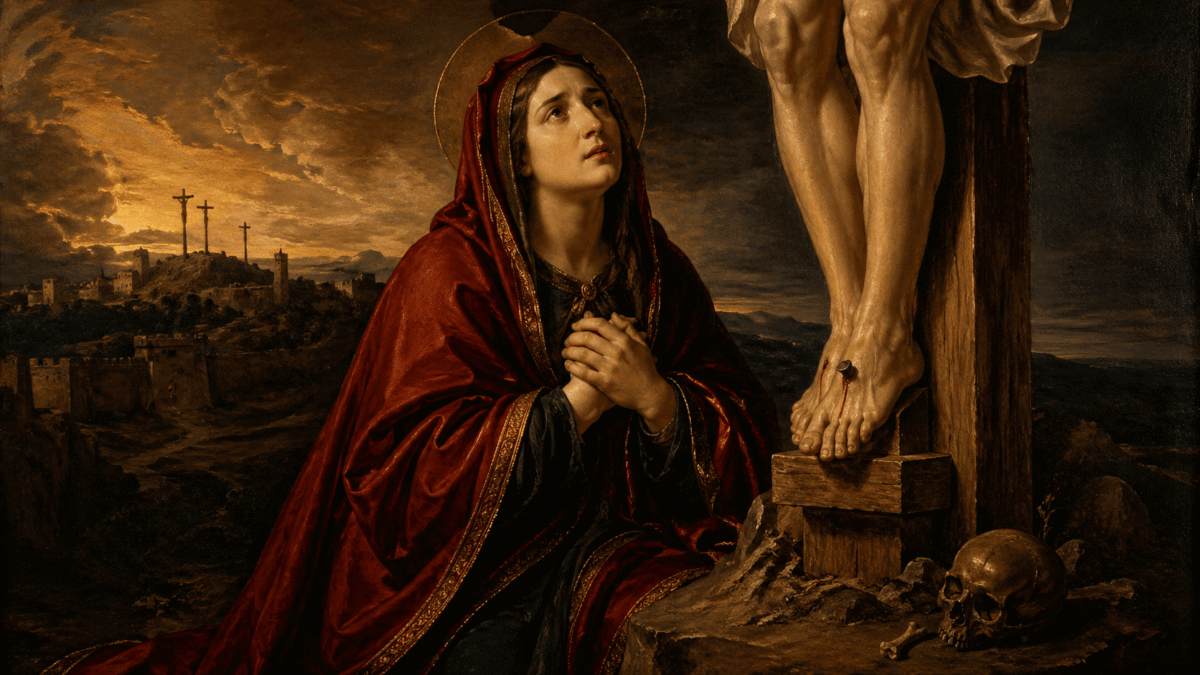
Tristitia vestra vertetur in gaudium (…) et gaudium vestrum nemo tollet a vobis.
Jn 16:20, 22
“Your sorrow will turn into joy (…) and no one will take your joy from you.” Jn 16:20-22 promises the transformation of sorrow into joy, using the image of a woman in labor: “When a woman is in labor, she feels anguish because her hour has come. But when she has given birth to the child, she no longer remembers the tribulation, because of the joy that a man has been born into the world” (Jn 16:21). Mariology finds in this image, proposed by Jesus Himself, one of its richest metaphors: Mary “in labor” on Calvary, whose sorrow is transformed into the joy of the Resurrection.
I. The Image of the Woman in Labor: Exegesis and Mariological Application
The image of the woman in labor (he gynê hotan tiktê) in Jn 16:21 was recognized early on as a reference to Mary, in a twofold sense: as the woman who brought forth the Son (the birth at Bethlehem) and as the woman who “brought forth” the Church on Calvary (a spiritual birth). The “sorrow” of the woman in labor is the pain of Calvary. The “joy that a man has been born into the world” is the joy of the Resurrection. And “the man” who is born is at once the risen Christ and the Church born of His death.
Patristic exegesis explored this twofold reference with great fruitfulness. Origen saw in the woman in labor the figure of the soul that “brings forth” virtues in spiritual suffering. Augustine applied the image to the whole Church, which suffers in the world but will bring forth eschatological joy. But the Mariological application, which starts from Jn 16:21 to shed light on the scene of Jn 19:25-27, is particularly rich: Mary, who “was standing” beside the Cross, was in spiritual “labor,” bringing forth Jesus’ spiritual children for the Church.
The Woman of the Apocalypse (Rev 12:1-2), who “is with child and cries out in the pains and anguish of childbirth,” is the link that connects Jn 16:21 with the scene of Calvary. Tradition interprets this woman as being at once Mary and the Church: Mary, who bore the Son in the historical birth and who “gave birth” to the Church in the spiritual birth of Calvary; the Church, which “gives birth” to new members for Christ in every generation, passing through the suffering of evangelization and persecution. This composite figure, Mary-Church in labor, is one of the richest in biblical theology.
The distinction between the “hour” of childbirth and the “hour” of the Cross in John is deliberate: in both cases, Jesus uses the term hôra (Jn 2:4; 7:30; 8:20; 12:23; 13:1; 17:1). Jesus’ “hour” in John is the hour of the Cross-Resurrection. The “hour” of the woman in labor in Jn 16:21 is the same “hour”: the hour in which sorrow is transformed into joy, in which death brings forth life, in which suffering becomes fruitfulness.
II. Mary from Calvary to the Resurrection: Sorrow Transformed
Jn 19:25: Mary “was standing” beside the Cross, in sorrow, in suffering, in spiritual “labor.” Jn 20 does not narrate the appearance of the Risen One to Mary, but tradition has always recognized that it was to her that Jesus appeared first. This first appearance, implicit in the text but explicit in tradition, is the moment when “sorrow is transformed into joy” most dramatically: the woman who “was standing” beside the Cross receives the news that the Son is alive.
The paschal dimension of Mariology, which sees Mary’s experience as the archetypal journey of the passage from the Cross to the Resurrection, is one of the most fruitful themes of contemporary Mariology. It is not a sentimental vision of the Mother who suffers and then rejoices; it is a theological vision of the paschal structure that shapes all Christian existence: whoever is called to share in the suffering of Christ is also called to share in His glory (Rom 8:17).
Saint John Paul II, in Salvifici Doloris (1984), developed the idea that suffering has a salvific meaning when it is united to the suffering of Christ. Mary is the supreme model of this unity: she who united her suffering to that of the Son on Calvary was the first to receive the joy of the Resurrection. The “sorrow that is transformed into joy” (Jn 16:20) is not merely a future consolation; it is a transformation that already begins in the present, insofar as suffering is accepted and offered in union with Christ.
Christian mysticism has explored this dimension in depth: Saint John of the Cross, in the “Dark Night,” describes the passage from the “sorrow” of spiritual desolation to the “joy” of contemplative union as analogous to the passage from the Cross to the Resurrection. Mary, who lived this passage more radically and more definitively than any other human being, is the guide for this crossing: she who “remained” in the sorrow of Calvary and received the joy of the Resurrection is the intercessor for all who pass through their own “dark nights.”
III. “No One Will Take Your Joy from You”: Mary’s Eschatological Joy
Jn 16:22: “and no one will take your joy from you.” Paschal joy is a joy that no power can destroy, because it depends not on external circumstances but on the reality of Christ’s Resurrection. This inviolable joy finds its fullest realization in Mary: she who is in the glory of the Assumption possesses, definitively and irrevocably, the joy that “no one can take from her.”
Marian joy in tradition, celebrated in the second Joyful Mystery (the Visitation), in the fifth Joyful Mystery (the finding of Jesus in the Temple), and above all in the Glorious Mysteries, is a joy that always has the structure of Jn 16:20: a joy that has passed through sorrow and been deepened by it. Mary’s joy is not the superficial joy of one who has never suffered; it is the profound joy of one who suffered much and “remained,” and whose sorrow was transformed into inviolable joy.
The Marian title Causa Nostrae Laetitiae, “Cause of Our Joy,” expresses this participation of Mary in the eschatological joy that she communicates to her spiritual children. She is not merely “joyful”; she is the “cause” of the joy of others: the one who, through her intercession and her spiritual motherhood, transmits to her children the joy that Jn 16:22 promises. This “causality” of joy is not autonomous; it is derived from the joy of the risen Son, of whom Mary is the most perfect reflection.
Christian eschatology, the hope of future fullness, is the horizon that gives Marian joy its fullness. The Assumption of Mary is not the end of history; it is the anticipation of the fullness of history: she who is already in the full joy of the Risen One prefigures what all redeemed humanity will be. To contemplate Mary in glory is to anticipate one’s own joy: “a joy that no one will take from us,” because it is rooted in the Resurrection of Christ, which is definitive and irrevocable.
IV. The Woman Who “Brought Forth a Man into the World”: Motherhood and Joy
Jn 16:21: “because of the joy that a man has been born into the world” (dia tên charan hoti etechnthê anthrôpos eis ton kosmon). The joy of the woman in labor is the model of paschal joy: the life that has been born, the “man” who has come into the world, justifies all the anguish of childbirth. In the Johannine context, the “man” who is “born for the world” through the death and resurrection of Jesus is the “New Man,” the second Adam (1 Cor 15:45), whose birth into the world transforms the structure of human existence.
Mary is the woman who “brought forth this Man for the world” in the most radical sense: she who brought forth the Son in the Incarnation and who “brought forth” the spiritual children on Calvary shares in the joy of having given humanity the “Man” who transforms it. Her joy is not self-centered; it is a mother’s joy at the life of her children: the joy of one who sees that the suffering of childbirth was worth it because the child is alive and healthy.
This dimension of the “joy of motherhood” has a theological depth that Marian devotion rarely explores. Mary does not merely “enjoy” the glory to which she was raised; she rejoices in the life and salvation of her spiritual children. Her spiritual motherhood is not a passive state; it is an activity of fruitful joy that produces new children for Christ in every generation. Every conversion, every return of a sinner, every young person who discovers their vocation: all of this is a cause of joy for Mary, the Mother who brought forth the “Man” who came into the world so that they “may have life, and have it in abundance” (Jn 10:10).
Mary, whose sorrow on Calvary was transformed into the inviolable joy of the Resurrection, is the model for every soul called to pass through the anguish of “labor” to the joy that no one can take away.
References
- John Paul II, Salvifici Doloris, no. 25 (1984).
- Second Vatican Council, Lumen Gentium, no. 58 (1964).
- A. Feuillet, L’Heure de la Femme (Jn 16:21) et l’Heure de la Mère de Jésus (Jn 19:25-27) (1966).
- H. U. von Balthasar, Heart of the World (1979).
- X. Léon-Dufour, Lecture de l’Évangile selon Jean, vol. III (1993).
Postgraduate Program in Mariology
Would you like to deepen your formation in Mariology? Discover the Postgraduate Program in Mariology of Locus Mariologicus, an academic formation that unites theological rigor, spiritual life, and the living tradition of the Church.
Would you like to study Mariology seriously?
This article grows out of the works in the Locus Mariologicus library. The Postgraduate Program in Mariology takes you to the same source, with academic guidance: Scripture, the Fathers of the Church, and the Magisterium, from the first dogma to contemporary questions.




Responses