Beata quae credidisti: The Visitation and the Encounter of Hopes
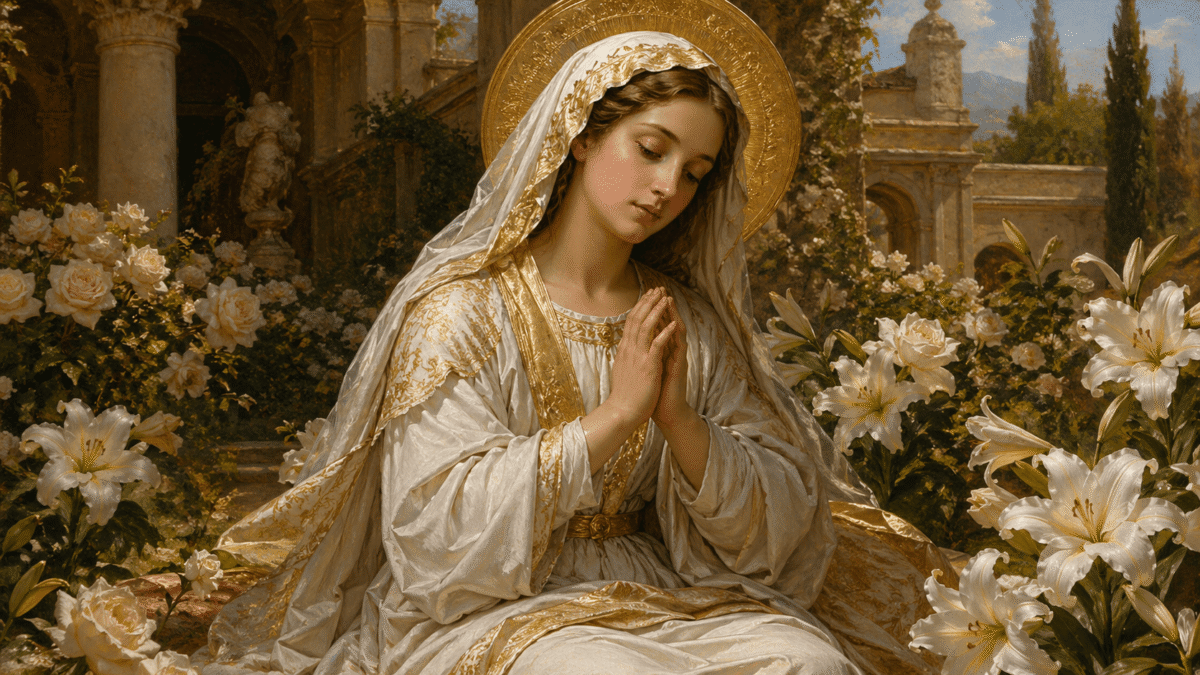
Beata quae credidisti, quoniam perficientur ea quae dicta sunt tibi a Domino.
Lk 1:45
Beata Quae Credidisti: The Feast of the Visitation of Mary to Elizabeth, celebrated on June 1 when May 31 coincides with the Solemnity of the Most Holy Trinity, is one of the richest in the Marian calendar. Lk 1:39-56 narrates, with extraordinary theological and literary density, the meeting of two pregnant women: Mary, who has just received the announcement of the Incarnation, and Elizabeth, who is already in the sixth month of her pregnancy with John the Baptist. This meeting, which the Fathers called the “encounter of the Messiahs”, is the moment when the grace of the Incarnation pours forth for the first time beyond Mary, the moment when the incarnate Word, still in Mary’s womb, makes Himself known to the precursor, John, still in Elizabeth’s womb. The Visitation is, in a profound sense, Mary’s first “mission”: she who received the gift of God goes out to meet one in need, becoming the first missionary of the incarnate Gospel.
I. The narrative of the Visitation: exegesis of the encounter
The title Beata Quae Credidisti (Lk 1:45) sums up the entire Lukan narrative: Mary’s faith becomes the principle of the evangelical beatitude.
The narrative of Lk 1:39-45 begins with a precise geographical indication: Mary “went in haste into the hill country, to a city of Judah” (Lk 1:39). The detail of the “haste” (meta spoudês) has been interpreted by tradition as an expression of Mary’s ardor to serve: she who has just received the greatest gift ever granted to a creature does not keep it for herself, but sets out at once to share it with her cousin in need. The “hill country of Judah” points to Ein Karem (according to tradition), about 150 km from Nazareth, a journey of several days on foot, which Mary undertakes “in haste”.
Mary’s arrival and her greeting to Elizabeth set off an event that Luke describes with precision: “When Elizabeth heard Mary’s greeting, the child leaped for joy in her womb, and Elizabeth was filled with the Holy Spirit” (Lk 1:41). The sequence is significant: first, Mary’s greeting. Then, the Baptist’s leap in Elizabeth’s womb. Finally, Elizabeth’s being filled with the Holy Spirit. John’s “leap” (eskirtêsen) is the prenatal recognition of the Messiah, a form of prophetic exultation that Luke links to the Holy Spirit. John, who will be the “precursor” who prepares the ways of the Lord, recognizes the Lord before he is born, with the only organ at his disposal: his body, which “leaps” for joy.
The formula Beata Quae Credidisti, Elizabeth’s exclamation (Lk 1:42-45), has the structure of a Jewish berakah, a blessing that proclaims the greatness of God through the greatness of the person blessed: “Blessed are you among women, and blessed is the fruit of your womb! How has it been granted to me that the mother of my Lord should come to me?” (Lk 1:42-43). The title “mother of my Lord” (hê mêtêr tou Kyriou mou) is theologically decisive: Elizabeth, filled with the Holy Spirit, recognizes in Mary not merely the mother of a human son, but the “Mother of the Lord”, which implies the recognition of the divinity of the son whom Mary carries. This inspired recognition, prior to the birth, prior to Jesus’ public life, prior to any proof or miracle, is the biblical foundation of the title Theotokos (Mother of God) that the Council of Ephesus (431) would define as dogma.
Verse 45, “Blessed are you for having believed, for what was spoken to you from the Lord will be fulfilled”, is the hermeneutical key to the Visitation. Elizabeth proclaims Mary blessed not for her biological motherhood, but for her faith: “quoniam credidisti”. This distinction is theologically crucial: Mary’s greatness does not lie primarily in the biological fact of having borne Jesus, but in the disposition of faith with which she received the announcement and said “fiat”. As Augustine would emphasize: “Mary conceived in faith before conceiving in the flesh”. The Visitation confirms this priority of faith over biology in Mary’s greatness.
II. “Exsultavit infans”: John the Baptist and the prenatal recognition
The blessing Beata Quae Credidisti also illuminates this dimension of Mariological meditation.
The “leap” of John the Baptist in Elizabeth’s womb (Lk 1:41, 44) is one of the most surprising gestures of the Lukan Infancy Gospel. Luke uses the verb skirtaô (to leap, to jump for joy), the same verb the LXX uses for calves that leap (Ps 29:6) and for lambs that frolic (Mal 3:20). This leap is not a mere physiological reflex; it is, in Luke’s reading, an act of prophetic recognition: John “leaps” because he recognizes the presence of the Messiah whom Mary’s voice announces. Mary’s first “preaching”, her greeting, provokes the Baptist’s first “response”, his prophetic leap.
Within the horizon of the Beata Quae Credidisti, the theology of John’s prenatal recognition has implications that tradition has developed in depth. First, it implies that John was sanctified while still in Elizabeth’s womb: tradition identified in this episode the “sanctification” of John before his birth, which explains why John can be celebrated as a saint for his own birth (June 24) and not only for his death. Second, it implies that Mary is the instrument of this sanctification: she who bears the Son of God becomes, by her mere presence and greeting, the vehicle of the grace that sanctifies the Precursor.
This mediating function of Mary, becoming a vehicle of Christ’s grace for others, is what contemporary Marian theology (in particular John Paul II and Benedict XVI) calls Mary’s “maternal mediation”. Not a mediation independent of Christ’s, but a mediation that flows from Christ’s and is wholly dependent on it, just as John’s leap is not independent of the presence of Jesus, but is precisely a response to that presence which Mary bears. The Visitation is thus the paradigmatic model of Marian mediation: Mary brings Christ. Christ, through Mary, transforms whoever receives her.
Patristic exegesis saw in John’s leap an anticipation of Baptism: just as Baptism is the sacrament through which Christ comes into contact with the soul and transforms it, John’s “leap” is the prenatal “baptism” through which contact with Christ-in-Mary’s-womb transforms John even before he is born. Ambrose of Milan wrote celebrated commentaries on this episode, emphasizing that “the Lord entered the house and John prophesied”: the presence of Christ, even hidden in His mother’s womb, is enough to awaken prophecy.
III. The Magnificat: a biblical theology of liberation
The canticle responds to the blessing Beata Quae Credidisti: Mary proclaims that faithful faith is the root of all the liberation wrought by God.
In the light of the Beata Quae Credidisti, the Magnificat (Lk 1:46-55), the canticle Mary intones in response to Elizabeth’s blessing, is one of the richest poetic and theological compositions of the New Testament. Its structure is that of an individual psalm of thanksgiving that opens onto a communal and eschatological dimension: it begins with Mary’s personal joy (“My soul magnifies the Lord, my spirit rejoices in God my Savior”, Lk 1:46-47), moves through her personal situation (“He has looked upon the humility of His servant”, Lk 1:48), and culminates in a panoramic vision of God’s action in history (“He has cast down the mighty from their thrones and exalted the lowly”, Lk 1:52).
The language of the Magnificat is densely Old Testament in character: at least 15 of its 10 phrases (the text has 80-90 words in Greek) have direct parallels in the Psalms, in Habakkuk, in Zephaniah, and above all in the canticle of Hannah (1 Sam 2:1-10). This saturation with biblical language is not mere literary erudition; it is the expression of the fact that Mary speaks from within the interiority of Scripture, which she “pondered in her heart” (Lk 2:19, 51). The Magnificat is proof that Mary was a woman profoundly formed by the Word of God, capable of articulating her personal experience in the language of Israel’s biblical tradition.
The theological core of the Magnificat is the proclamation of God’s action on behalf of the poor (Anawim) against the powerful: “He has scattered the proud in the thoughts of their hearts. He has cast down the mighty from their thrones and exalted the lowly. He has filled the hungry with good things and sent the rich away empty-handed” (Lk 1:51-53). This “eschatological reversal”, in which God acts contrary to the logic of human power, is the center of the biblical theology that the Magnificat synthesizes. Mary is not a passive observer of this reversal; she is its first beneficiary: “humbled” (without power, without status), she was “exalted” by the creative act of God, who chose her.
The reception of the Magnificat in the history of theology has been, and remains, extraordinarily diverse: from Luther, who commented on it as the “Evangelium in the Gospel”, to Latin American Liberation Theology (which found in it the program of a faith committed to the poor); from the monastic contemplation of Vespers (where it is recited daily) to feminist theology, which sees in Mary a woman who proclaims the subversion of oppressive structures. This diversity of readings is a sign of the inexhaustible richness of the text, not of its ambiguity, but of its depth.
IV. Mary and Elizabeth: two charisms in the economy of salvation
In both, though in different ways, the echo of the Beata Quae Credidisti resounds as a mutual recognition of the divine wonders.
The Visitation is the meeting not only of two persons, but of two “charisms”, two complementary modes of presence in the economy of salvation. Elizabeth represents Old Testament prophecy: she is the last of the women who conceived by divine miracle (in the line of Sarah, Rebekah, Rachel, and Hannah), and her son John will be the last of the prophets of Israel. Mary represents New Testament newness: she is the Virgin who conceives by the Holy Spirit, and her Son is the Messiah to whom all the prophets pointed.
The relationship between Elizabeth and Mary is not one of competition; it is one of complementarity and communion. Elizabeth, the elder, acknowledges the younger: “How has it been granted to me that the mother of my Lord should come to me?” (Lk 1:43). Symbolic precedence belongs not to the elder (Elizabeth) but to the younger (Mary), not for human reasons but for reasons of grace: what Mary carries infinitely transcends what Elizabeth carries, although both are gifts of God. This humility of Elizabeth, recognizing in Mary a greatness that surpasses her, is the model of the Christian attitude toward the Mother of God.
The three months that Mary remains with Elizabeth (Lk 1:56) are a seemingly secondary narrative detail, yet theologically significant. Mary stays with Elizabeth “until the birth” of the Baptist (probably): she who received grace does not keep it for herself, but stays with her cousin until the moment of greatest need, the delivery. This concrete, domestic, discreet service is the style of Marian charity: not great spectacular gestures, but the faithful presence that stays “to the end”. It is the same style we will find on Calvary: Mary, who stays beside the Cross to the very end.
Under the sign of the Beata Quae Credidisti, the Visitation also reveals the contemplative-active dimension of Mary that tradition has always emphasized. Mary is not only the contemplative of the Fiat; she is also the active woman who sets out “in haste” to serve. But her activity is not detached from contemplation: she carries Christ with her while she serves Elizabeth. This balance between contemplation and action, not as tension but as unity, is the model of Marian spirituality that the Visitation manifests in an exemplary way. Mary acts because she contemplates. Her action is fruitful because what she carries with her is the very Son of God.
V. The Visitation as a model of Christian mission
Every Christian mission prolongs Mary’s gesture and hears Elizabeth’s Beata Quae Credidisti addressed to itself.
The missionary dimension of the Visitation has been emphasized by the recent Magisterium. John Paul II, in Redemptoris Mater (1987), developed the image of Mary as the first “missionary”: just as she brought Christ to Elizabeth and to the Baptist even before he was born, Christians are called to bring Christ to the world through the witness of their lives. Mary’s “missionary go”, setting out “in haste” to meet the other, is the model of all evangelization: not waiting for others to come, but going out to meet them, bringing the gift one has received.
The theme of “evangelization” through presence and service, rather than through verbal proclamation, is particularly timely in a culture in which the credibility of words has been eroded. Mary evangelized Elizabeth not with a theological discourse, but with her greeting, with her presence, which bore Christ. The most effective “mission” is often that of simple human contact which, because it is inhabited by grace, transforms whomever it meets. This silent, hidden, domestic mission, the style of the Visitation, is the most universally accessible form of evangelization.
In this perspective of the Beata Quae Credidisti, the spirituality of the Christian Life Communities (CLC) and of many movements of Marian spirituality found in the Visitation the model of “contemplative charity”: social and charitable action motivated and nourished by the contemplation of Christ. To be a “visitor” in the evangelical sense is not to be a social worker with humanistic motivations; it is to be a bearer of Christ to the other, aware that what transforms the other is not our human competence but the presence of God who dwells in us. This distinction between “evangelical charity” and “philanthropy” is not spiritual elitism; it is realism about the source of truly lasting transformations.
The religious congregation of the “Visitandines”, founded by Francis de Sales and Jane de Chantal in the seventeenth century, took the Visitation as its founding charism: charitable visits to the poor and the sick, inspired by the model of Mary visiting Elizabeth. Over the centuries, this charism evolved toward cloistered contemplation, but the origin remains: Mary’s Visitation is the archetype of all Christian charity that visits, serves, and brings Christ to those who are “in the hill country” of human life.
VI. The Feast of the Visitation: history and liturgical meaning
The liturgical feast perpetuates the Beata Quae Credidisti as an antiphon of the Church’s faithful faith.
The Feast of the Visitation was introduced into the Latin liturgy by the Franciscan Saint Bonaventure, who proposed it for the Franciscan Order in 1263. The motivation was partly ecumenical and political: the feast was meant to obtain, through the intercession of Mary, the end of the Western Schism (which had been going on since 1378). Urban VI extended it to the universal Church in 1389, and Pius X fixed it definitively on July 2, where it remained until the liturgical reform of Paul VI (1969), which transferred it to May 31, to close the Month of Mary and link the Visitation to the cycle of the Incarnation (between the Annunciation on March 25 and the Nativity of John the Baptist on June 24).
In the light of the blessing of the Beata Quae Credidisti, the date of May 31 has a clear liturgical logic: Mary visits Elizabeth in the “sixth month” of Elizabeth’s pregnancy (Lk 1:26), which, counted from the conception of John the Baptist (celebrated at the September equinox, by liturgical convention), coincides approximately with the end of March, exactly when the Church celebrates the Annunciation (March 25). The Visitation would therefore fall in the following weeks, which the date of May 31, two months after the Annunciation, reasonably approximates.
When May 31 coincides with a Solemnity (such as the Most Holy Trinity in 2026), the Visitation is transferred to June 1, the first available day. This transfer does not diminish the importance of the feast. Rather, it recalls that the solemnities of the Lord take precedence over the feasts of Mary, which is theologically correct: Mary always exists in relation to Christ, never in competition with Him. The Visitation that “waits” a day to be celebrated is itself an expression of Mary’s style: she who serves, she who waits, she who places the Son above herself.
The liturgical meaning of the Visitation as the close of the cycle of the Incarnation points to one of the deepest insights of Luke’s theology: the Incarnation is not a private event between Mary and God; it is an event that, from the very first instant, pours outward, goes out to meet the world, and makes those who receive it “leap” for joy. Mary setting out “in haste” for the hill country is the image of grace that does not remain closed in on itself but overflows to others. This continuing “visitation”, God’s love that always goes out to meet humanity, is the heart of the Gospel that the Feast of May 31 (or June 1) celebrates with joy.
Mary, setting out “in haste” for the hill country, carrying the Son of God in her arms and her joy in her heart, is the oldest and most eloquent image of Christian mission: grace received is not kept; it overflows into the encounter with the other, becoming a source of life for those who receive it.
References
- John Paul II, Redemptoris Mater, nos. 12-19 (1987).
- Second Vatican Council, Lumen Gentium, no. 57 (1964).
- Ambrose of Milan, Expositio Evangelii secundum Lucam II, 19-26.
- R. Brown, The Birth of the Messiah (1977).
- I. de la Potterie, Maria nel mistero dell’Alleanza (1988).
Postgraduate Program in Mariology
Would you like to deepen your formation in Mariology? Discover the Postgraduate Program in Mariology from Locus Mariologicus — an academic formation that unites theological rigor, spiritual life, and the living tradition of the Church.



Responses