Vos estis sal terrae: Mary, a Discreet Presence That Transforms
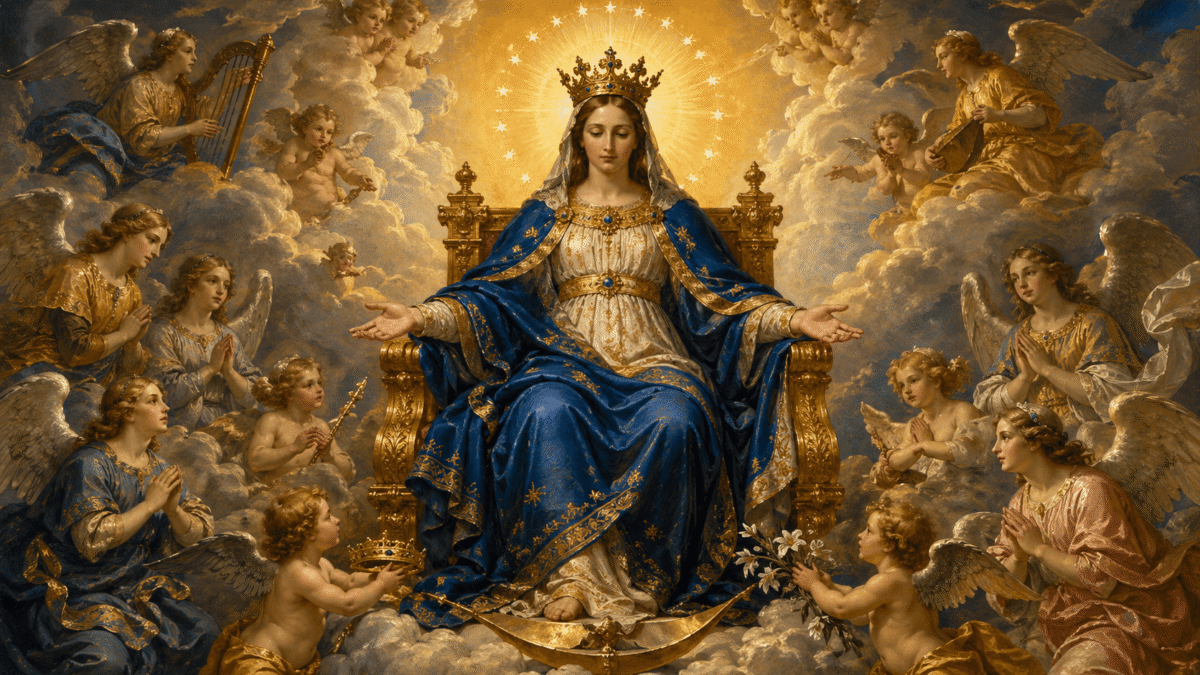
Vos estis sal terrae. Quod si sal evanuerit, in quo salietur?
Mt 5:13
Vos Estis Sal Terrae: With the beginning of Ordinary Time after the Solemnity of the Most Holy Trinity, the liturgy sets out on the long road of everyday Christian life. The Sermon on the Mount, which Matthew places at the beginning of Jesus’ ministry as His “magna carta,” opens with the Beatitudes (Mt 5:1-12) and continues with two images of great poetic density: “You are the salt of the earth” and “You are the light of the world” (Mt 5:13-14). Mary, who lived the Beatitudes in their fullest form (the “blessed” one par excellence, as Elizabeth proclaimed), is also the model of the “salt” and the “light” that Jesus asks of His disciples: a presence that transforms without imposing, that illuminates without dazzling, that gives flavor without overpowering the flavor of others.
I. Salt: A Symbol of Preservation and of Flavor
The Marian Vos Estis Sal Terrae illuminates this dimension.
In the ancient world, salt was at once an agent of preservation, a condiment that gave flavor, and a symbol of covenant and purity. Preservation by salt (the salting of food) was the only way to keep food for long periods without refrigeration; salt was literally the difference between life and death in times of scarcity. Its liturgical use in the Old Testament (Lev 2:13: “you shall not fail to put salt on your offerings”) linked it to the purity of worship and to faithfulness to the covenant.
Jesus applies this image to the disciples: “You are the salt of the earth.” The expression “of the earth” (tês gês) is global: not only “of this community” or “of this synagogue,” but of the whole inhabited earth. The disciples are called to exercise a “preserving” and “seasoning” function in human life in all its breadth: to preserve the flavor of humanity against the corruption of evil, and to give savor to human life with the joy of the Gospel. This universal vocation is demanding: it is not possible to be “salt” only in religious settings or in the private sphere.
Jesus’ warning, “if the salt loses its flavor, how can it be salted again?”, points to a real threat. The salt that “loses its flavor” (môranthê, which in Greek also means “to become foolish,” from the same root as môros, stupid) is the disciple who, by adapting completely to the world, loses what set him apart and made him useful. The “insipidity” of the salt is the metaphor for the “worldliness” of discipleship: when the Christian life becomes indistinguishable from non-Christian life, it loses its capacity to transform, to preserve, and to give flavor.
For centuries, the liturgy of Baptism used the gesture of placing a grain of salt in the mouth of the person being baptized, symbolizing the gift of “wisdom” and the call to be “salt of the earth.” This gesture, abolished in the liturgical reform but restored in the extraordinary form, gave visible expression to the theology of Mt 5:13: in Baptism, the Christian is called not only to receive grace for himself, but to become an agent of preservation and of flavor in the life of the world.
II. The Light of the World: Visibility That Guides
The Marian Vos Estis Sal Terrae illuminates this dimension.
The second image, “You are the light of the world” (Mt 5:14), complements the first. Salt acts through direct contact, in an almost invisible way. Light acts at a distance, in a visible way. The disciple is called to be both: the salt that transforms through discreet contact and the light that guides through public visibility. The “city set on a hill” that “cannot be hidden” (Mt 5:14) is the image of communal witness: the Church as a visible community whose consistency in a life according to the Gospel is in itself a guiding sign for the world.
“No one lights a lamp to put it under the bushel basket, but on the lampstand, so that it gives light to all who are in the house” (Mt 5:15). This domestic image, the “lampstand” of the family home, is significant: light is not only for great public spaces, but for the “house.” Christian life begins in the domestic and family setting before radiating out into the public sphere. It is in the closest relationships (family, friendship, work) that the Christian first exercises the function of “light.”
Jesus’ practical conclusion (Mt 5:16) is direct: “So let your light shine before men, that they may see your good works and glorify your Father who is in heaven.” The purpose of Christian visibility is not self-promotion; it is the glorification of the Father. The disciple “shines” not in order to be admired himself, but so that those who see him may be directed toward God. This distinction, between the witness that points to God and the performance that points to oneself, is one of the most reliable criteria of authentic discipleship.
III. Mary as Salt and Light: The Style of Discretion
The Marian Vos Estis Sal Terrae illuminates this dimension.
Mary is the most perfect model of “salt” and “light” as Jesus describes them. She is salt: her presence, discreet, silent, almost invisible in the Gospels, is decisive at the crucial moments. At the Wedding at Cana (Jn 2:1-12), she “perceives” the need before any explicit request and acts effectively, transforming the situation without drama. On Calvary (Jn 19:25-27), her “salting” presence, which preserves against despair, is the silent gift that John receives when he is given to her as a son. Mary “salts” the history of salvation with her faith, her silence, and her persistence: not with great speeches, but with her simple, faithful presence.
She is also light: “Blessed are you among women” (Lk 1:42); Elizabeth’s proclamation points to Mary’s “luminous” function. But Mary, unlike those who shine for themselves, immediately redirects the light to God: “My soul magnifies the Lord” (Lk 1:46). The Magnificat is the paradigm of the “light” that refuses to shine for itself and points to the source of all brightness: God, who “has looked upon the humility of his handmaid” (Lk 1:48). Mary does shine, for otherwise she would not be the “sign” that the Book of Revelation describes (Rev 12:1: “a woman clothed with the sun”); but her brightness is a reflection, not a source.
Mary’s “discreetness” in the Gospels has been noted by exegetes: she appears only a few times, speaks even less, and never puts herself at the center. But in the moments when she does appear (the Annunciation, the Visitation, Cana, Calvary, the Upper Room), her presence is always decisive. This “discreetness” is not marginality; it is the style of the salt that acts from within, not from without, and of the light that guides without dazzling. Marian spirituality has learned from this discreetness: not a visibility that forces itself on others, but a presence that serves.
IV. “Not Losing Flavor”: Fidelity as a Permanent Challenge
The Marian Vos Estis Sal Terrae illuminates this dimension.
Jesus’ warning about the salt that “loses its flavor” has a direct Marian application: Mary is the model of the fidelity that does not “evaporate” with time and hardship. From the Annunciation to Calvary, a journey of thirty years that included incomprehension (Mt 12:46-50), suffering (Lk 2:35: the “sword that will pierce your soul”), and apparent loss (the Cross), Mary kept the “flavor” of her initial faith. She did not “lose her flavor” in the difficulties she encountered. On the contrary, her “salt” became more concentrated, purer, and more effective as it was tested.
The temptation to “lose flavor” (to dilute the faith to make it more acceptable to the world, to adapt the Gospel to cultural expectations, to replace the radicalness of the “fiat” with the comfort of compromise) is a permanent one in the history of the Church. Mary, who remained beside the Cross when the disciples fled, who went on believing when everything seemed to contradict belief, is the figure of the fidelity that is not diluted by adversity. Her “salt” did not evaporate; it withstood the fire of trial.
Contemplating Mary as “salt of the earth” and “light of the world” is an invitation to a demanding path: to be a disciple is not only to receive grace; it is to let that grace transform us in such a way that we in turn become agents of transformation. Salt that does not salt and light that does not illuminate are useless by the measure of the Gospel. The question that Mt 5:13-16 puts to every Christian is this: what flavor do I bring to the world? What light do I cast? The way to answer this question passes through Mary, who neither lost her flavor nor hid her light under the bushel basket of timidity or conformism.
Mary, the discreet salt who preserved the faith of Israel and gave flavor to the history of salvation, is the model of the disciple who does not lose flavor even when the world rejects him: faithful, humble, yet indelibly present in the lives of all who receive her.
References
- Second Vatican Council, Lumen Gentium, no. 58 (1964).
- John Paul II, Redemptoris Mater, nos. 20-24 (1987).
- U. Luz, Das Evangelium nach Matthäus, vol. I (1985).
- W. D. Davies / D. C. Allison, Matthew, vol. I (ICC, 1988).
Postgraduate Program in Mariology
Would you like to deepen your formation in Mariology? Discover the Postgraduate Program in Mariology of Locus Mariologicus — an academic formation that unites theological rigor, spiritual life, and the living tradition of the Church.
Would you like to study Mariology seriously?
This article grows out of the works in the Locus Mariologicus library. The Postgraduate Program in Mariology takes you to the same source, with academic guidance: Scripture, the Fathers of the Church, and the Magisterium, from the first dogma to contemporary questions.



Responses