Messis quidem multa operarii autem pauci: Anthony, Mary, and the Reapers of the Lord
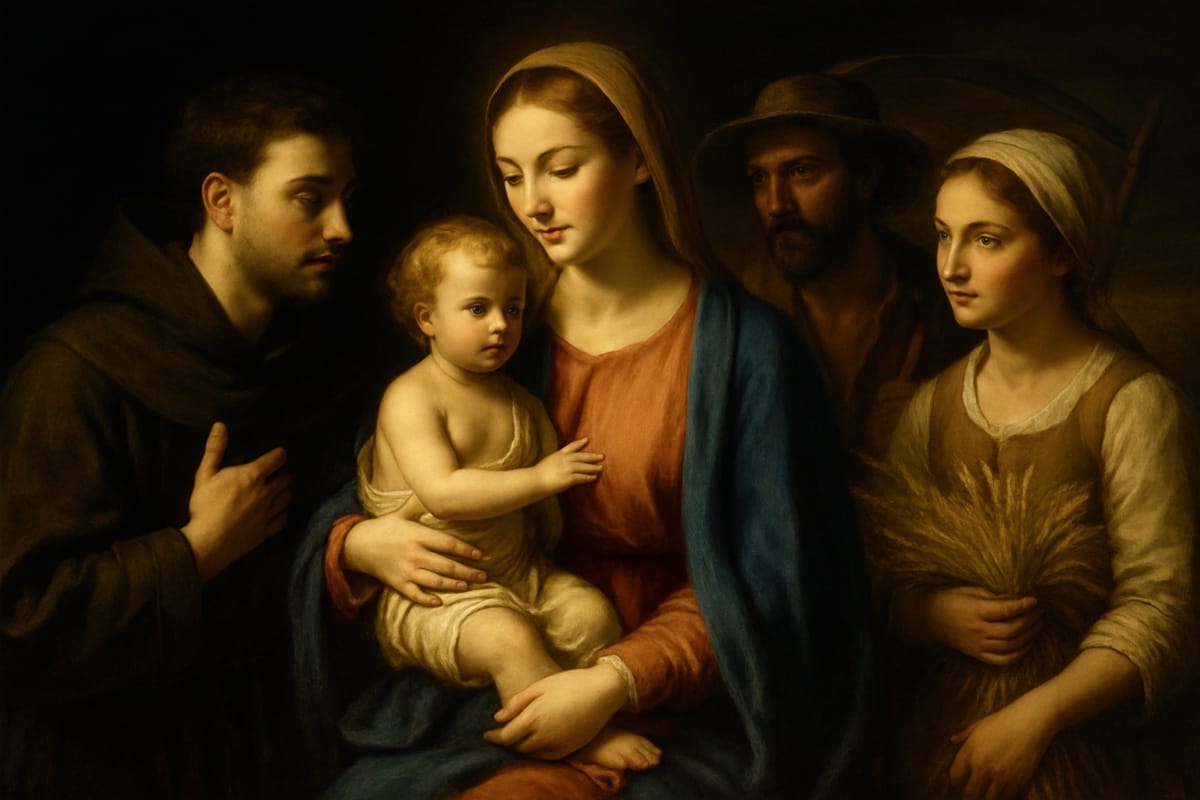
Messis quidem multa, operarii autem pauci. Rogate ergo Dominum messis ut mittat operarios in messem suam.
Lk 10:2
The Memorial of Saint Anthony of Padua, celebrated on June 13, the day of his death in 1231, and made official within a year of his death, honors one of the most beloved figures in the history of the Church. Fernando Martins de Bulhões, born in Lisbon around 1195 into a noble family, was first an Augustinian canon regular in Coimbra and then a Franciscan Friar Minor, moved by the martyrdom of the first Franciscan martyrs of Morocco in 1220. His extraordinary theological talent, unusual in an Order that in its first generation was distrustful of learning, led Francis of Assisi to authorize his theological teaching with the famous letter: “To my brother Anthony, my bishop: it pleases me that you teach sacred theology.” Canonized in 1232, only 352 days after his death, the fastest process in history, he was declared a Doctor of the Church by Pius XII in 1946 with the title Doctor Evangelicus.
The Gospel of this feast belongs to the sending discourse to the seventy-two disciples (Lk 10:1-9): the broadest mission that Jesus organizes beyond the Twelve. The urgency of the harvest, “the harvest is great, the laborers are few,” justifies the radical character of the missionary style proposed: no purse, no bag, no spare sandals, trusting only in God’s providence and in the hospitality of the households. Anthony lived this style. Mary inaugurated it at the Visitation.
I. Anthony of Padua: The Evangelical Doctor
The title Doctor Evangelicus, “Evangelical Doctor,” given to Saint Anthony is not merely honorific: it describes his specific charism. Anthony was the theologian at the service of evangelization, not evangelization at the service of an academic career. His Sermons, which have come down to us in critical editions and are studied by theologians and historians of medieval theology, combine impressive erudition (patristics, nascent scholasticism, allegorical exegesis) with an uncommon gift for communicating with ordinary people. He preached in squares and marketplaces with the same theological depth that others reserved for university chairs.
His devotion to Mary was central to his life and his preaching. Anthony’s Sermons contain Mariological reflections of great richness, from a time before the scholastic systematization of Mariology. He preached Mary as “Ark of the New Covenant,” as “Star of the Sea,” as “Gate of Heaven,” images that the liturgy and the Marian tradition preserve to this day. The best-known iconography of Anthony, with the Child Jesus in his arms, arose from a hagiographical episode, but it expresses the center of his spirituality: Christ mediated by Mary, the Son whom the mother shows to the world.
Anthony’s charism as the “saint of lost objects,” one of the most universal popular devotions in Catholicism, has a theological root that transcends physical objects. In his sermons and in his pastoral activity, Anthony was the one who sought and found the “lost sheep” of the Gospel: the sinners whom the religious society of his time had cast aside, those estranged from the ecclesial community, those who lived on the margins of the moral and social order. His preaching was famous for converting the most hardened. His reputation as a “seeker of the lost” expresses, in popular language, a profoundly evangelical charism.
II. The Harvest and the Urgency of Mission
The image of the ripe harvest in Lk 10:2 evokes an agricultural urgency that Jesus transfers to mission: a harvest that is ripe must be gathered at once, or it is lost. There are people ready to receive the Gospel now, who need laborers now. The prayer that Jesus asks for, “pray the Lord of the harvest to send out laborers,” is at once an admission of human insufficiency (it is not we who choose the missionaries; it is the Lord) and a call to availability (whoever prays for the mission becomes a candidate to be sent).
The “Lord of the harvest” (Kyrios tou therismou) is an image with Old Testament roots: Yahweh is the owner of the land and of its fruits. In New Testament eschatology, the “harvest at the end of time” (Mt 13:30, 39) is the final judgment, in which the Lord gathers His elect. The sending discourse of Lk 10 belongs within this theology: mission is an anticipated participation in the eschatological action of God, who gathers His people. Anthony, who preached with eschatological urgency, understood this dimension: the conversion of sinners is not only a work of mercy in the present; it is a preparation for the definitive harvest.
Anthony’s missionary style, traveling through northern Italy and southern France and preaching in villages, marketplaces, and public squares, corresponds exactly to the discourse of Lk 10: a mission “going forth,” which goes where people are and does not wait for them to come to the temple. Pope Francis, in Evangelii Gaudium (2013), described the “Church going forth” using images that Anthony had anticipated eight centuries earlier: going out to meet the existential peripheries, preaching at the “crossroads” of culture, not reserving the Gospel for those who already know it.
III. Mary, the First Laborer in the Harvest
Mary’s Visitation to Elizabeth is the archetype of every “sending” of which Lk 10:1 speaks. Mary is sent, not explicitly by the angel, but by the impulse of the love she has received, into the hill country of Judah to serve and, without explicitly knowing it, to evangelize. She is the first of the “seventy-two”: she goes “with haste” (meta spoudes), without purse or program, trusting only in her cousin’s welcome. Her mission is discreet and domestic, but its effects are extraordinary: the prenatal sanctification of John the Baptist, the Magnificat, Elizabeth’s recognition of the Theotokos.
The logic of the Marian mission, grace received that overflows into freely given service to others, is the fundamental law that Lk 10 describes and that Anthony lived. Mary had no plan of evangelization. She had the Son of God in her womb and love in her heart, and that was enough to transform everything she touched. This logic of overflowing, grace that cannot be contained within us and overflows to others, is the fundamental law of authentic Christian mission, prior to any pastoral plan or communication strategy.
Anthony’s Marian devotion found concrete expression in his attention to the poor and the marginalized, whom he identified with Mary’s favored ones (according to the Magnificat: “he has filled the hungry with good things and sent the rich away empty-handed”). The “harvest” of which Jesus speaks is gathered above all among the poor and the little ones. Neither Anthony nor Mary turned preferentially to the powerful. The mission that both of them lived, freely given, to the poor, out of love, is the criterion that Lk 10 proposes for all authentic evangelization.
IV. The Saint of the Lost: A Theology of Mercy
Popular devotion to Saint Anthony as the “saint of lost objects,” one of the oldest and most universal in the Catholic tradition, expresses in immediate language a profound theological confidence: God, like the father in the parable of the two sons (Lk 15:11-32), never gives up on what has been lost. Prayer to Anthony for those who are “lost” in faith, in vices, in relationships is the expression of this confidence: that there is always a “laborer” whom God has sent to find what had been lost.
This theology of mercy has its ultimate root in Mariology. Before Anthony, Mary is the “seeker of those who are lost” in the Catholic tradition. The Salve Regina, probably from the eleventh century, invokes Mary as “advocata nostra,” she who pleads for those in danger. And the final supplication, “show us Jesus, the blessed fruit of your womb,” is precisely the request to be “found” by the merciful gaze of the Son through the mediation of the Mother. Anthony prolongs, in time and space, this Marian mission of seeking the lost and showing them to Jesus.
The feast of Saint Anthony is a celebration of grace that seeks before it is sought, a mercy that does not wait for the lost to return but goes to find them where they are. This proactive mercy, the “great harvest” that the Lord wishes to gather and for which He sends His laborers, has in Mary and in Anthony its two most eloquent icons in the Western Christian tradition. And Jesus’ command remains timely: “Pray the Lord of the harvest to send out laborers into his harvest,” and may we ourselves be the laborers whom He sends.
Postgraduate Program in Mariology
Would you like to deepen your formation in Mariology? Discover the Postgraduate Program in Mariology of Locus Mariologicus — an academic formation that unites theological rigor, spiritual life, and the living tradition of the Church.
Would you like to study Mariology seriously?
This article grows out of the works in the Locus Mariologicus library. The Postgraduate Program in Mariology takes you to the same source, with academic guidance: Scripture, the Fathers of the Church, and the Magisterium, from the first dogma to contemporary questions.



Responses