Vinum novum in utres novos: Mary, the New Wine, and the New Wineskins
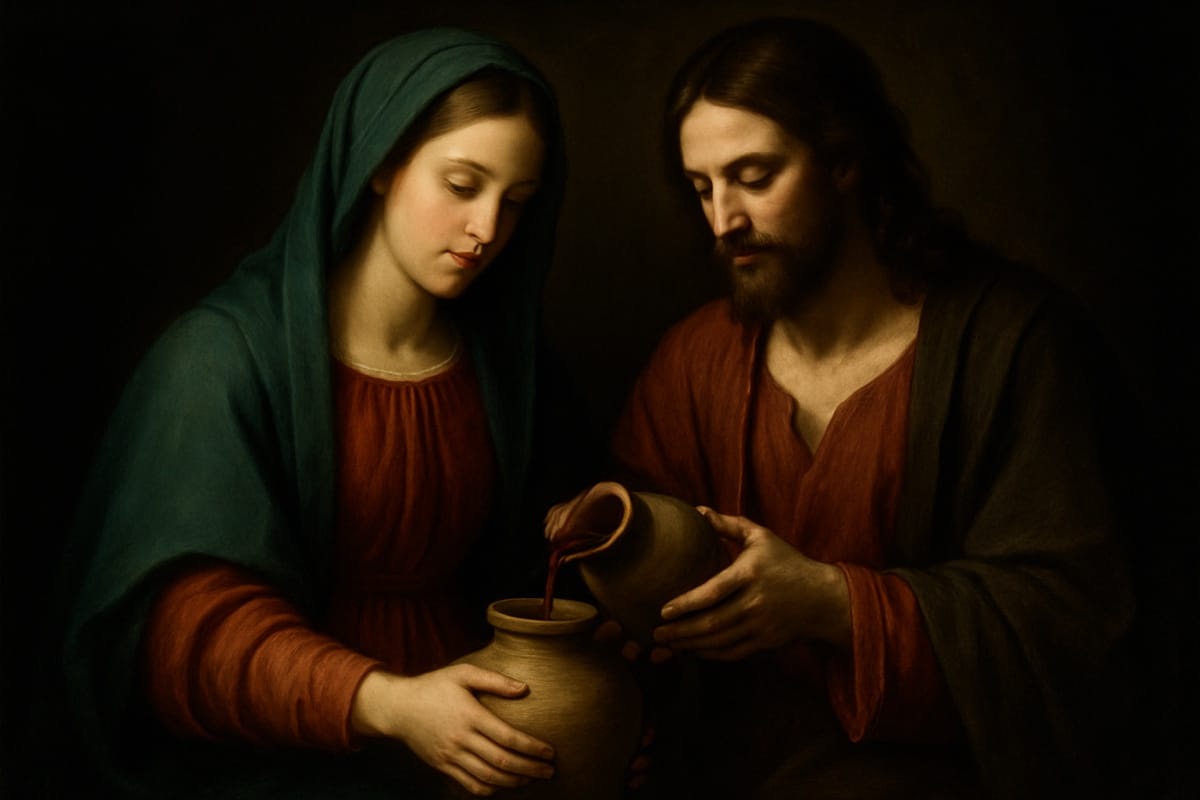
Nemo mittit vinum novum in utres veteres. Alioquin rumpuntur utres, et vinum effunditur, et utres pereunt: sed vinum novum in utres novos mittunt, et ambo conservantur.
Mt 9:17
The Saturday of the Twelfth Week in Ordinary Time is, in the liturgical tradition, Our Lady’s Saturday, the day on which, since at least the twelfth century, the Latin Church has dedicated the last day of the liturgical week to the memory of Mary. The Gospel pericope for this Saturday, Mt 9:14-17, on the fasting of the disciples and the new wineskins, offers a surprisingly rich hermeneutical key for understanding the Marian charism: Mary as the “new wineskin” that was able to hold the “new wine” of the Incarnation.
The question put by John’s disciples, “why do your disciples not fast?” and Jesus’ answer in three images (the wedding guests, the old/new patch, the new wine/old wineskins) describe the nature of the new time inaugurated by the presence of Jesus. Fasting is a sign of expectation and of mourning. The presence of the Bridegroom turns mourning into feasting. A new patch on an old cloth would destroy both. New wine in old wineskins would burst both. The newness of the Gospel, the grace that Jesus brings, cannot simply be “patched” onto the old structures: it demands new vessels, a new availability, a new heart.
I. The Disciples’ Fasting: Joy and the Nuptial Time
Jesus’ answer to the question about fasting, “can the wedding guests be sad while the bridegroom is with them?” (Mt 9:15), is one of the most veiled yet most significant self-declarations in the Gospel of Matthew. Jesus implicitly identifies Himself with the Bridegroom, an identification that the Old Testament tradition reserved for Yahweh in relation to Israel (Hos 2:16-22; Jer 2:2; Ezek 16; Song of Songs). By presenting Himself as the Bridegroom whose presence excludes mourning, Jesus claims for Himself the relationship that the prophets described between God and His people.
The nuptial image has an immediate Mariological significance: in the patristic and medieval tradition, Mary is the “Bride” who received the “Bridegroom” at the Annunciation. The patristic interpretation of the Song of Songs as a description of the relationship between the Logos and the human soul in general, and Mary in particular, developed by Origen, Bernard of Clairvaux, and the Carmelite tradition, sees in the fiat the Bride’s response to the Bridegroom who knocks at the door. In this context, the Marian Saturday as a day of nuptial joy, not of fasting, has a precise theological coherence: it is the day on which the relationship between the Bridegroom and His first and perfect Bride is celebrated.
The somber note that Jesus adds, “the days will come when the Bridegroom will be taken away from them, and then they will fast” (Mt 9:15b), introduces the paschal dimension: the joy of following Christ is real but not exempt from the Cross. The “nuptial time” of Jesus’ public life ends on Calvary. The disciples’ fasting begins with the death of Jesus and the experience of abandonment on Holy Saturday. Mary lived this Holy Saturday, the day between the death and the Resurrection, in a singular way: tradition contemplates Mary on that day as the one who, unlike the disciples, kept the faith alive. The Marian Saturday is therefore also the day of Holy Saturday: the vigil of waiting for the Resurrection.
The alternation between feasting and fasting, between the time of the Bridegroom and the time of His absence, describes the rhythm of the Christian spiritual life that the mystical tradition has identified as “consolation and desolation.” Ignatius of Loyola’s instruction on spiritual desolation, “make no changes to the decisions that were made in the time of consolation,” is precisely the answer to the time of fasting: to remain faithful to what one committed to in the time of joy, knowing that consolation will return. Mary is the model of this fidelity in desolation: Holy Saturday was her time of greatest fasting, and she remained.
II. New Wineskins for New Wine: Interior Renewal
The image of new wineskins for new wine is one of the metaphors most frequently used in the Christian tradition to describe the need for interior renewal as the condition for receiving the new gifts of the Spirit. The “old wineskins” are the hardened interior structures, the certainties that close us off, the habits that prevent surprise, the prejudices that filter reality before encountering it. The “new wine” is grace, the gift of the Spirit, the newness that God wishes to introduce into personal and communal history. The condition for the new wine not to burst the wineskins is the renewal of interior availability.
The history of the Church shows that resistance to renewal, attachment to the “old wineskins” of cultural, liturgical, theological, and institutional forms, has been one of its recurring temptations. The Second Vatican Council was explicitly described by its protagonists as an effort to create “new wineskins,” new forms of ecclesial life that could hold the “new wine” of the Gospel in a radically new age. Resistance to Vatican II on the part of some sectors of the Church is, theologically, the resistance of the “old wineskins” that prefer the already fermented wine to the newness of the Spirit.
The contemporary Charismatic Renewal, the movements of renewal in the Spirit that emerged in the second half of the twentieth century, saw its own vocation in the image of the “new wineskins”: to create communities of faith with new forms (charismatic prayer, personal testimony, participatory liturgy) that could hold the outpouring of the Spirit the movement was experiencing. Evaluating these movements by the criteria of Art70 (the fruits) is the correct way to discern: where the “new wineskins” produce fruits of love, service, and conversion, the wine is authentic. Where they produce division, spiritual arrogance, and flight from ordinary responsibilities, the “wineskins” may be new, but the wine is doubtful.
In the spiritual tradition, the interior renewal that the image of the wineskins describes is the fruit of continual conversion, the permanent metanoia that prevents spiritual hardening. Ignatius of Loyola, in the Examination of Conscience that he proposed as a daily practice, aimed at precisely this: a daily awareness of interior movements, of subtle hardenings, of nascent resistances, so that the “wineskins” do not harden before the “wine” has finished fermenting. The Marian Saturday, as a day of reflection on the week that has passed, has an analogous function: awareness of the “wineskins” that have hardened during the week and that need to be renewed before the week that is beginning.
III. Mary as the New Wineskin: Total Availability
Mariology uses the image of the new wineskins to describe the uniqueness of Mary’s availability for the Incarnation. The Fathers of the Church, particularly Epiphanius of Salamis (fourth century), described Mary as the “pure vessel” who was able to hold the Word of God because she was entirely available, without interior resistances, without hardenings of selfishness or sin. The doctrine of the Immaculate Conception gives theological articulation to this intuition: Mary was preserved from original sin, from the structural hardening that affects human freedom, precisely in order to be the “new wineskin” capable of holding the “new wine” of the Incarnation.
This image does not imply that Mary was passive or that her availability was automatic. The theologians who have insisted on the freedom of the fiat (Duns Scotus, Hans Urs von Balthasar, John Paul II in Redemptoris Mater) emphasize that Mary’s availability was a free response, not a necessity of nature. Mary’s “new wineskins” were not merely a precondition for the Incarnation: they were the fruit of a life of growing availability, of fidelity to the motions of the Spirit, of active love that made her heart ever more capable of receiving the greatest gift.
In this context, Saturday Marian devotion has a precise spiritual function: it is the day on which the faithful ask Mary to help them “renew the wineskins,” the interior availability that the week may have hardened. The weariness, frustrations, disappointments, and sins of the week may have created resistances and hardenings that prevent the reception of the “new wine” of the approaching Sunday. Contemplating Mary as the “new wineskin” is an invitation to renew one’s availability: “just as Mary said yes, ask her to help you say yes to what the Lord wants to bring into you.”
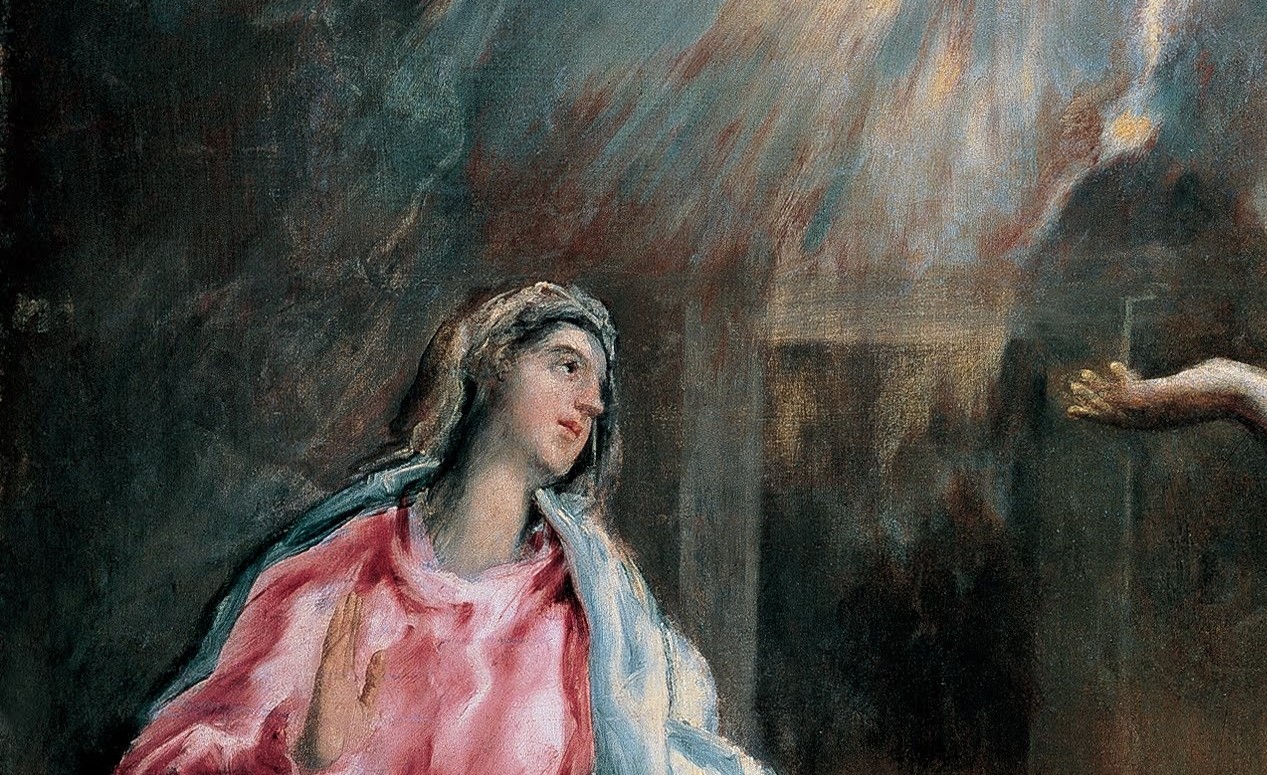
The angel’s words at the Annunciation, “full of grace” (kecharitomene: the perfect passive participle indicates a fullness of grace that is received and permanent), describe Mary precisely as the wineskin that grace filled completely, with no room for emptiness. The “new wine” of the Incarnation found a wineskin capable of holding it because that wineskin was filled with the prior grace that had prepared it. Marian spirituality invites the faithful to ask for the same grace: not the immediate fullness that Mary had, but progressive growth in the availability that makes it possible to receive more and more of the “new wine” that the Lord wishes to give.
IV. The Marian Saturday: Contemplating the Mother of the New Wine
The historical origin of the Marian Saturday goes back to the twelfth century, with the spread of Marian devotion promoted by Bernard of Clairvaux and the Cistercians. The tradition, consolidated by the Mass of the Blessed Virgin Mary on Saturday, introduced by Alcuin in the ninth century and made widespread in the twelfth, sees Saturday as the day on which Mary “kept the faith,” the Saturday between the death and the Resurrection when the disciples doubted and Mary remained. In this sense, the Marian Saturday is the day of persevering faith, of active waiting, of the “dark night” that precedes the dawn of Sunday.
The contemplation of Mary on Saturday has an eschatological dimension: Mary is already in the fullness of the Resurrection; the doctrine of the Assumption affirms that she is already with the Risen One in body and soul. The Marian Saturday is therefore the contemplative anticipation of what Sunday affirms: the victory of life over death, the fullness of the “new wine” in which Mary is already immersed. To contemplate Mary on Saturday is to contemplate the end toward which the Christian life is journeying: the fullness of grace that she already possesses and that the disciple still awaits.
The Liturgy of the Hours on Saturday has a specific tone: the Saturday evening hymns, such as the Ave Maris Stella and the Salve Regina at Compline, express a trusting surrender of the end of the day and of the week to Mary, who “keeps watch” over those who sleep in the peace of God. This nocturnal trust in Mary, the mother who stays awake while her children sleep, has a biblical root in the episode of Gethsemane: the disciples slept while Jesus was in agony. Mary, though not physically present in that garden, was spiritually present, awake in faith, like the sentinel of Ps 130 who “waits for the Lord more than the watchman waits for the dawn.”
The “new wine” that Sunday’s liturgy will celebrate, the blood of Christ poured out in the Eucharist, the “fruit of the vine” transfigured at the Supper, has in Mary its “new wineskin” par excellence. The Sunday Eucharist is the “new wine” that the “new wineskins” of the faithful need to be ready to receive. The Marian Saturday is the preparation of these wineskins: the day on which, through the contemplation of Mary, the heart is renewed in availability, in silence, in waiting for the Resurrection that Sunday will bring. The believer who arrives at Sunday with “renewed wineskins” can receive the “new wine” in all its fullness, and that is the gift for which Mary, the mother of the new Wine, intercedes on behalf of all her children.
Postgraduate Program in Mariology
Would you like to deepen your formation in Mariology? Discover the Postgraduate Program in Mariology at Locus Mariologicus – an academic formation that unites theological rigor, spiritual life, and the living tradition of the Church.
Would you like to study Mariology seriously?
This article grows out of the works in the Locus Mariologicus library. The Postgraduate Program in Mariology takes you to the same source, with academic guidance: Scripture, the Fathers of the Church, and the Magisterium, from the first dogma to contemporary questions.




Responses