Elizabetha peperit filium: John the Baptist, Mary, and the Joy of the Forerunner
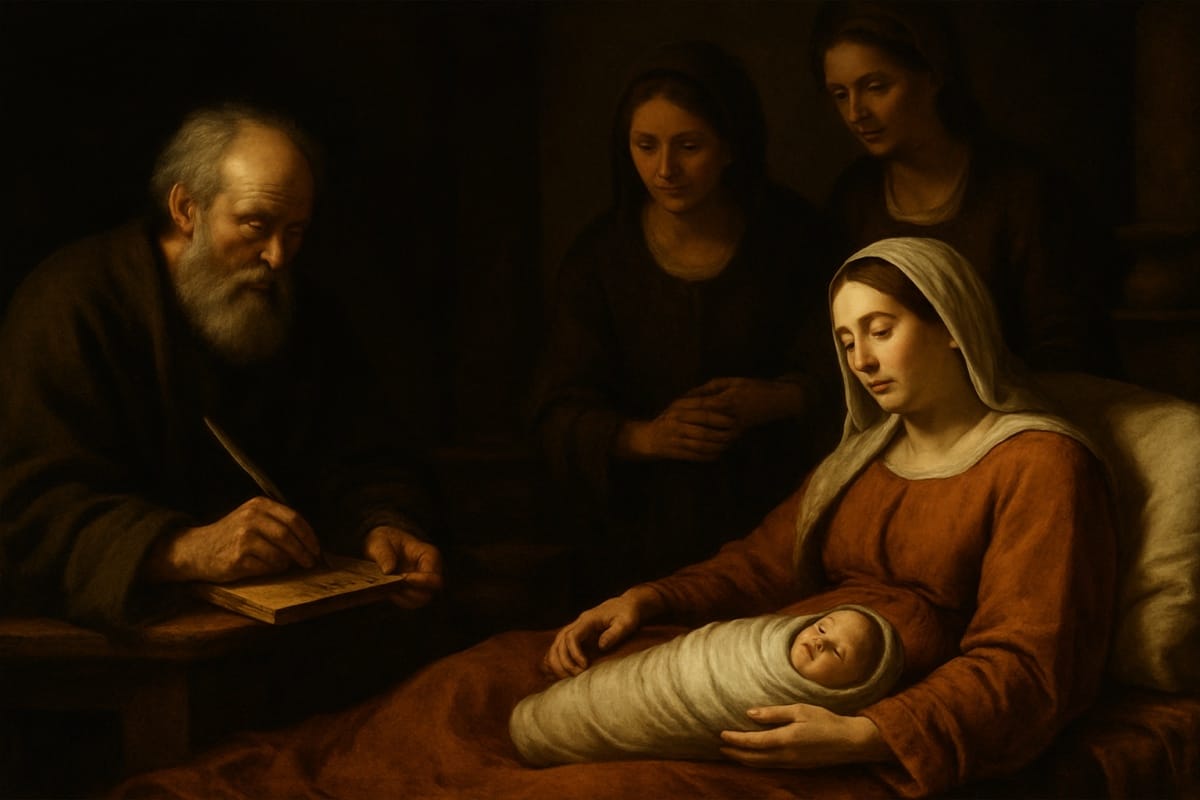
Elizabetha autem impletum est tempus pariendi, et peperit filium. Et audierunt vicini et cognati eius, quia magnificavit Dominus misericordiam suam cum illa, et congratulabantur ei.
Lk 1:57-58
The Solemnity of the Nativity of Saint John the Baptist (June 24) is one of the oldest feasts of the Christian calendar, already celebrated in the fourth century, and one of the rare occasions on which the Church celebrates the birth of a saint and not only his martyr’s death. The uniqueness of John the Baptist among all the saints lies precisely here: his birth is itself a saving event, the immediate preparation for the coming of Christ. The account in Lk 1:57-66, 80 narrates his birth, his circumcision, and the giving of the name “John,” a name given by God and confirmed when Zechariah recovered from his muteness. The joy of the neighbors and relatives, the wonder at the child upon whom “the hand of the Lord was,” and his growth in the wilderness until the day of his manifestation to Israel: these are the elements of a narrative that Luke composes in deliberate parallel with the narrative of the infancy of Jesus.
The connection with Mary is constitutive of Luke’s narrative of John’s infancy: the Visitation (Lk 1:39-56) precedes John’s birth and is the context in which John receives his first sanctification: “when Elizabeth heard the greeting of Mary, the child leaped for joy in her womb” (Lk 1:41). John’s first “testimony” to Jesus took place before either of them was born: John recognized the presence of the Messiah in Mary’s womb before any verbal revelation, through the leap of joy that Lk 1:44 explicitly attributes to the Holy Spirit. Mary was the vehicle through which John received his mission before he was born, and this priority of Marian mediation marks the whole theology of the Forerunner.
I. “Elizabetha peperit filium”: The Joy of an Improbable Birth
Elizabeth was “barren and advanced in years” (Lk 1:7), and in the biblical world barrenness was not merely a medical condition but a situation of social dishonor and apparent abandonment by God. The biblical pattern of grace springing up where nature has failed runs through the whole history of salvation: Sarah (Gen 11:30 → Gen 21), Hannah, the mother of Samuel (1 Sam 1), the mother of Samson (Judg 13), the Shunammite woman (2 Kgs 4). In each case, barrenness is the dark background against which God’s grace appears with greater clarity: God does not need favorable conditions in order to act; He acts precisely where human conditions are unfavorable, so that the glory may be recognized as His.
In this context, John’s birth is not only Elizabeth’s joy but the public manifestation that “the Lord had magnified his mercy toward her” (Lk 1:58, emegas kyrios to eleos autou met’ autes). God’s “mercy,” the Hebrew hesed, the loyal love that does not abandon, was made concretely manifest in Elizabeth’s womb. The neighbors and relatives “rejoiced with her”: the joy that begins in one womb overflows into the community. This structure, personal grace that becomes communal joy, parallels the structure of the Visitation: Mary received the grace of the Annunciation and immediately went to share it with Elizabeth. Elizabeth received the grace of John’s birth, and immediately the community rejoiced with her.
The analogy between the birth of John and the birth of Jesus is deliberate in Luke. Both are announced by Gabriel (Lk 1:19 to Zechariah; Lk 1:26 to Mary). Both are characterized as works of the Holy Spirit (Lk 1:15, 35). Both are welcomed with a joy that reaches beyond the parents (Elizabeth, Mary, neighbors, shepherds, magi). Luke draws a careful parallel to emphasize that John and Jesus are inseparable, not rivals but complementary: John prepares what Jesus accomplishes; the “voice” prepares the way for the “Word.”
The “magnificat” that Mary sang at the Visitation (Lk 1:46-55) anticipated John’s birth in the language of praise: “he has shown strength with his arm… he has filled the hungry with good things… he has helped his servant Israel.” Mary celebrated John’s coming in advance, because John is part of the plan that Mary’s “yes” had made possible. There is no John the Baptist without Mary: it was through Mary’s presence that John leaped for joy in Elizabeth’s womb and received his mission.
II. “His Name Is John”: The Identity That God Gives
The episode of the naming (Lk 1:59-63) is narratively crucial: the family wanted to call the child “Zechariah,” after his father, in keeping with the tradition of perpetuating the family name. Elizabeth insists: “No, he shall be called John” (Lk 1:60). The relatives’ objection, “none of your kindred has this name” (1:61), reveals what is at stake: the name is identity, belonging, continuity with the family and with tradition. To give John a name without precedent in the family is to break with that continuity and to open oneself to a new identity, given from outside, by God Himself.
“John,” Iōhannēs, a transliteration of the Hebrew Yōhānān: “YHWH is gracious” or “YHWH has granted mercy.” The Forerunner’s name is in itself a theology in miniature: he who prepares the coming of the Messiah bears a name that announces the grace the Messiah will bring. The name is not decorative; it is vocational. John is “gracious” because he is the bearer of the grace he announces. He is the “merciful one” because his ministry consists in preparing the hearts of those who will receive God’s mercy incarnate in Jesus.
Zechariah recovers his voice at the moment he confirms the name (Lk 1:63-64): “His name is John,” and immediately “his mouth was opened and his tongue loosed, and he spoke, praising God.” Obedience to God’s will, manifested in the acceptance of the name God had chosen, restores the capacity to communicate that disobedience (the doubt of Lk 1:18-20) had silenced. The parallel with the call of Moses (Ex 4:10-12: “I do not know how to speak”; “I will open your mouth”) is deliberate: the Forerunner is, like Moses, the one whose voice God uses as His instrument to prepare the liberation of His people.
The link to the name of Jesus is parallel: the name “Jesus” was likewise given by Gabriel before the birth (Lk 1:31; Mt 1:21), not chosen by the parents but given by God. “Jesus,” Iēsous, a transliteration of Yēshûa’: “YHWH saves.” The Savior’s name announces the salvation He will accomplish. Mary received her Son’s name and accepted it: the fiat includes the acceptance of the name, which is the acceptance of the identity and mission of the Son she was to carry. Just as Zechariah accepted “John” and recovered his voice, Mary accepted “Jesus” and became the “voice” that sang of Him in the Magnificat.
III. “The Hand of the Lord Was with Him”: A Vocation from Birth
Lk 1:66b, “and the hand of the Lord was with him,” is the divine assessment of the newborn John: the blessing that precedes every human response, the grace that is present before any merit. John is sanctified from his mother’s womb (Lk 1:15: “he will be filled with the Holy Spirit, even from his mother’s womb”), which the theology of the following centuries would articulate as a “prenatal sanctification,” analogous to, but of a lower degree than, Mary’s Immaculate Conception.
John’s prophetic vocation “from his mother’s womb” (Lk 1:15; cf. Is 49:1; Jer 1:5) places him in the long line of prophets who were called before they were born. This priority of the divine call over any human response is central to the biblical theology of election: it is not John who first chooses God; it is God who first chooses John. Grace precedes freedom. Election precedes response. Mary was the first to understand this bodily: her womb was the place where God’s grace became flesh, before any response from John, before any public announcement, in the silence of the meeting between the two wombs.
“He grew and became strong in spirit, and he was in the wilderness until the day of his manifestation to Israel” (Lk 1:80): John’s formation takes place in the wilderness, in anonymity, in silence. John’s “manifestation” (Lk 1:80: anadeixis, “solemn public appearance”) at the Jordan (Lk 3:1-20) will be preceded by decades of hidden formation. The same pattern applies to Jesus: He “grew in wisdom, in stature, and in grace before God and men” (Lk 2:52) during the thirty years at Nazareth. And the same pattern applies to Mary: Mary’s “formation,” in the Law of Israel, in the prayer of the Psalms, in meditation on the Scriptures, preceded the fiat and made it possible.
John’s preaching at the Jordan, “Prepare the way of the Lord, make his paths straight” (Lk 3:4, quoting Is 40:3), is the public expression of the mission contained in his name: to prepare hearts to welcome the Savior. But this preparation began earlier, at the Visitation, when Mary arrived at Elizabeth’s house and the child leaped for joy. Mary was the first “preparer” of the Forerunner: her visit sanctified John before his birth, prepared the preparer, and anointed the herald with the oil of the presence of Jesus in her womb.
IV. Mary and John: The “Voice” and the “Word”
Bernard of Clairvaux, in his celebrated Sermo in Adventu Domini, developed the distinction that John himself proposed in Jn 1:23 (“I am the voice of one crying in the wilderness”): John is the “voice,” Jesus is the “Word.” The “voice” precedes the “Word”; there is no audible “Word” without the “Voice” that carries it. There is no John without the Jesus whom he announces. But the “Voice” is not the “Word”: the “Voice” passes away and the “Word” remains. John himself declared: “He must increase, but I must decrease” (Jn 3:30).
Mary stands at the center of this relationship between Voice and Word: she is the one who holds the Word in her womb and who, by her presence, is the cause of the Voice’s joy before his birth. The Visitation is the event in which the Voice (John in Elizabeth’s womb) is awakened to his mission by the presence of the Word (Jesus in Mary’s womb). Mary is the vehicle through which the Word awakens the Voice. Without Mary, there is no Visitation. Without the Visitation, there is no prenatal sanctification of John. Without prenatal sanctification, there is no Forerunner. Without the Forerunner, the “Word” arrives at an unprepared heart.
The Nativity of John the Baptist is, therefore, a profoundly Marian feast: John cannot be separated from Mary, because it was through Mary that he received the grace that made him the Forerunner. The liturgical tradition, which places this solemnity in June, six months before Christmas, underscores this connection: John precedes Jesus by six months, just as the Visitation precedes the Nativity by six months. The liturgical calendar keeps a parallel count: what took place in Elizabeth’s womb six months before what took place in Bethlehem anticipates in the temporal structure what it announces in the theological structure.
The feast of John the Baptist invites every Christian to reflect on his or her own role as a “voice that prepares for the Word” in the hearts of those with whom he or she lives. Like John, every Christian is called to be a forerunner, to prepare in others the disposition to welcome the Gospel. And as with John, this mission is not self-initiated: it begins when Mary draws near, when the Gospel arrives through another, when the presence of Christ in a brother or sister awakens in the heart the joy that recognizes the Savior. Mary is the “occasion” of John’s joy: her nearness awakens what the Spirit had already placed in the heart that awaited her.
Postgraduate Program in Mariology
Would you like to deepen your formation in Mariology? Discover the Postgraduate Program in Mariology of Locus Mariologicus, an academic formation that unites theological rigor, spiritual life, and the living tradition of the Church.
Would you like to study Mariology seriously?
This article grows out of the works in the Locus Mariologicus library. The Postgraduate Program in Mariology takes you to the same source, with academic guidance: Scripture, the Fathers of the Church, and the Magisterium, from the first dogma to contemporary questions.




Responses