Modicae fidei: Mary, the Storm, and the Faith That Does Not Sink
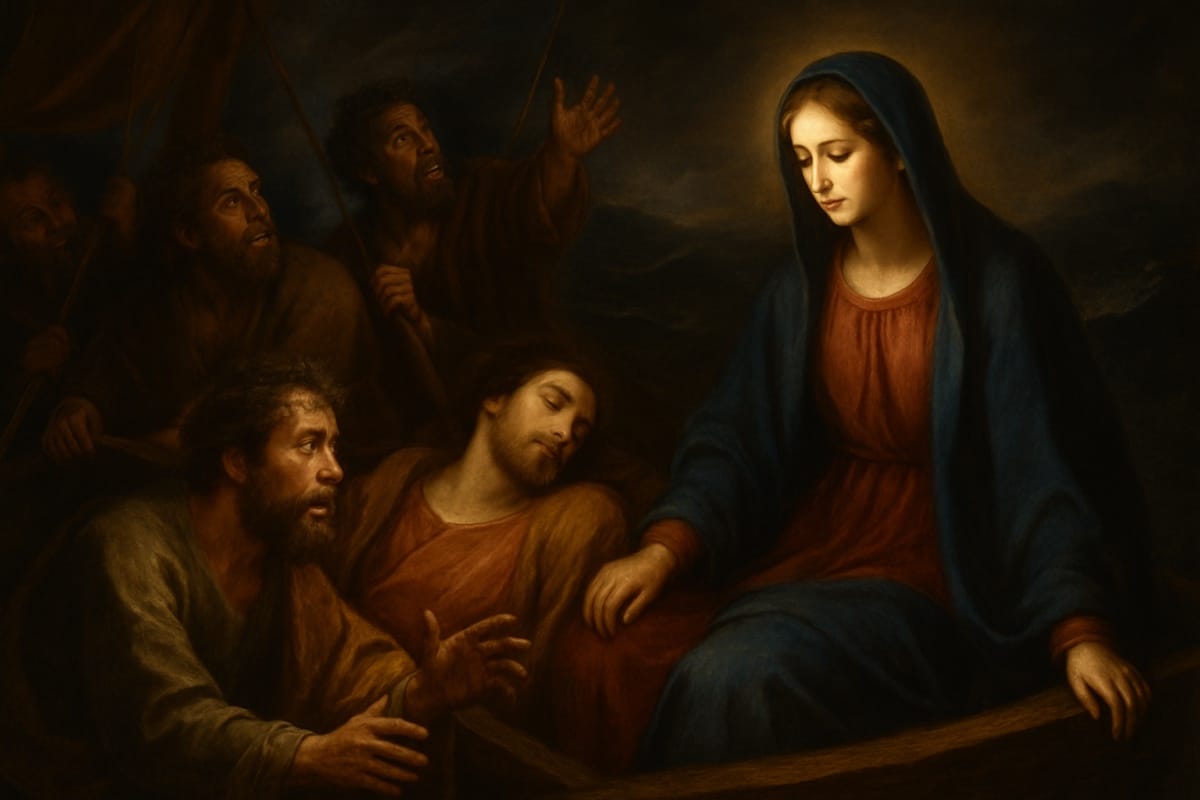
Et dicit eis: Quid timidi estis, modicae fidei? Tunc surgens imperavit ventis et mari, et facta est tranquillitas magna.
Mt 8:26
The calming of the storm (Mt 8:23-27) is one of the miracles richest in symbolic resonances in the whole Gospel of Matthew. The boat tossed by the waves, the disciples in a panic, Jesus asleep, and the plea that wakes the Lord: “Lord, save us, we are lost!” (Mt 8:25). The sequence is at once a miracle narrative and a parable of the Christian life: the boat is the Church, the storm is the tribulations of history, Jesus’ sleep is the apparent absence of God in times of crisis, and the disciples’ cry is the prayer of those who still have enough faith to cry out, even if it is the “small” faith that Jesus rebukes.
Jesus’ reproach, “modicae fidei,” “man of little faith” (Mt 8:26, singular in Greek: “you of little faith”), is surprising: Jesus rebukes before He calms. The order of the sentence is theologically significant: first the question about faith, then the act of power. It is not that Jesus rejects those who have “little faith”; as the case of the epileptic’s father in Mt 17:20 shows (“if you have faith the size of a mustard seed”), “little faith” is more than enough to begin with. The problem is not the amount of faith but what “small faith” failed to see: that the one sleeping in the boat was the Lord of the storms.
I. The storm and fear: faith put to the test
“A violent storm arose on the sea, so that the waves were covering the boat. Jesus was asleep” (Mt 8:24): the image of the boat covered by the waves, with Jesus sleeping, is one of the most vivid in the Gospel. The boat that “is covered” by the waves is technically sinking; the Greek verb kalyptesthai suggests submersion. The disciples were not excessively afraid: the boat was objectively in danger of sinking. The difference between their fear and the faith Jesus asks for is not the difference between one who sees the danger and one who does not: it is the difference between one who sees the danger and does not see who is in the boat, and one who sees the danger and sees Who is in the boat.
In the biblical imagination the sea is the realm of chaos, of threat, of the uncontrollable. Genesis begins with “the Spirit of God was moving over the waters,” the divine Spirit ordering the primordial chaos. The Psalms describe God as the one who “rules the pride of the sea. When its waves rise, You calm them” (Ps 89:10). When Jesus “rebukes the winds and the sea” with a simple word, He is doing exactly what the God of Israel does in the Psalms: bringing order to chaos. The disciples who “were amazed” were not merely amazed at a meteorological miracle; they were witnessing the Creator exercising authority over creation.
The sequence “fear of the storm” → “cry for help” → “Jesus’ rebuke” → “calm” → “amazement” is the pattern of the prayer of petition in times of tribulation. Fear is not a sin; it is the natural response to real danger. The cry for help is not a lack of faith; it is the minimal expression of faith: one still believes there is someone to cry out to. Jesus’ rebuke is not rejection but education: “why did you doubt?” is not a condemnation but a teaching question that opens the way to a deeper understanding of what is in the boat.
Mary went through her most violent “storm” on Calvary, the moment when the boat of all her hope seemed covered by the waves of death. But Mary, unlike the disciples, who slept in Gethsemane and fled, stayed at the foot of the Cross, the equivalent of crying “Lord, save us” when all seemed lost. Mary’s faith in the “storm” of Calvary was not the faith that sees the imminent miracle: it was the faith that remains even without seeing the miracle, the faith that “sets its face” (Lk 9:51) and stays when the others have fled.
II. “Maria stella maris”: the star that guides the boat
The title “Stella Maris,” Star of the Sea, is one of the oldest Marian titles in the Latin liturgy, popularized by the ninth-century hymn “Ave Maris Stella” (possibly from the seventh century) and taken up by the devotion of medieval sailors. The image is astronomical before it is Mariological: the pole star, which remains fixed in the sky while the other stars turn, is the point of reference that allows the navigator to find his bearings in the midst of a storm. Mary is “Stella Maris” because she remains fixed, in faith, in discipleship, in love for the Son, when everything around her moves and threatens.
The tradition of the “Ave Maris Stella” developed the image: “guide the sure steps of those who sail, so that, seeing Jesus, we may rejoice with Him.” Mary is not the harbor of arrival; she is the star that points to the harbor. “Seeing Jesus” is the goal. “Stella Maris” is the means of orientation when the storm makes it impossible to see the harbor directly. This orienting function, not a substitute but an aid, is the correct theological structure of Marian devotion: Mary points to Christ as the pole star points to the north, without being the north or claiming its function.
The Galilean fishermen who were in the boat with Jesus knew the storms of the Lake of Gennesaret well, a lake set among mountains that can produce sudden, violent storms when the wind comes down from the hills. Their experience as sailors did not save them from fear. The presence of Jesus sleeping in the boat did not save them from fear. What saved them was the act of waking Jesus, the cry for help that turned fear into prayer. Mary is the “Stella Maris” who teaches seafarers caught in a storm to wake Jesus, to turn fear into a cry for help that receives an answer.
The Church as a “boat,” the “navis Ecclesiae” of early Christian art, with its mast in the shape of the Cross, is an image that the calming of the storm nourished for centuries. The catacombs of Rome are full of images of boats under sail, a symbol of the Church sailing toward the heavenly harbor across the stormy sea of history. Mary on board the boat, as she was in the Cenacle when the Church was officially born, is the maternal presence that does not pilot the boat but that, through her prayer, keeps up the bond with the Son, who can calm the storms that threaten to cover the boat.
III. The boat of the Church in the storms of history
The history of the Church is the history of a boat that has survived storms that seemed final. The Roman persecutions of the first centuries, the Arianism that threatened to dissolve orthodox Christology, the Schism of the eleventh century, the Reformation of the sixteenth century, the Enlightenment and the revolutions of the eighteenth and nineteenth centuries, the totalitarian regimes of the twentieth century: each of these storms was a moment when reasonable observers could conclude that the boat was “covered by the waves.” And each time, the promise of Mt 16:18 (“the gates of the Abyss shall not prevail against it”) was confirmed: the boat did not sink.
This survival is not an argument for institutional self-sufficiency: it is a sign of the presence of the Risen One who, as in the boat on the Lake of Gennesaret, seems to be asleep but is not absent. The internal crises of the Church, the scandals, the divisions, the infidelities, are the equivalent of the “waves that cover the boat” coming from within, not only from without. The Christian response to these crises is neither despair nor denial: it is the same cry for help as that of the disciples, “Lord, save us, we are lost!”, which acknowledges the danger without abandoning faith in the one who is in the boat.
Marian devotion in times of ecclesial crisis has precisely this function: Mary as “Stella Maris” is the point of orientation when internal storms make it hard to see the north. The history of the great saints who founded religious orders, who invariably had a strong Marian devotion, shows that the relationship with Mary was not a pious ornament but a spiritual resource in the most difficult moments. Bernard of Clairvaux, Francis of Assisi, Ignatius of Loyola, Louis Grignion de Montfort: all of them passed through their internal and external storms with Mary as the “Stella Maris” who guided them toward the Son.
“Modicae fidei,” “you of little faith,” is the reproach that Jesus addresses to those who, in the boat of the Church, see only the storm and forget Who is in the boat. Mary’s answer to “modicae fidei” is not the suppression of fear (which is human and real) but the redirection of attention: from this storm that you see, turn your eyes to Him who is stronger than the storm. “Be great of heart,” the Augustinian formulation of the desire for God, is the spiritual translation of Jesus’ invitation: not “stop being afraid” but “look at Who is in the boat before you give in to fear.”
Postgraduate Program in Mariology
Would you like to deepen your formation in Mariology? Discover the Postgraduate Program in Mariology of Locus Mariologicus, an academic formation that unites theological rigor, spiritual life, and the living tradition of the Church.
Would you like to study Mariology seriously?
This article grows out of the works in the Locus Mariologicus library. The Postgraduate Program in Mariology takes you to the same source, with academic guidance: Scripture, the Fathers of the Church, and the Magisterium, from the first dogma to contemporary questions.



Responses