Dominus est enim sabbati: The Lord of the Sabbath, and Mary Who Kept Holy Saturday.
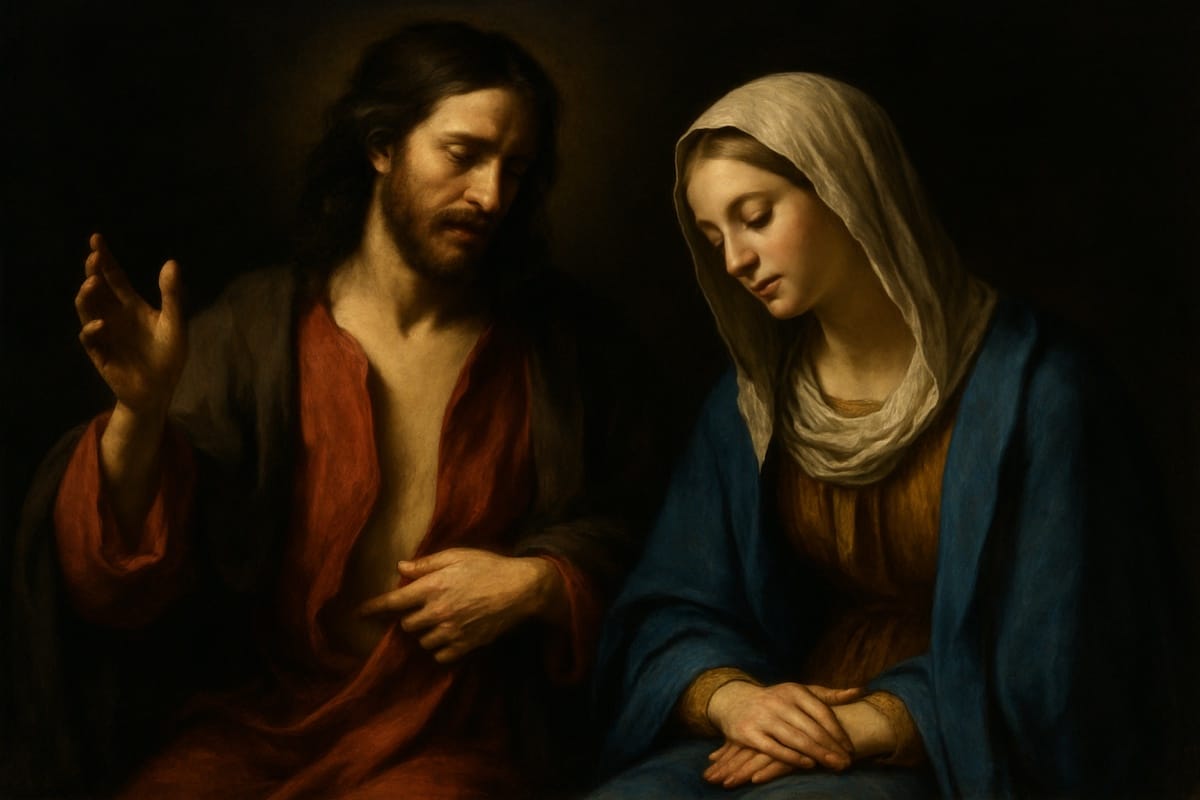
Misericordiam volo et non sacrificium. Si autem scissetis quid est: Misericordiam volo et non sacrificium, numquam condemnassetis innocentes. Dominus est enim Sabbati Filius hominis.
Mt 12:7-8
Mt 12:1-8 narrates the first of the Sabbath controversies in the Gospel of Matthew: the disciples of Jesus pluck ears of grain as they pass through the fields on the Sabbath, and the Pharisees accuse them of violating the precept of Sabbath rest. The response of Jesus is threefold: a biblical argument (David and the bread of the Presence), a cultic argument (the priests who work in the Temple on the Sabbath), and a central Christological affirmation, “The Son of Man is Lord of the Sabbath” (Mt 12:8). This affirmation is one of the most significant of the public ministry of Jesus: it not only reinterprets the Sabbath but claims authority over the Sabbath law, the authority of the one who instituted the Sabbath.
The citation of Hos 6:6, “I desire mercy, and not sacrifice” (Mt 12:7, cited also in Mt 9:13), is the hermeneutical key that Jesus offers for the correct understanding of the Sabbath: the Sabbath law is at the service of mercy, not the other way around. The Pharisees, by “condemning the innocent” (the hungry disciples who plucked ears of grain), inverted the hierarchy: they placed ritual observance above human need. Jesus restores the correct hierarchy: mercy has precedence over sacrifice, and whoever does not understand this “has not understood” (Mt 12:7) the meaning of the very Torah he cites.
I. “Have You Not Read What David Did”: The Arguments of Jesus
“Have you not read what David did when he was hungry, he and his companions”? (Mt 12:3). The first argument of Jesus is the precedent of David (1 Sam 21:1-6): the king anointed by God ate the “bread of the Presence” (reserved exclusively to the priests, Lev 24:5-9) because he was hungry. David’s need justified the violation of the ritual law. In the same way, the disciples’ need justifies the plucking of ears of grain on the Sabbath. The logic is not that the ritual laws have no value, but that they are not absolute when they come into conflict with genuine human need.
“Have you not read in the Law that on the Sabbath the priests in the Temple violate the Sabbath and are innocent”? (Mt 12:5). The second argument is even more direct: the Mosaic Law itself requires priestly work on the Sabbath (the daily sacrifices of the Temple do not cease on the Sabbath, cf. Num 28:9-10). The priests “violate” the Sabbath because there is something greater than the Sabbath, the service of the Temple. Jesus concludes: “I tell you that something greater than the Temple is here” (Mt 12:6). If the service of the Temple justifies the Sabbath work of the priests, how much more does the service of Him who is greater than the Temple justify what the disciples do.
“You would not have condemned the innocent if you had understood: I desire mercy, and not sacrifice” (Mt 12:7). The citation of Hosea is the central point: Hos 6:6 places “mercy” (hesed, faithful love, loyalty) above “sacrifice” (ritual worship). This hierarchy does not reject worship but orders it: worship is at the service of faithful love, not faithful love at the service of worship. The Pharisees inverted the hierarchy; they made worship (the observance of the Sabbath) an obstacle to faithful love (caring for those who are hungry).
II. “The Son of Man Is Lord of the Sabbath”: The Christological Affirmation
“The Son of Man is Lord of the Sabbath” (Mt 12:8). This affirmation is the most direct claim of authority by Jesus over the Torah in the synoptic Gospels. “Lord of the Sabbath” implies not only interpretive authority (like a rabbi who gives his exegesis of the Sabbath law) but constitutive authority, the authority of the one who established the Sabbath. In the context of Matthew’s theology, the affirmation is equivalent to that of the Sermon on the Mount: “I say to you” (Mt 5:22, 28, 32, 34, 39, 44). Jesus does not cite authorities but speaks with His own authority.
The Sabbath was established by God on the seventh day of creation (Gen 2:2-3) as a sign of the covenant (Ex 31:13-17). The “Lord of the Sabbath” is, in this sense, the Lord of creation and the Lord of the covenant. The claim of Jesus is Christological in the deepest sense: He is the Creator who established the Sabbath and who therefore has the authority to interpret it authentically, to reveal what the Sabbath always meant but which the interpretive tradition had obscured.
Christian theology associated the Sabbath with the “eschatological rest,” the “eternal sabbath” that the authors of the New Testament (especially the Letter to the Hebrews) announce as the goal of the Christian pilgrimage. Jesus, as “Lord of the Sabbath,” is the Lord of eschatological rest, the One who can give the “rest” promised in Mt 11:28-29 because He is the Creator who established the sabbath rest as an anticipation of eternal rest.
III. Mary and Holy Saturday: The Faith That Waits
There is a special Sabbath in the history of salvation, the Sabbath between the death and the resurrection of Jesus: the great Holy Saturday, the day on which the body of Jesus rested in the tomb and the disciples were scattered in fear and mourning. Theological tradition (developed above all by Hans Urs von Balthasar and Louis Bouyer) has reflected on this Sabbath as the “sabbath of faith,” the moment in which God seems absent, the moment in which faith has no visible confirmation, the moment in which the disciple is called to wait without seeing.
The unanimous tradition of the Gospels presents Mary at Calvary (Jn 19:25) but not in the appearances of the Risen One, not because Mary did not see the Risen One, but because the Gospels present the paschal revelation as a surprise for all the disciples, including those who were closest to Him. On Holy Saturday, between the death and the resurrection, Mary kept the faith that the others had lost. It is the conviction of Marian devotion, which sees in the “Saturday of Our Lady” (the liturgical Saturday as a Marian day) the memory of this Holy Saturday on which Mary remained faithful.
The “fidelity of Mary on Holy Saturday” has a specific Mariological dimension: Mary, who received the “fiat” at the beginning of the Son’s life, remained faithful to the end, including at the moment when the Son was dead and buried. The “Lord of the Sabbath” rested in the tomb. Mary kept the Sabbath of faith, waiting, without seeing, for what the Lord of the Sabbath had promised. The spirituality of the Sabbath as “faithful waiting” has in Mary its perfect model.
IV. The Mercy That Does Not Sacrifice: The Teaching for Ecclesial Life
“I desire mercy, and not sacrifice.” The citation of Hos 6:6 that Jesus uses to reinterpret the Sabbath is also the hermeneutical principle for all liturgical and ecclesial life. Worship, the “sacrifice,” is at the service of “mercy,” not the other way around. The Christian community that gives priority to ritual observance over attention to the concrete needs of its members repeats the error of the Pharisees of Mt 12: it “condemns the innocent” by placing the law above love.
Reflection on this principle has practical implications for parish and community life: the liturgical structures, the schedules, the traditions, the pious practices, everything must be evaluated in the light of “I desire mercy, and not sacrifice.” Not in order to abolish the structures (Jesus did not abolish the Sabbath) but in order to keep them ordered to their end: the service of mercy, the building up of the community of love, availability to those who are in need.
Mary embodied this principle at the Visitation: she arose “with haste” (Lk 1:39) to go to meet Elizabeth, without hesitating on account of social conventions or of her own needs. Mercy had precedence over the “sacrifice” of comfort. And at Calvary, she remained standing beneath the Cross. The “mercy” that stays close to the suffering of the Son prevailed over the “sacrifice” of fleeing to protect herself from sorrow. Mary, who “desires mercy,” lived the principle of Hos 6:6 before Jesus enunciated it, and for this reason she is the model of the authentic interpretation of the commandment of love that lies at the heart of the Torah.
Postgraduate Program in Mariology
Would you like to deepen your formation in Mariology? Discover the Postgraduate Program in Mariology of Locus Mariologicus, an academic formation that unites theological rigor, spiritual life, and the living tradition of the Church.
Would you like to study Mariology seriously?
This article grows out of the works in the Locus Mariologicus library. The Postgraduate Program in Mariology takes you to the same source, with academic guidance: Scripture, the Fathers of the Church, and the Magisterium, from the first dogma to contemporary questions.




Responses