The Wedding at Cana, Mary, the first sign and the exegesis of Jn 2:1-12
The Wedding at Cana: the Gospel text and its context
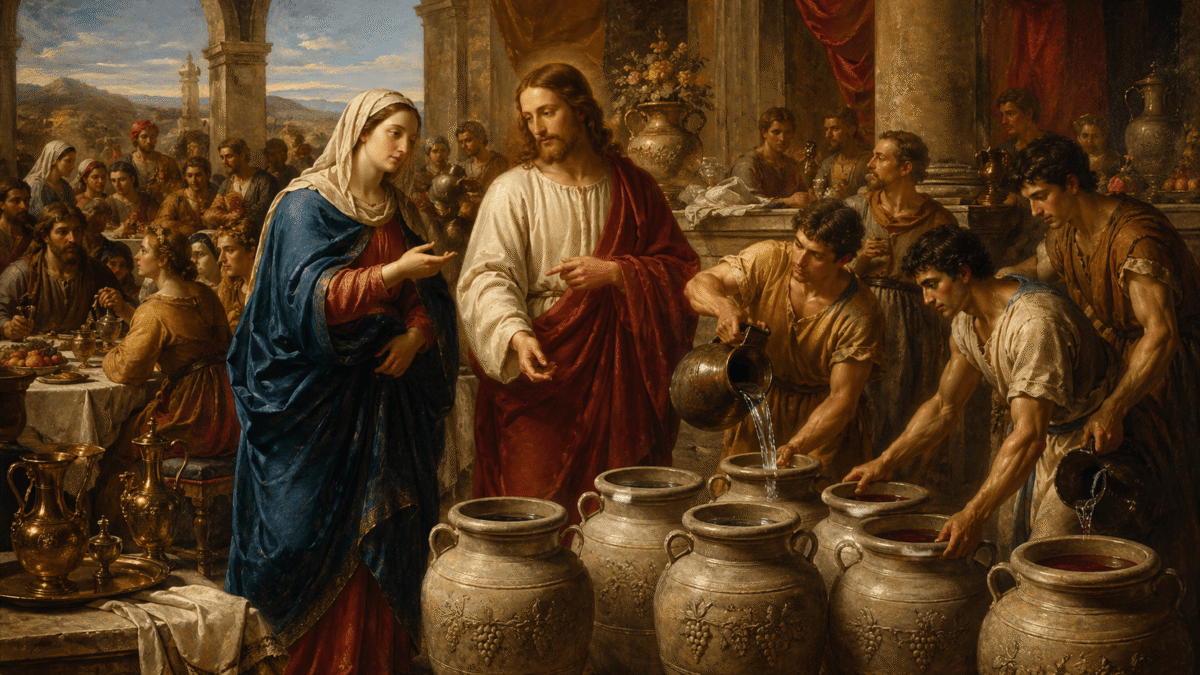
The episode of the Wedding at Cana (Jn 2:1-11) is the first sign (σημεῖον) worked by Jesus in the Gospel of John and the only miracle of the fourth Gospel in which Mary plays an active and decisive role. The narrative is set in Galilee, on the third day after the call of the first disciples (Jn 1:35-51), and belongs to the inaugural week of Jesus’ public ministry, which Johannine exegetes identify as a typology of the week of creation (Gen 1:1-2:3) and of the new creation inaugurated by the incarnate Word. The temporal detail “on the third day” (τῇ ἡμέρᾳ τῇ τρίτῃ) already echoes, for the attentive reader, the resurrection.
The scene has a clear narrative structure: Mary’s observation of the lack of wine (Jn 2:3), the dialogue between Mary and Jesus (Jn 2:4-5), Mary’s instruction to the servants (Jn 2:5) and the transformation of the water into wine (Jn 2:6-10). Each element of this structure has a theological density of its own, which the patristic, medieval and modern tradition explored with increasing depth. The monograph by Aristide Serra OSM, Le nozze di Cana (Messaggero Padova, 2009; 599 pp.), is today the most complete exegetical analysis of Jn 2:1-12 in scholarly Mariological literature.
“They have no wine”: Mary as mediatrix
Mary’s intervention, “They have no wine” (Jn 2:3), is the central Mariological act of the episode. Mary does not ask directly, nor does she formulate a solemn prayer: she observes a human need and places it before her Son. This way of interceding – discreet and trusting – became the model of all Marian devotion of mediation. Aristide Serra documents that Mary’s wording resonates with the intercessory gestures of the Old Testament (Is 38:2-3; 2 Kgs 4:14): Mary does not demand, but trusts. Saint Bernard of Clairvaux, in the twelfth century, interpreted this scene as the demonstration that Mary “recognizes the will of the Son even before He manifests it” (Sermo in Dominica infra octavam Assumptionis).
The reply of Jesus, “Woman, what have I to do with you? My hour has not yet come” (Jn 2:4), is one of the most debated sentences of Johannine exegesis. The vocative γύναι (“Woman”) is not distant or cold in Semitic culture: it is the same term with which Jesus addresses Mary on Calvary (Jn 19:26), establishing an intentional parallel between Cana and the Cross. The “hour” (ὥρα) is the hour of glorification, of death and resurrection (Jn 7:30; 12:23; 17:1). Mary, by interceding at Cana, anticipates that hour and directs Jesus toward it. Her mediation does not contradict the will of the Son: it cooperates with it.
“Do what he tells you”: Mary and the covenant of Sinai
The verse Jn 2:5 – “Do what He tells you” – is for Serra the one of greatest theological density in the whole pericope. The formula resonates with the words of Israel at Sinai: “All that the Lord has spoken we will do” (Ex 19:8; 24:3, 7). Mary thus becomes the Woman of the New Covenant, who transmits to the servants – read as ministers of the new covenant – the same attitude of obedience that Israel promised at Sinai. The typology of Joseph (Gen 41:55: “What he tells you, do it”) reinforces the identification of Mary with the mediating figure of the Old Testament tradition. This is likewise the last record of Mary as a speaking character in the Gospel of John – her spiritual testament to the Church.
The wine, the Spirit and the Eucharist: a typological reading
Patristic exegetes read the transformation of the water into wine as a prefiguration of the Eucharist. Origen, in his Commentary on the Gospel of John, interprets the six stone jars as the six days of creation and the new wine as the Eucharistic blood that surpasses the Law (the water of purification). In ancient Judaism, “wine” was a privileged metaphor for the Torah (Prov 9:5; Song 1:2; Sir 24:19-21) – Jesus produces “good” wine while the hosts have run out of the “old” wine: a typology of the old Torah and the new Word. The wine in abundance (approximately 600 liters in the six jars) is a symbol of the eschatological banquet (Is 25:6; Am 9:13-14). Augustine of Hippo, in the Tractatus in Iohannem, stresses that Jesus chose precisely a wedding feast for the first sign because the Church is the Bride of Christ and the wine is the blood of the new covenant.
The presence of Mary in this scene of Eucharistic inauguration is not accidental: she who conceived the Word by the Holy Spirit is present at the moment when the Word inaugurates sacramental mediation. John Paul II, in Redemptoris Mater (n. 21), saw at Cana “the first public act of maternal mediation” and the fullest expression of Mary’s cooperation in the redemptive work of her Son.
Deepen your studies: explore Mariology, Marian Theology, Marian apparitions and the Postgraduate Program in Mariology.
Postgraduate Program in Mariology
Would you like to deepen your formation in Mariology? Discover the Postgraduate Program in Mariology of Locus Mariologicus – an academic formation that unites theological rigor, spiritual life, and the living tradition of the Church.
See also: Luminous Mysteries: what they are, when they are prayed and how to meditate on them
See also
Would you like to study Mariology seriously?
This article grows out of the works in the Locus Mariologicus library. The Postgraduate Program in Mariology takes you to the same source, with academic guidance: Scripture, the Fathers of the Church, and the Magisterium, from the first dogma to contemporary questions.

Responses