Marian devotion: forms, history and spirituality
What is Marian devotion?
Marian devotion is the body of practices, prayers, attitudes and spiritual dispositions by which Christians honor the Virgin Mary and seek her intercession. The Second Vatican Council (Lumen Gentium n. 66-67) set Marian devotion within the whole of Christian piety: the veneration of Mary must be clearly distinguished from divine adoration. The distinction is fundamental: devotion to Mary is hyperdulia, never latria.
Biblical foundation
The biblical foundation of Marian devotion is found in Lk 1:48: “All generations will call me blessed.” This prophecy of the Magnificat describes the “cult of hyperdulia,” the singular veneration due to Mary among all creatures. Marian devotion is not a medieval invention: it is the obedient response of the Church to the beatification that the Holy Spirit Himself inspired in Mary. Lk 1:28 (kecharitōménē) and Jn 19:27 (“Behold your Mother”) complete the scriptural foundation.
Principal forms of Marian devotion
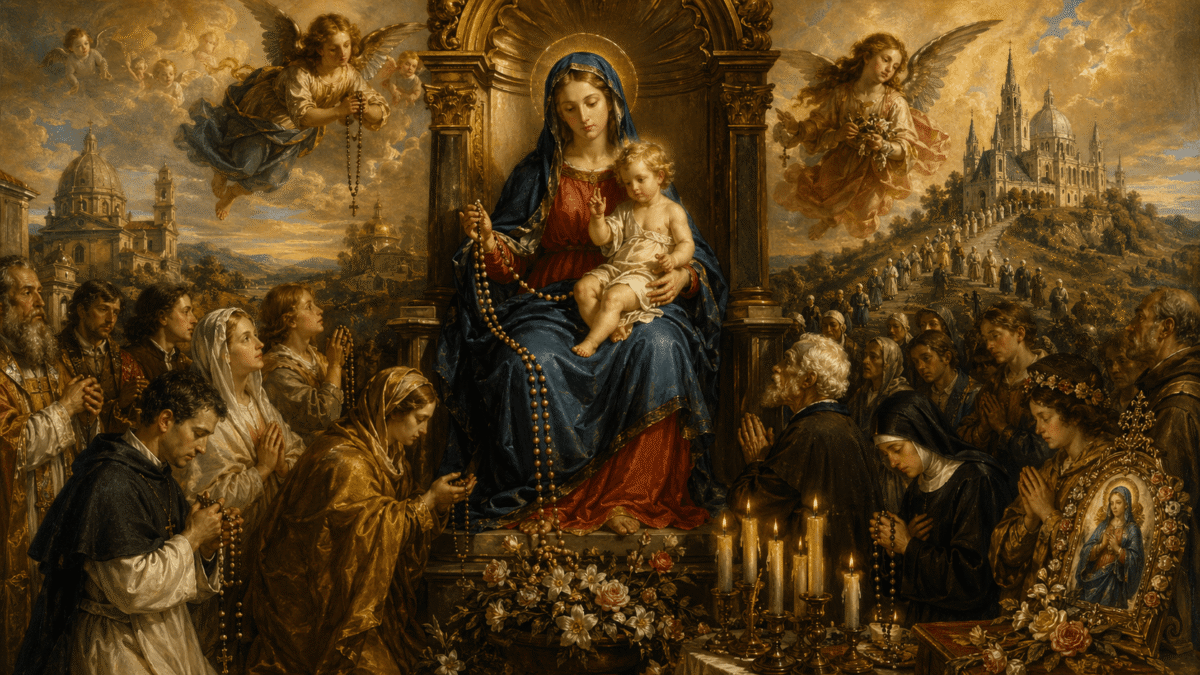
Rosary: meditation on the mysteries of the life of Christ with Mary; John Paul II called it “my favorite prayer.” Angelus and Regina Caeli: a prayer three times a day that recalls the Annunciation. Consecration to Mary: the total surrender of one’s life to Jesus through Mary, in the tradition of Louis de Montfort (Totus Tuus). Marian antiphons: Alma Redemptoris Mater, Ave Regina Caelorum, Regina Caeli and Salve Regina. Pilgrimages: Fatima, Lourdes, Guadalupe, Aparecida, Częstochowa. Scapular of Mount Carmel: a symbol of consecration to Our Lady of Mount Carmel since 1251.
Marian devotion vs. adoration: the fundamental distinction
Latria (adoration) is due exclusively to God. Dulia (veneration) is due to the saints. Hyperdulia (higher veneration) is due to Mary, by reason of her singular dignity as Mother of God. Anyone who adored Mary would commit idolatry, an error always rejected by Catholic theology. Protestant criticism has frequently confused hyperdulia with latria. The Church responded with the distinction already present in Origen (3rd century) and systematized by Thomas Aquinas (STh II-II, q.103).
Vatican II criteria for authentic devotion
Lumen Gentium n. 67 gives criteria of authenticity: (1) Christocentric, Mary always leads to the Son. (2) biblical and patristic, founded on the Scriptures and on Tradition. (3) liturgical, integrated into the liturgy. (4) ecumenical, attentive to the impact on the separated brethren. (5) without false exaggerations. Evangelii Gaudium n. 284 adds: popular Marian devotion is “genuine” when it expresses the faith of simple people in contact with grace.
Deepen your studies: explore Mariology, Marian Theology, Marian prayers, consecration to Our Lady and the Postgraduate Program in Mariology.
Postgraduate Program in Mariology
Would you like to deepen your formation in Mariology? Discover the Postgraduate Program in Mariology of Locus Mariologicus – an academic formation that unites theological rigor, spiritual life, and the living tradition of the Church.
Would you like to study Mariology seriously?
This article grows out of the works in the Locus Mariologicus library. The Postgraduate Program in Mariology takes you to the same source, with academic guidance: Scripture, the Fathers of the Church, and the Magisterium, from the first dogma to contemporary questions.




Responses