Ave Maria: The Prayer of the Angelic Salutation
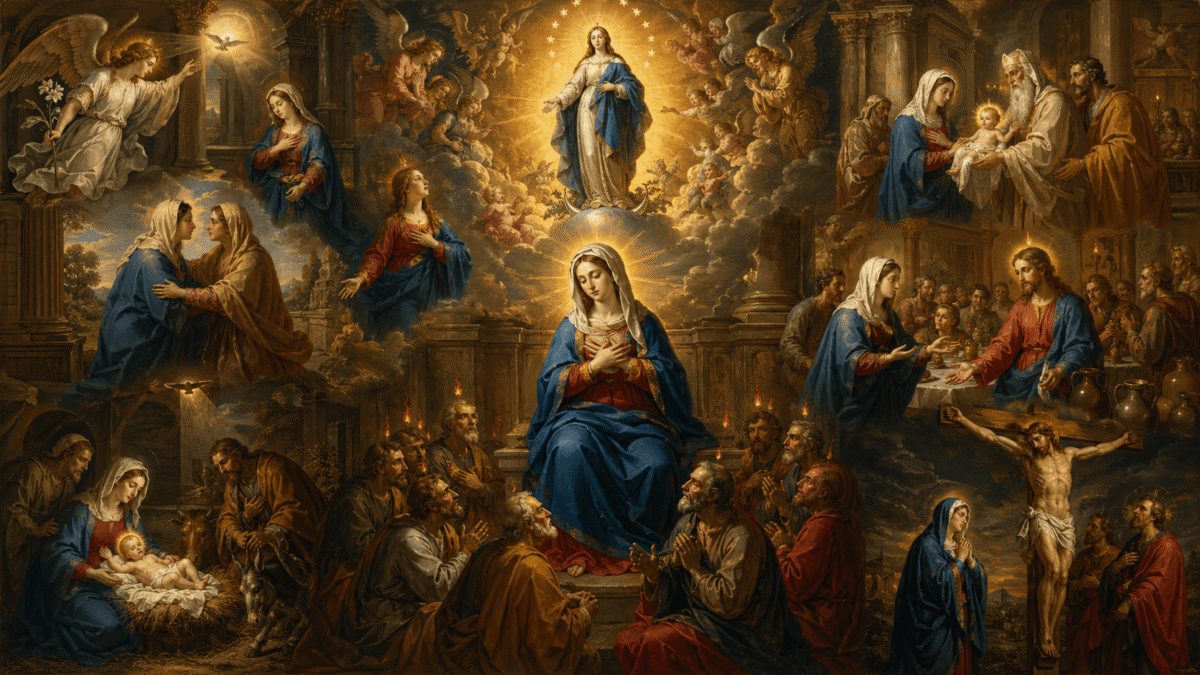
Ave Maria, the Prayer of the Angelic Salutation
The Ave Maria is the most widespread Marian prayer in the Christian world. It combines three elements: the greeting of the Angel Gabriel at the Annunciation (Lk 1:28), Elizabeth’s acclamation at the Visitation (Lk 1:42), and the ecclesiastical petition added in the fifteenth century. For a complete article: Ave Maria, Prayer and Spirituality.
The Three Parts
The first part is biblical: “Hail Mary, full of grace, the Lord is with thee” (Lk 1:28). The second is as well: “Blessed art thou among women, and blessed is the fruit of thy womb, Jesus” (Lk 1:42 + the addition of the name Jesus). The third, “Holy Mary, Mother of God, pray for us sinners, now and at the hour of our death,” was added gradually between the fourteenth and sixteenth centuries.
Place in the Rosary
The Ave Maria is the central element of the Rosary: each decade consists of a meditation on a mystery accompanied by 10 Ave Marias. To pray the entire Rosary means to pray 150 Ave Marias, the number of the Psalms. Hence the ancient name of the Rosary: Mary’s Psalter.
Deepen your studies: explore Mariology, Marian Theology, Marian apparitions, and the Postgraduate Program in Mariology.
Magisterium of the Church
Hail Mary, full of grace, the Lord is with thee, blessed art thou among women and blessed is the fruit of thy womb Jesus. Holy Mary, Mother of God, pray for us sinners, now and at the hour of our death. Amen.
Salutatio angelica ex Luca 1,28.42, forma liturgica approbata (saec. XV)
📚 Literal translation: Hail Mary, full of grace, the Lord is with you, blessed are you among women and blessed is the fruit of your womb Jesus. Holy Mary, Mother of God, pray for us sinners, now and at the hour of our death. Amen.
Postgraduate Program in Mariology
Would you like to deepen your formation in Mariology? Discover the Postgraduate Program in Mariology of Locus Mariologicus – an academic formation that unites theological rigor, spiritual life, and the living tradition of the Church.




Responses