Marian cult: foundations, history, and renewal
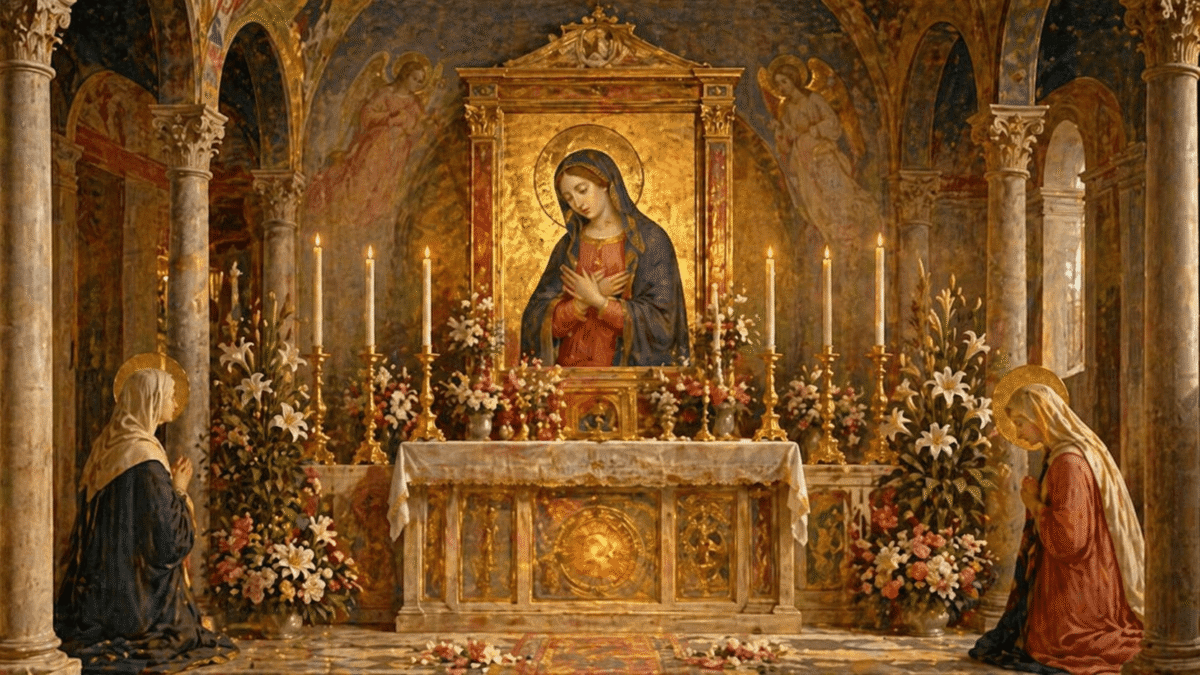
Marian cult: foundations, history, and renewal
The cult of Mary is, in a certain way, as ancient as the Church. From the prayer Sub tuum praesidium (third century) to the pontificate of John Paul II, the veneration of the Mother of the Lord accompanied the life of the Christian community without interruption, taking on expressions shaped by the cultural and religious conditions of each age. The Second Vatican Council and the apostolic exhortation Marialis Cultus (Paul VI, 1974) profoundly renewed the theological and pastoral understanding of the Marian cult, anchoring it in the one Christian liturgy and guiding its aggiornamento.
Theological foundations
The foundation of the cult of Mary rests on a threefold title. First, the divine motherhood: Mary is the Mother of the incarnate Son of God, and this title, dogmatically defined at the Council of Ephesus (431), justifies a veneration that exceeds the one due to any other saint. Second, her association with the mystery of Christ: Mary cooperated with the Redeemer throughout the whole history of salvation, from the Annunciation to the Cross, in a unique and preeminent way. Third, the sublime holiness attained by the Handmaid of the Lord, formed by the Holy Spirit in total conformity to the Son. These three elements constitute the root of the veneration that the Church has expressed to Mary from her earliest days. The cult of Mary is essentially different from the cult of adoration due to the Persons of the Most Holy Trinity: it is a cult of veneration (hyperdulia) directed to the most exalted creature, in a subordinate way and ordered to the glorification of God. Its ultimate purpose is that, “while the Mother is honored, the Son may be rightly known, loved, and glorified” (LG 66).
A brief historical overview
The Marian cult developed progressively. In the first centuries, the presence of Mary in the primitive liturgical cult is attested by the formulas of the baptismal creed, of the regula fidei, and of the eucharistic anaphora. The prayer Sub tuum praesidium (third century) is the oldest known direct Marian prayer and already reflects a solid faith in the intercession of the Mother of God. The definition of the Theotokos at the Council of Ephesus (431) brought about an explosion of the Marian cult in the East and in the West. In the patristic age the first images, the first accounts of apparitions, and the first organized devotions appear. In the medieval period, the Marian cult attained an extraordinary richness: the Rosary, the Hail, Holy Queen, the Angelus, Marian feasts, shrines, religious orders dedicated to Mary. The modern era saw the definition of new Marian dogmas (the Immaculate Conception, 1854; the Assumption, 1950) and the flourishing of Marian congregations and movements. Vatican II opened a phase of critical renewal and of theological deepening.
The four notes of the renewed Marian cult
Marialis Cultus (1974) identified four notes that must characterize devotion to Mary in the Church of today. The Trinitarian note recalls that the Marian cult is part of the one Christian cult, which is a cult offered to the Father, through the Son, in the Holy Spirit. All honor given to Mary must resolve itself, in the last analysis, into praise of the triune God who raised her to her sublime dignity. The Christological note stresses that in Mary “everything is relative to Christ and dependent upon Him” (MC 25): Marian devotion must bring out the indissoluble bond that unites the Mother to the Savior. The pneumatological note invites a deeper penetration of the mystery of the action of the Holy Spirit in Mary and in the Church: the Spirit who overshadowed Mary at the moment of the Incarnation continues to act in the Church. The ecclesial note recalls that Mary occupies, after Christ, the highest place and the one closest to us (LG 54): the Marian cult must reflect her insertion into the mystery of the Church, of which she is an eminent member, type, and model.
The four pastoral orientations
The same apostolic exhortation proposes four orientations for the aggiornamento of the Marian cult. The biblical orientation asks that devotion to Mary be imbued with the great themes of the Christian message as Scripture sets them forth, avoiding purely anecdotal elements. The liturgical orientation affirms the primacy of the liturgy as the “golden rule of Christian piety” (MC 23) and asks that devotional practices, such as the Rosary and the Angelus, be harmonized with the liturgical cult. The ecumenical orientation requires that the Marian cult avoid anything that might create misunderstandings with our separated brethren, affirming the hope that veneration of the Virgin may be “a meeting point for the union of all the faithful in Christ” (MC 33). The anthropological orientation asks that Mary be presented not merely as a model of passive recollection, but as the woman who “adhered fully and responsibly to the will of God” (MC 35): the courageous woman of the Magnificat, the strong mother beside the Cross, the mirror of the aspirations of contemporary man (MC 37). By keeping these orientations in balance, the cult of Mary becomes an itinerary of authentic spiritual growth, avoiding both triumphalist exaggerations and rationalist reductions.
Deepen your studies: explore Mariology, Marian Theology, the Rosary, and the Postgraduate Program in Mariology.
Magisterium of the Church
Cultus erga Beatam Virginem intra totum cultum christianum necessario inscribitur: hic cultus est specifice christianus quia a Christo oritur, in Christo explet et per Christum ad Patrem in Spiritu tendit.
Paulus VI, Exh. Ap. Marialis Cultus, n. 25 (2 februarii 1974)
📚 Literal translation: The cult of the Blessed Virgin is necessarily inscribed within the whole of Christian worship: this cult is specifically Christian because it takes its origin in Christ, is accomplished in Christ, and tends, through Christ, to the Father in the Spirit.
Postgraduate Program in Mariology
Would you like to deepen your formation in Mariology? Discover the Postgraduate Program in Mariology of Locus Mariologicus — an academic formation that unites theological rigor, spiritual life, and the living tradition of the Church.
Would you like to study Mariology seriously?
This article grows out of the works in the Locus Mariologicus library. The Postgraduate Program in Mariology takes you to the same source, with academic guidance: Scripture, the Fathers of the Church, and the Magisterium, from the first dogma to contemporary questions.




Responses