Mary and the Eucharist: the Mother Who Leads to the Bread of Life
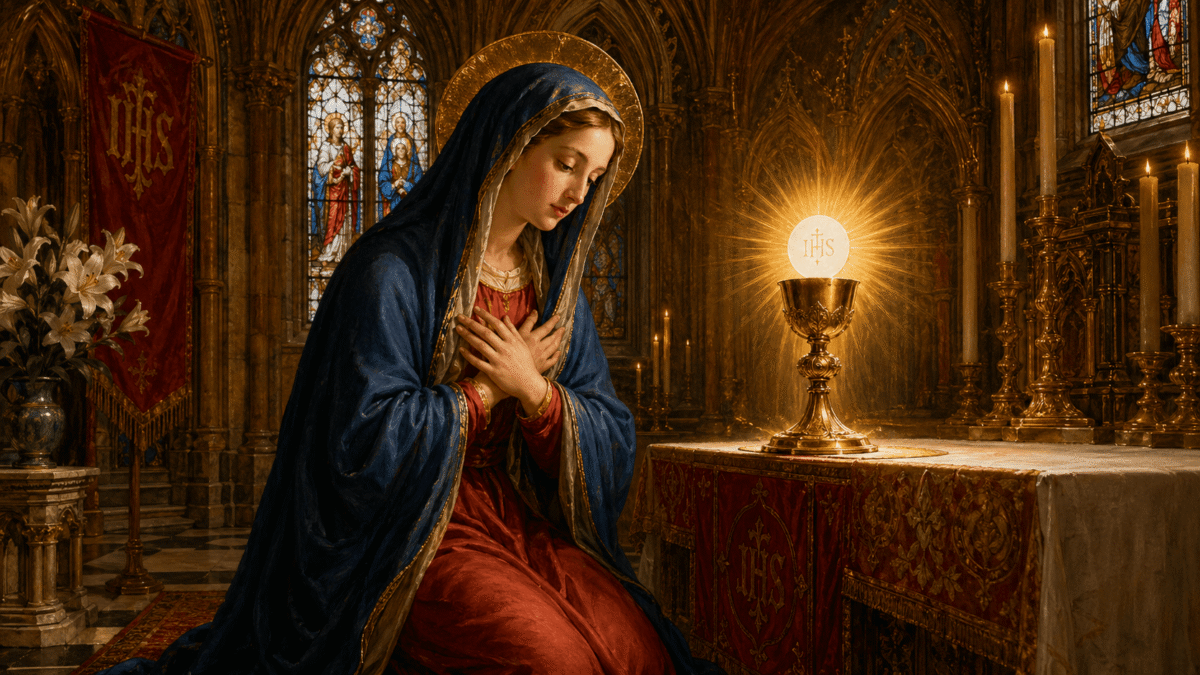
Mary and the Eucharist, the Mother who leads to the Bread of Life
The link between Mary and the Eucharist is one of the themes least made explicit by great theology, but one of the most present in the concrete life of the Church: in the Eastern and Western liturgies, in popular piety, in the shrines, in the spirituality of the movements. In the Eastern tradition, the iconostasis must necessarily contain the image of the Virgin (called tis Evangelismós) alongside that of Jesus, both turned toward the altar. At Lourdes, where the maternal presence of the Virgin is felt in an impressive way, the center of prayer is the celebration of the Eucharist.
Cana: “Do what he tells you”
The Gospel of John frames the mission of Jesus between two decidedly Marian scenes: Cana (Jn 2:1-12) and Calvary (Jn 19:25-27). At Cana the eucharistic symbolism is evident: the transformation of water into wine anticipates the discourse on the Bread of Life (Jn 6). The initiative is Mary’s, and her charge to the servants, “Do whatever he tells you” (Jn 2:5), is the synthesis of her maternal ministry in the Church: to direct the faithful toward Christ, to lead them to the eucharistic Bread. It is no accident that Paul VI, in Marialis Cultus, set this charge of Mary alongside the Father’s invitation at the Transfiguration: “Listen to him” (Mt 17:5). Both are an “itinerary to the Father through Christ in the Spirit” (MC 57).
Calvary: the new motherhood
In the scene of Calvary (Jn 19:25-27), Jesus entrusts His mother to the “beloved disciple”, calling her “woman”, a term that points back to the beginning (Gen 2:23) and that marks the start of a new generation. From the opened side of Jesus come blood and water, symbols of the sacraments of the Church. Mary becomes the mother of the disciple and, through him, the mother of the community that feeds on the eucharistic body and blood of Christ. If before Jesus was born of the Virgin, now it is the Virgin who receives a new motherhood from the crucified Son. Physical motherhood is as it were “abolished”, in order to inaugurate a spiritual and ecclesial motherhood.
Mary in the early eucharistic community
The Acts of the Apostles (1:14) confirm the presence of Mary in the post-paschal community at prayer. Her presence at the Last Supper cannot be excluded: according to the Jewish paschal custom, it fell to the mother of the family to light the lamps, and Mary was in Jerusalem in those days (Jn 19:27). Luke underlines the eucharistic symbolism of Bethlehem, “house of bread”, where Jesus, the Bread of Life, was laid in a manger, with Mary as the “domus” par excellence of the eucharistic Bread.
Theological and pastoral implications
The triad Mary-Church-Eucharist structures Catholic spiritual life. As Henri de Lubac stated about the Church and the Eucharist: “The Church makes the Eucharist, but it is also the Eucharist that makes the Church.” Mary stands at the heart of this: she is the first and most perfect “eucharistic temple”, the one who received the Word made flesh in her womb before any altar. The cult of the Virgin has “a fundamental christological note joined to a specifically eucharistic dimension”: the Virgin exercises as it were a “charismatic ministry” of guiding the faithful to the Eucharist, in continuity with her “Do what he tells you” at Cana.
Deepen your studies: explore Mariology, Visitation, Marian Theology, and the Postgraduate Program in Mariology.
Magisterium of the Church
Mary is a “woman of the Eucharist” in her whole life. The Church, in contemplating Mary, recognizes in her its most luminous mirror in the eucharistic mysteries.
Saint John Paul II, Enc. Ecclesia de Eucharistia, no. 53 (April 17, 2003)
📚 Literal translation: Mary is a “woman of the Eucharist” in her whole life. The Church, in contemplating Mary, recognizes in her its most luminous mirror in the eucharistic mysteries.
Postgraduate Program in Mariology
Would you like to deepen your formation in Mariology? Discover the Postgraduate Program in Mariology of Locus Mariologicus – an academic formation that unites theological rigor, spiritual life, and the living tradition of the Church.
Learn what the Church teaches about Mary, Mediatrix of All Graces.
Would you like to study Mariology seriously?
This article grows out of the works in the Locus Mariologicus library. The Postgraduate Program in Mariology takes you to the same source, with academic guidance: Scripture, the Fathers of the Church, and the Magisterium, from the first dogma to contemporary questions.





Responses