Daughter of Zion: Mary as the personification of the people of God
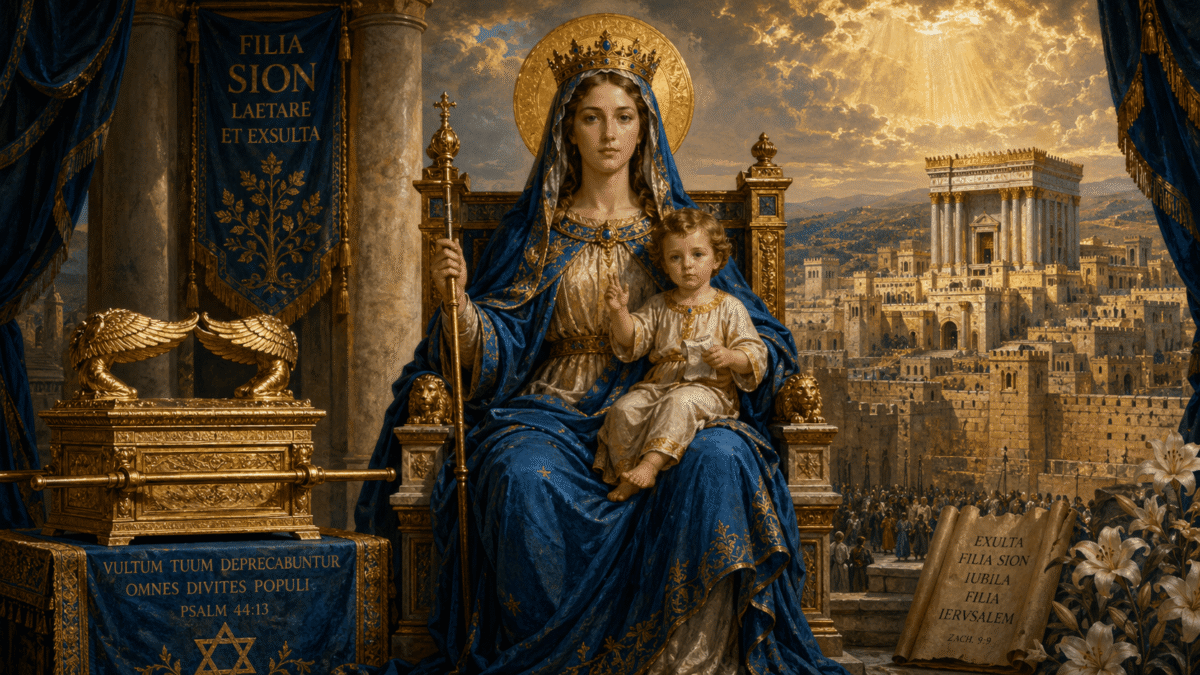
Daughter of Zion: Mary as the personification of the people of God
The expression Daughter of Zion (bat Sion) is a biblical title of the Old Testament that the Second Vatican Council solemnly applied to Mary. Lumen Gentium (n. 55) affirms that in her, the “exalted Daughter of Zion,” after the long expectation of the promise, the times are fulfilled and the new economy of salvation is established. The title illumines the biblical foundation of Mariology and opens the way to ecumenical dialogue.
The title in the Old Testament
In Scripture, “Daughter of Zion” is a feminine personification of Jerusalem or of Israel, used above all in the prophets (Micah, Zephaniah, Jeremiah, Lamentations, Isaiah). The prophet Micah (4:10-13) was probably the first to introduce this expression to designate the “remnant of Israel,” the part of the people that is wounded yet bears a new hope, and that will give birth to a liberated people. Zephaniah (3:14-17) addresses the Daughter of Zion with an invitation to messianic joy: “Exult, Daughter of Zion! Shout for joy, Israel! […] The Lord your God is in your midst, a hero who saves.” This text proved fundamental for the exegesis of the Annunciation.
The Annunciation and the “chaire, kecharitomene”
The exegete S. Lyonnet showed in 1939 that the angel’s greeting to Mary in Luke 1:28, “chaire, kecharitomene” (“Rejoice, full of grace”), is not a commonplace greeting but the precise echo of four Old Testament texts addressed to the “Daughter of Zion” (Zeph 3:14, Joel 2:21, Zech 9:9, Lam 4:21). All these texts share the invitation to messianic joy, the exhortation “do not fear,” and the announcement of God’s coming to dwell in the midst of His people. R. Laurentin deepened this discovery: the whole Lucan account of the Annunciation (Lk 1:26-38) transposes to the person of Mary what the prophets said to the Daughter of Zion. God’s dwelling in Zion is realized in the mystery of the virginal conception. In this way, Luke deliberately replaces the “Daughter of Zion,” the collective personification of Israel, with the concrete person of Mary, who receives the messianic promise in the name of the whole people.
The Johannine tradition: “the woman”
In the Gospel of John, Mary is called “woman” at two decisive moments: at Cana (2:4) and at the Cross (19:26). Recent studies (A. Serra) have shown that the Cana scene was structured by John on the basis of the great theophany of Sinai (Ex 19 and 24). Mary’s words, “Do whatever he tells you” (Jn 2:5), correspond to the profession of faith of the covenant community: “All that the Lord has said, we will do” (Ex 19:8). John would thus be identifying Mary with the community of the exodus, which receives the new covenant. The expression “woman” would be the Johannine equivalent of “Daughter of Zion” in Luke: the personification of the Israel of messianic times that brings forth the new people.
Mariological and ecumenical implications
The title “Daughter of Zion” reveals that Mariology is not an extrinsic addition to Christian theology, but is inscribed in the backbone of Scripture. Mary is not merely an individual person: she is “qualitative Israel,” the faithful remnant that receives the Messiah in the name of all, and for this reason the purest personification of the Church. As Lumen Gentium (n. 53) affirms, Mary is “a preeminent and altogether singular member of the Church.” On the ecumenical level, this title offers a shared biblical basis for dialogue with the Churches of the Reformation, which acknowledge the authority of Scripture. The Daughter of Zion is in the Gospel.
Deepen your studies: explore Mariology, Marian Theology, Mary and Israel, and the Postgraduate Program in Mariology.
Daughter of Zion: Mary as the personification of Israel
In the prophets of the Old Testament, the title Daughter of Zion designates the personification of faithful Israel awaiting the Messiah. The Marian tradition identified Mary as the perfect realization of this figure: she is the Daughter of Zion who receives the Son of God in the name of the whole chosen people. For the full article: Daughter of Zion.
The most relevant prophetic texts: Zephaniah 3:14 (“Exult with joy, Daughter of Zion!”), Zechariah 9:9 (“Exult with all your strength, Daughter of Zion!”), Micah 4:8 (“And you, Migdal-Eder, hill of the Daughter of Zion…”). The Angel’s greeting to Mary (Kecharitomene) has the same structure as the oracles of joy addressed to the Daughter of Zion.
The figure of the Daughter of Zion is collective: it represents the people, not merely an individual. When Mary personifies the Daughter of Zion, she represents all redeemed humanity receiving the Savior. Her Fiat is the “yes” of all humanity to God’s plan, not merely a personal act.
Deepen your studies: explore Mariology, Marian Theology, Marian apparitions, and the Postgraduate Program in Mariology.
Magisterium of the Church
Propter hoc dabit Dominus ipse vobis signum: ecce virgo concipiet et pariet filium, et vocabitur nomen eius Emmanuel.
Isaiah 7:14 (Vulgata Clementina)
📚 Literal translation: Therefore the Lord Himself will give you a sign: Behold, the virgin shall conceive and bear a son, and His name shall be called Emmanuel.
Laetatae sunt filiae Sion propter iudicia tua, Domine.
Psalmus 97 (96), 8 (Vulgata)
📚 Literal translation: The daughters of Zion rejoiced because of Your judgments, O Lord.
Postgraduate Program in Mariology
Would you like to deepen your formation in Mariology? Discover the Postgraduate Program in Mariology of Locus Mariologicus – an academic formation that unites theological rigor, spiritual life, and the living tradition of the Church.
Learn what the Church teaches about Mary, Mediatrix of All Graces.
Would you like to study Mariology seriously?
This article grows out of the works in the Locus Mariologicus library. The Postgraduate Program in Mariology takes you to the same source, with academic guidance: Scripture, the Fathers of the Church, and the Magisterium, from the first dogma to contemporary questions.





Responses