Immaculate Conception: the dogma and its theology
Immaculate Conception, the dogma and its theology
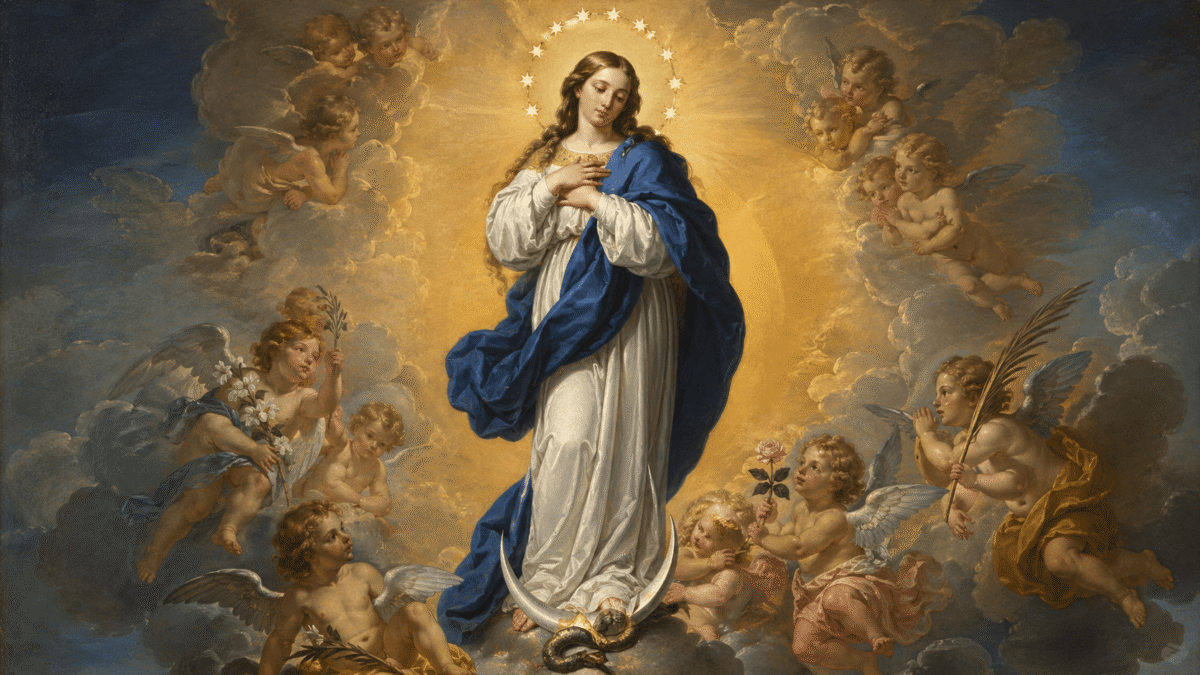
The Immaculate Conception is the dogma defined by Pius IX on December 8, 1854 (the bull Ineffabilis Deus): the most blessed Virgin Mary, in the first instant of her conception, by a singular grace and privilege of almighty God and in view of the merits of Jesus Christ, Savior of the human race, was preserved immune from all stain of original guilt. It is one of the four Marian dogmas defined by the Catholic Church. For the full article: Immaculate Conception.
The historical-theological process
The dogma of the Immaculate Conception is the fruit of a dynamism of faith that involved three inseparable agents. The first is the sensus fidelium: popular faith preceded theology and the Magisterium for centuries. The people celebrated the feast of the Conception even when great medieval theologians such as Anselm, Bernard, Thomas Aquinas, and Bonaventure still hesitated. The second agent is theology: the decisive step was taken by the Franciscan John Duns Scotus (†1308), with the argument of the “perfect mediator.” Christ, the perfect mediator, exercised toward Mary the most excellent mediation possible, preserving her from sin instead of removing it after it had been contracted. This is a preservative redemption, not less but more perfect than ordinary redemption. The third agent is the Magisterium: over the centuries the popes were moderators and promoters of the immaculist faith, never contradicting it, until the dogmatic definition of 1854. Pius IX consulted the bishops with the encyclical Ubi primum (1849): 546 of 603 bishops answered favorably. The definition was received with popular joy comparable, according to Le Bactelet, to the acclamation of Ephesus (431).
Biblical foundations
The bull Ineffabilis Deus does not cite isolated biblical texts, but invokes Scripture read with the eyes of the living Tradition of the Church. The principal texts are these: Gen 3:15, the protoevangelium, where the Fathers saw Mary associated with the victory over the serpent (“I will put enmity between you and the woman, between your seed and her seed”). Lk 1:28, the greeting “chaire kecharitomene,” interpreted by the Fathers as “you who are and remain full of the divine favor,” and Lk 1:42, Elizabeth’s praise. The exegete A. Serra has further shown how Mary, as Daughter of Zion, represents the crowning of a long process of purification of Israel: as God purified His people, calling it a bride “without stain” at Sinai (Song 4:7), so He preserved Mary from every stain for the “fiat” of the Annunciation.
The theology of the Immaculate Conception
Contemporary theology presents the dogma under three inseparable perspectives. In the first place, it is a sign of the gratuitous love of the Father: the preservation of Mary from original sin is a sovereign and gratuitous act of God, prior to any human merit or response. Mary proclaims to the whole community of the redeemed: “Soli Deo gloria.” In the second place, it is the perfect expression of Christ’s redemption: Mary is not an exception to universal redemption, but its most excellent case. The bull affirms that she was redeemed “in a more sublime manner” (sublimiori modo redemptam), preserved from sin thanks to the retroactive value of the paschal mystery, instead of being delivered from it after having contracted it. LG 53 recalls that Mary is “united in the line of Adam with all men who are in need of redemption.” In the third place, it is a creation in the grace of the Holy Spirit: the Second Vatican Council (LG 56), following the Eastern Fathers, presents Mary as “immune from every stain of sin, as though fashioned by the Holy Spirit and formed as a new creature.” Saint Maximilian Kolbe explored this dimension by presenting Mary as the perfect reflection of the Holy Spirit who dwells in her from the first instant, going so far as to speak, with theological caution, of a “quasi-incarnation” of the Spirit in the Immaculate One.
Ecumenical dimension
The dogma is a point of difficulty in ecumenical dialogue. Protestant Christians object that the definition of 1854 lacks an explicit written foundation and seems to place Mary outside the field of sin, so that Christ would not be her true Savior. The Scotist perspective of preservative redemption answers: Mary is precisely the greatest and most perfect beneficiary of redemption. Orthodox theologians, although they acknowledge Mary’s singular holiness, tend to reject the dogmatic formulation of 1854, in part for methodological reasons. One possible path of ecumenical convergence, suggested by Stawrowsky, consists in presenting the dogma in the positive terms of “fullness of grace and holiness created by the Spirit,” rather than in the negative terms of “absence of original sin.”
Deepen your studies: explore Mariology, Marian dogmas, Marian Theology, and the Postgraduate Program in Mariology.
Immaculate Conception, the dogma of 1854
The Immaculate Conception is the dogma defined by Pope Pius IX on December 8, 1854, in the bull Ineffabilis Deus: Mary “was preserved immune from all stain of original sin, by virtue of the merits of Jesus Christ.” For the full article: Immaculate Conception, Dogma and Spirituality.
The dogma affirms that Mary, unlike all other human beings, was not touched by original sin. This preservation was not by her own merit, but by anticipation of the merits of Christ: Mary’s redemption was preventive (redemptio preservativa), whereas ours is curative.
Four years after the dogmatic definition, in 1858, Our Lady appeared at Lourdes to Bernadette and identified herself: “I am the Immaculate Conception.” This coincidence was interpreted as a supernatural confirmation of the recently defined dogma.
Magisterium of the Church
declaramus, pronuntiamus et definimus doctrinam quae tenet beatissimam Virginem Mariam in primo instanti suae Conceptionis fuisse singulari omnipotentis Dei gratia et privilegio, intuitu meritorum Christi Iesu Salvatoris humani generis, ab omni originalis culpae labe praeservatam immunem, esse a Deo revelatam, atque idcirco ab omnibus fidelibus firmiter constanterque credendam.
Pius IX, Ap. Const. Ineffabilis Deus (December 8, 1854)
📚 Literal translation: we declare, pronounce, and define that the doctrine which holds that the Most Blessed Virgin Mary, in the first instant of her conception, was, by a singular grace and privilege of almighty God, in view of the merits of Jesus Christ, Savior of the human race, preserved immune from all stain of original guilt, is a doctrine revealed by God and therefore must be firmly and constantly believed by all the faithful.
Postgraduate Program in Mariology
Would you like to deepen your formation in Mariology? Discover the Postgraduate Program in Mariology of Locus Mariologicus, an academic formation that unites theological rigor, spiritual life, and the living tradition of the Church.
Learn what the Church teaches about Mary, Mediatrix of All Graces.
Would you like to study Mariology seriously?
This article grows out of the works in the Locus Mariologicus library. The Postgraduate Program in Mariology takes you to the same source, with academic guidance: Scripture, the Fathers of the Church, and the Magisterium, from the first dogma to contemporary questions.


Responses