Holy Mary at the Presentation of the Lord
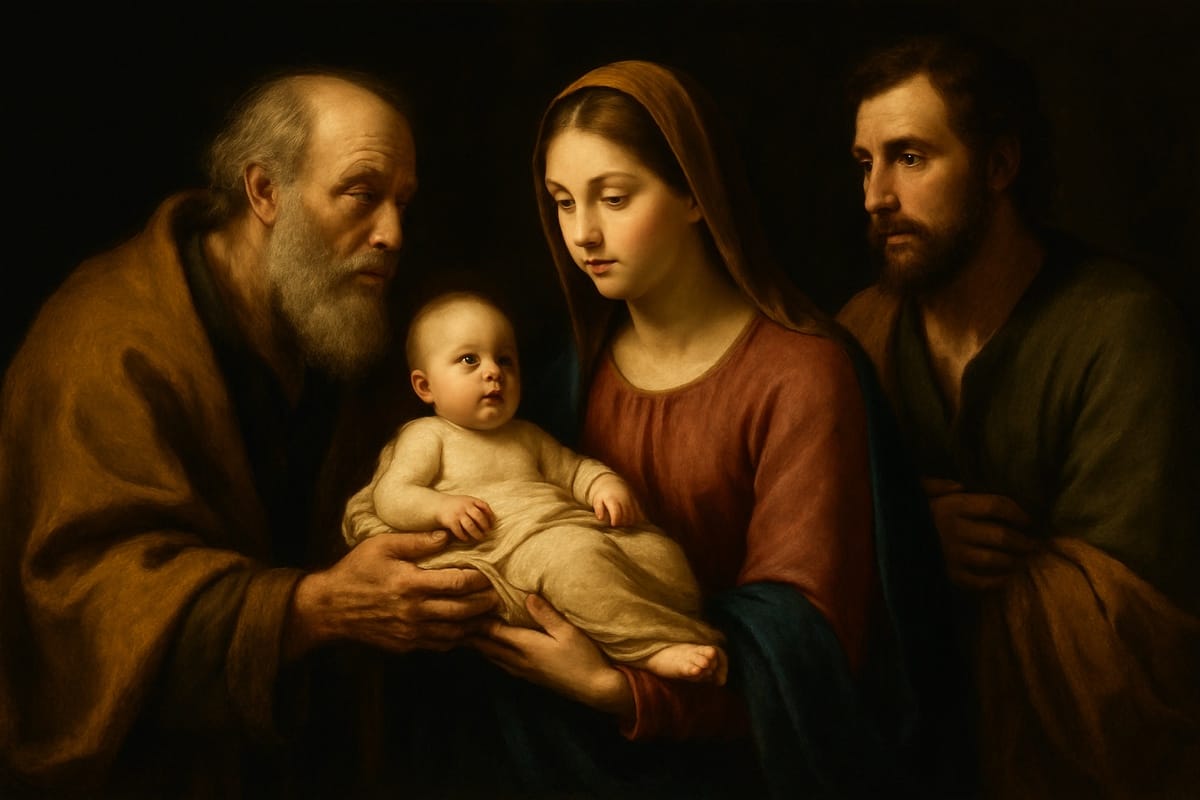
“Ecce mitto angelum meum et praeparabit viam ante faciem meam”. “Behold, I send my messenger to prepare the way before me”. (Mal 3:1)
I. The Messenger Who Purifies: The Oracle of Malachi
The oracle of the prophet Malachi with which the reading of this Mass opens is set in a context of religious crisis: the priests had corrupted worship, the offerings had been debased, the people had lost the sense of divine holiness. The divine response is not immediate condemnation, but the announcement of a purification: “Behold, I send my messenger to prepare the way before me, and suddenly the Lord whom you seek will come to his temple, and the angel of the covenant whom you desire” (Mal 3:1). The coming of the Lord to His temple is not a courtesy visit: it is a coming that purifies, that judges, that sifts. “He is like the refiner’s fire and like the fullers’ lye. He will sit refining and purifying the silver” (Mal 3:2-3). The purity of worship that Malachi demands is not the purity of external forms, but that of the interior intention, of the oblation that springs from an upright heart.
The liturgy applies this oracle to the mystery of the Presentation of Jesus in the Temple: the “Lord whom you seek” who comes to His temple is Jesus Himself, brought by His parents to be presented to the Father according to the Law of Moses. The irony of this application runs deep: the Lord whom the prophet had announced as purifier arrives at the temple in the hands of a young mother, wrapped in the arms of an old man, incapable of purifying anything whatever by His own gestures. And yet He is the Purifier: His presence is already judgment, is already discernment, is already the touchstone that will reveal the thoughts of many hearts.
II. The Law and Grace: The Encounter in the Temple
The Lucan account of the Presentation is a threshold text: it stands between Christmas and the hidden life of Nazareth, between the angelic announcement and the silence of thirty years. Mary and Joseph scrupulously fulfill the prescriptions of the Mosaic Law: the purification of the mother forty days after the birth and the consecration of the firstborn to the Lord. This fulfillment of the Law is not mere formal observance: it is the expression of a piety that finds in the divine commandment the path of encounter with God. The family of Nazareth is profoundly Jewish in its spirituality, rooted in the practices that the Lord had prescribed for His people. Jesus is born within the Law because He came to be “born under the Law, to redeem those who were under the Law” (Gal 4:4-5).
In the temple Simeon is waiting, “a righteous and devout man, who was awaiting the consolation of Israel, and the Holy Spirit was upon him” (Lk 2:25). The description of Simeon sums up the profile of the Old Testament just man: righteousness in conduct, devotion in his relationship with God, the hope that awaits the fulfillment of the promises. When Mary and Joseph enter the temple with the child, the Holy Spirit moves Simeon to go to meet them. The old man takes the child into his arms and intones a canticle that the Church repeats at every Compline: the Nunc dimittis. The waiting of an entire lifetime culminates in this embrace: in Simeon’s arms is the salvation that God has prepared “in the sight of all peoples, a light to enlighten the nations and the glory of your people Israel” (Lk 2:31-32).
III. “A Sword Will Pierce Through Your Own Soul”
After the Nunc dimittis, addressed to God, Simeon turns to Mary and pronounces the words that no faithful reading can hear without a shudder of compassion and of wonder: “This child is destined to be a sign of contradiction, and a sword will pierce through your own soul, so that the thoughts of many hearts may be revealed” (Lk 2:34-35). The prophecy of the sword, addressed to the Mother, is inseparable from the prophecy of the sign of contradiction, addressed to the Son. Jesus will provoke division: there will be those who receive Him and those who refuse Him, and the line of division will pass through the heart of every man. And Mary will take part in this division in a unique way: not as a spectator, but as the one who will feel most closely the contradiction that the Son will arouse.
The Christian spiritual tradition has identified the sword of Simeon with the Passion of Christ. Mary, beside the cross, will feel in her heart what the prophet had announced in the temple forty days after the birth. But the sword is not only exterior suffering: it is the discernment that the presence of Christ demands, the judgment that the Mother will share with the Son, the division that will pass through her own heart as well when she confronts the unbelief of those who will refuse to accept what she loves most. Simeon tells Mary not what she wants to hear, but what she needs to know: that the divine motherhood is not a privilege without cost, but a participation in the redemptive mystery of the Son.
IV. Mary, Co-Participant in the Redemptive Mystery
The seventh Mass of the Collection contemplates Mary in the scene of the Presentation as the first recipient of the full revelation concerning her Son. Neither Joseph, nor the priests of the temple, nor even the Magi received what Simeon says to Mary: the prophecy of contradiction and the prophecy of the sword. This privilege of revelation is proportionate to the participation that Mary will have in the mystery of the Son: no one will take part so closely, so completely, so sorrowfully in the redemptive work of Christ as His Mother.
The Mariology that emerges from this Mass is the Mariology of co-redemption in its most precise and most cautious sense: not the assertion that Mary redeemed together with Christ, but the assertion that she took part in the redemptive suffering in a unique and incomparable way, in such a manner that her suffering beside the cross was not an accident external to God’s plan, but an element foreseen and willed by Him from the moment when Simeon pronounced his prophecy. The oracle of Malachi that had opened the Mass announced the Lord who would come to His temple as purifier. The prophecy of Simeon reveals that the purification will pass through Mary’s heart as well: that the sword which will judge the thoughts of many hearts will begin with the soul of the Mother, whose faith was the most tested and the most persevering in the whole history of salvation.
Postgraduate Program in Mariology
Would you like to deepen your formation in Mariology? Discover the Postgraduate Program in Mariology of Locus Mariologicus – an academic formation that unites theological rigor, spiritual life, and the living tradition of the Church.
Would you like to study Mariology seriously?
This article grows out of the works in the Locus Mariologicus library. The Postgraduate Program in Mariology takes you to the same source, with academic guidance: Scripture, the Fathers of the Church, and the Magisterium, from the first dogma to contemporary questions.




Responses