Holy Mary of Nazareth
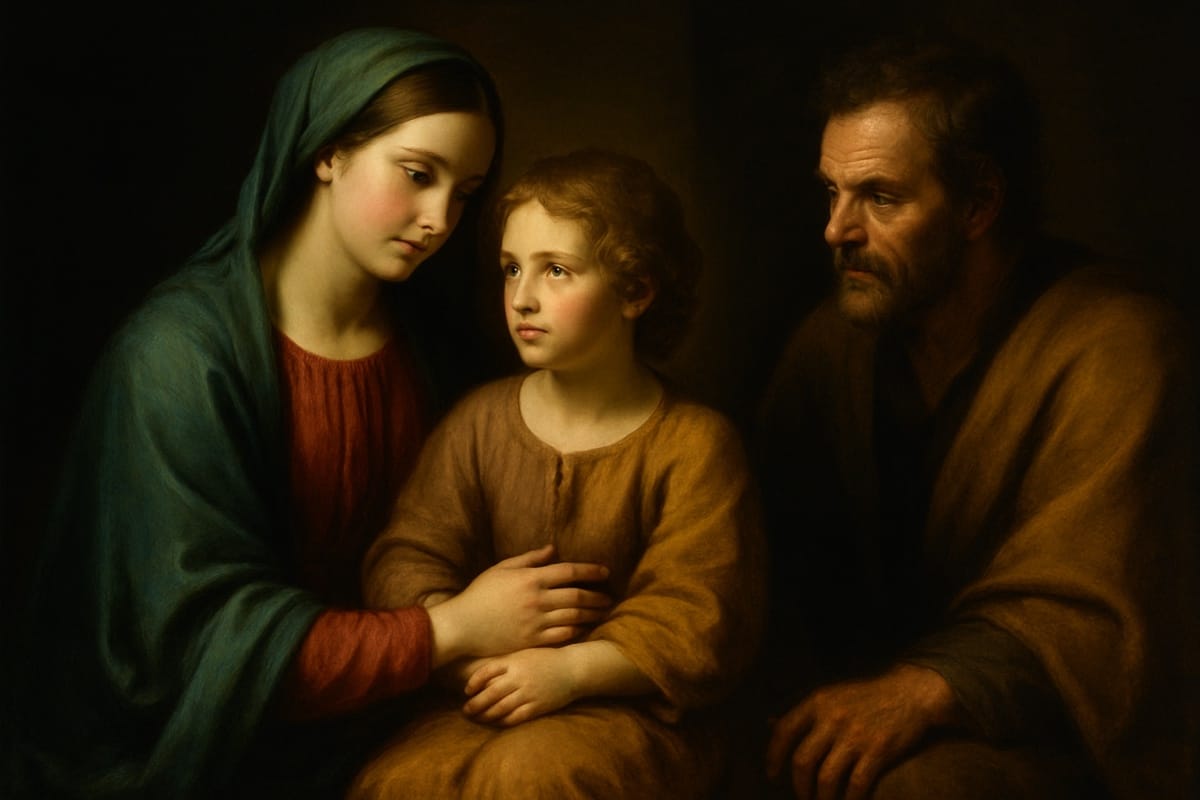
“Et erat subditus illis”. “And He was subject to them”. (Lk 2:51)
I. “Born of Woman, Born under the Law”: The Paradox of Divine Obedience
The Pauline synthesis of the Incarnation in the letter to the Galatians, in affirming that the Son of God was “born of woman, born under the Law” (Gal 4:4), concentrates in two participles the most paradoxical reality of Christian existence: God became obedient. He who is eternal, omnipotent, and without beginning consented to submit Himself to historical contingency, to cultural conditioning, and to the religious prescriptions of a concrete people. And He consented to it not in a superficial or apparent way, but in a real one: growing, learning, obeying, working with His own hands, living for thirty years in the village of Nazareth without anyone knowing who He was.
The “filial adoption” that Paul announces as the fruit of this obedient Incarnation is not brought about only at the moment of Easter or of Baptism: it begins to be brought about at Nazareth, in the daily rhythm of a family that prays, works, and grows to the measure of the divine and the human. Mary is the heart of this mystery of Nazareth. It is she who creates the atmosphere of faith, of prayer, and of fraternal love in which the Son of God learns to be a man. It is she who teaches Him His first words, who tells Him the stories of Abraham and of Moses, who introduces Him into the prayers of the people of Israel. Mary’s motherhood at Nazareth is a motherhood that educates, that forms, that shares in the divine plan in a way that exceeds all understanding.
II. The Mystery of Hiddenness and the Pedagogy of Silence
After the scene of the child Jesus in the temple, the Gospel of Luke covers thirty years of silence with a single sentence: “And Jesus increased in wisdom, in stature, and in grace before God and men” (Lk 2:52). Thirty years summed up in an observation about growth: human growth, spiritual growth, relational growth. God chose to spend the greater part of His human life in this silent growth, far from crowds and from miracles, far from any publicity or recognition. And He chose to live it with Mary and Joseph at Nazareth.
This hiddenness is not an insignificant prelude to the public life: it is in itself a revelation. It reveals that God does not need great human gestures in order to be present and to act. It reveals that the daily life of the family, manual work, regular prayer, filial obedience, are already a participation in the divine mystery. And it reveals that Mary, who lived those thirty years at the side of the Son of God, is the unsurpassable teacher of the life hidden with Christ in God, the one who knows better than anyone the weight and the beauty of a love that does not display itself, that does not seek recognition, that gives itself completely in the silence of ordinary life.
III. “And He Went Down with Them and Came to Nazareth, and Was Subject to Them”
Verse 51 of the second chapter of Luke is one of the most laden with theological meaning in the whole Gospel. After the episode in the temple, when the twelve-year-old boy answered the teachers with a wisdom that amazed them and told His parents that He had to be occupied with “the things of the Father” (Lk 2:49), the text adds without transition: “And He went down with them and came to Nazareth, and was subject to them” (Lk 2:51). What the boy had said in the temple about His divine mission does not interrupt His obedience to the family of Nazareth: the two things coexist without tension, because obedience to the heavenly Father and obedience to His earthly parents do not contradict each other, but are harmonized in the mystery of an Incarnation that embraced every condition of human existence, including childhood and adolescence.
Mary keeps this episode as she had kept the others: “His mother kept all these things in her heart” (Lk 2:51). The repetition of this formula, already used in Lk 2:19 for the episode of the shepherds, reveals the consistency of a spirituality: Mary does not react outwardly to what she does not understand, but interiorizes, keeps, ponders. Mary’s heart is a living archive of the mysteries of God, a space of contemplation where events are preserved until the moment when their fullness of meaning becomes accessible. Nazareth is the school of this contemplative spirituality, and Mary is its most perfect teacher.
IV. Mary of Nazareth, Model of the Sanctification of Daily Life
The eighth Mass of the Collection proposes Mary of Nazareth as an icon of the sanctification of ordinary life. It is not the Mary of the great privileges and of the extraordinary moments that this Mass contemplates in the foreground: it is the Mary of the thirty years of Nazareth, the Mary who kneaded the bread and washed the clothes, the Mary who prayed the prayers of the Psalter with her Son, the Mary who accompanied Joseph in his workshop and who brought Jesus up in the traditions of the people of God.
The Mariology of Nazareth is a Mariology of immanence: God making Himself present in the most concrete and smallest human space, the family, the house, the workshop, the oven. And Mary is the perfect inhabitant of this divine-human space: the one who knew how to recognize the presence of God in the face of the Son who asked her for bread, who knew how to find the divine will in daily obedience to the routines of family life, who knew how to make of Nazareth not a place of anxious waiting for the beginning of the public life, but the space full of meaning where the Word of God grew in silence until the moment that the Father had determined. To contemplate Mary of Nazareth is to learn that holiness does not need exceptional circumstances: it needs only a heart that keeps and ponders the mysteries of God in every moment of ordinary life.
Postgraduate Program in Mariology
Would you like to deepen your formation in Mariology? Discover the Postgraduate Program in Mariology of Locus Mariologicus – an academic formation that unites theological rigor, spiritual life, and the living tradition of the Church.
Would you like to study Mariology seriously?
This article grows out of the works in the Locus Mariologicus library. The Postgraduate Program in Mariology takes you to the same source, with academic guidance: Scripture, the Fathers of the Church, and the Magisterium, from the first dogma to contemporary questions.





Responses