The Magnificat as hermeneutical key in the Magnifica Humanitas of Leo XIV
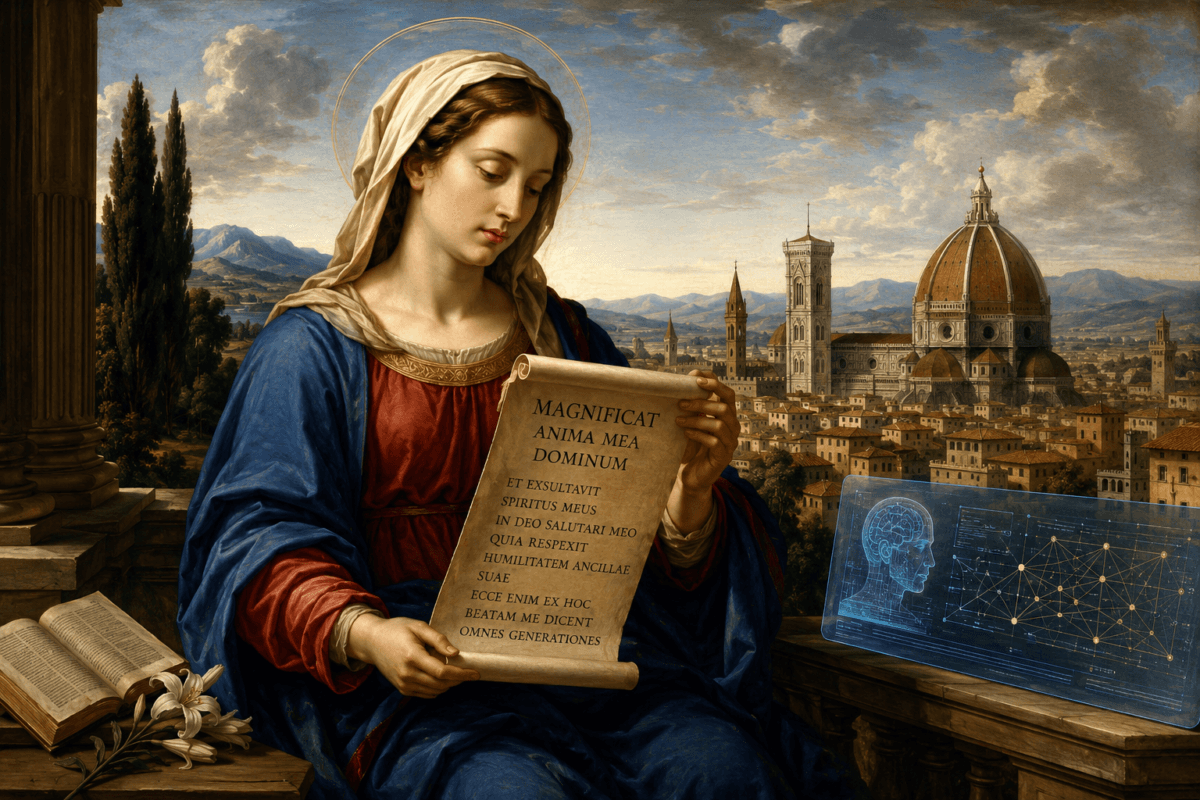
In Leo XIV’s encyclical Magnifica Humanitas, the Magnificat occupies the place of a hermeneutical key for a theological anthropology capable of responding to the age of artificial intelligence. This article analyzes the explicit use of Mary’s canticle in nn. 243-245, articulates it with the patristic tradition and the recent Magisterium, and critically assesses its Mariological scope.
1. Introduction: a title as a theological program
The choice of the title of a papal encyclical is never arbitrary. When Leo XIV entitled his first social document Magnifica Humanitas, he deliberately echoed the incipit of Mary’s canticle: Magnificat anima mea Dominum (Lk 1:46). The echo is not decorative. From the frontispiece onward it binds the reflection on the safeguarding of the human person in the age of artificial intelligence to a figure, to a canticle, and to a hermeneutic: that of Mary of Nazareth, who reads history from the perspective of the least and recognizes in God’s action the reversal of the structures of power.
The present article does not intend to supply what the encyclical chose not to say. It intends, rather, to examine what the document itself affirms about the Magnificat, to articulate it with the Mariological tradition that sustains it, and to assess critically the scope and the limits of that use within a text that is primarily one of Social Doctrine. The underlying question is: to what extent does the Magnificat function as an effective hermeneutical key of the Magnifica Humanitas, and not merely as a concluding ornament?
2. The Magnificat in nn. 243-245: analysis of the text
The Magnificat appears explicitly in the concluding section of the encyclical (nn. 243-245), entitled “The canticle of hope: Magnificat”. It is the fourth and last moment of a program of Christian life that the pope articulates around four poles:
- contemplation of the Father’s design,
- Eucharistic charity,
- active hope in the world, and
- prayer.
Mary and her canticle correspond to the fourth pole.
What Leo XIV says of Mary in that section can be summarized in three affirmations.
First: Mary is a “poetess and prophetess of redemption”, whose Magnificat is the most powerful and innovative hymn ever sung, with concrete historical and social consequences.
Second: Mary teaches us to see the world from the least, adopting “a different perspective, in order to observe the world from below, with the eyes of those who suffer”.
Third: the Virgin is proposed as a companion on humanity’s journey in the digital transformation, the recipient of the concluding entrustment of the document.
What we do not find is an autonomous Mariological development: there is no reflection on the divine motherhood, on the virginitas perpetua, on the mediation, on the Immaculate Conception, or on the Assumption. The use is functional and pastoral, not dogmatic. This, however, does not diminish its hermeneutical importance, as we shall see.
3. The Magnificat in the patristic tradition: an uncited substratum
The hermeneutic of the Magnificat proposed by the encyclical has deep patristic roots that the text does not cite explicitly, but that constitute its implicit substratum.
Origen, in the eighth homily on Luke, is the first patristic commentator to develop the Magnificat systematically. For him, Mary’s canticle is not merely a personal act of praise, but a prophetic reading of salvation history: Mary speaks in the name of all redeemed humanity, anticipating the anakephalaiosis of all things in Christ. The “soul” that glorifies is not only Mary’s, but the spiritual principle of all humanity that recognizes its radical dependence on God.
Ambrose of Milan, in his Expositio Evangelii secundum Lucam, takes a decisive step in proposing that “the soul of Mary be in each one to glorify the Lord”. Mary is not merely an external model: she is a principle of spiritual interiority that must be assimilated by the faithful. The Mariological dimension here becomes clearly ecclesiological and pneumatological.
Bede the Venerable develops the historical dimension of the canticle: the “humble who are exalted” and the “mighty deposed from the throne” are not merely spiritual figures, but real historical categories, whose destiny the Magnificat announces as already fulfilled in the Incarnation, even if not fully manifested. It is this reading, at once eschatological and historical, that resounds in the encyclical when it proposes Mary as “poetess and prophetess of redemption” with concrete social consequences.
4. Balthasar and von Speyr: Marian receptivity as a theological category
The most profound contemporary recovery of the hermeneutic of the Magnificat is found in Hans Urs von Balthasar and Adrienne von Speyr. Its relevance for the reading of the Magnifica Humanitas is indirect but substantive.
For Balthasar, the Magnificat expresses the fundamental structure of Marian receptivity: Mary does not act out of herself, but out of what she has received. The “yes” of the fiat and the praise of the Magnificat are two moments of the same disposition: that of one who does not absolutize her own project, but welcomes God’s design and returns it in praise. This receptivity is not passivity: it is the most active form of freedom, because it consents to the infinite’s dwelling in the finite without destroying it.
Adrienne von Speyr deepens this intuition in the direction of a spirituality of availability. What distinguishes Mary is not the excellence of her natural capacities, but her radical transparency to the Spirit. In the Magnificat, that transparency becomes word: Mary articulates, in the name of all humanity, what humanity alone cannot say about itself.
The pertinence of this framework for the encyclical is the following: the technocratic paradigm that Leo XIV criticizes throughout the document can be read, in the light of Balthasar, as the structural antithesis of Marian receptivity. The technocratic paradigm absolutizes the human project, does not welcome the other as other, optimizes instead of contemplating. The “Babel syndrome” described in the encyclical is, in the final analysis, the refusal of the fiat. The Magnificat, proposed as a conclusion, is therefore not an ornament: it is the hermeneutical inversion of the whole problem.
5. Continuity with Redemptoris Mater: Mary and the reading of history
John Paul II’s Redemptoris Mater (1987) is the document of the Magisterium that most developed the relationship between Mary and the reading of history in the light of faith. No. 37 is particularly relevant: John Paul II affirms that in the Magnificat “the prophetism of Mary is expressed”, which “illumines in a special way those epochs in which the Church, in accordance with the Magnificat, recognizes in the humble and the poor the sign of the times”.8
This line is implicitly taken up by Leo XIV when he proposes that Mary “directs our gaze to the fractures that mark humanity” and teaches us to “adopt a different perspective, in order to observe the world from below, with the eyes of those who suffer”. The language is distinct, but the theological structure is the same: the Magnificat as a hermeneutical criterion for reading the signs of the times.
There is, however, a difference of emphasis. Redemptoris Mater develops the hermeneutic of the Magnificat within a broad Mariological reflection, which includes Mary’s pilgrimage of faith, her ecclesiotypical function, and her relationship with the Holy Spirit. Magnifica Humanitas uses the Magnificat in a more concentrated and pastoral way, without the dogmatic depth that John Paul II provides. This difference of breadth is not a criticism: the literary genres and the aims are distinct. It is, however, a relevant datum for assessing the Mariological density of the document.
6. Critical assessment: what the document opens and what it leaves unsaid
The hermeneutical function of the Magnificat in the Magnifica Humanitas is real, but asymmetrical. It is real because Mary’s canticle structures the horizon of the whole encyclical: the title, the logic of the least as a criterion for reading history, and the conclusion converge on the same point of reference. It is asymmetrical because the theological weight placed on the Magnificat is not matched by an adequate Mariological development in the body of the text.
What the document opens up is significant. In proposing Mary as “poetess and prophetess of redemption” with historical and social consequences, Leo XIV offers a basis for a Mariology of historical commitment that does not yield to empty activism: the transforming action of the faithful in the digital world is born not of a technical competence, but of a spiritual availability analogous to Mary’s.
Moreover, the proposal that the Magnificat is the “most powerful and innovative hymn” ever sung, with consequences for the social order, takes up a line present in Paul VI and in Balthasar that social theology has not yet sufficiently explored. Mary’s canticle as a paradigm of a non-technocratic anthropology is a research program that the encyclical suggests without developing.
What the document leaves unsaid is equally relevant. The relationship between the “magnificent humanity” created by God, of which no. 1 speaks, and the “magnificent humanity” of Mary, which the title evokes, is not made explicit. The articulation between the Magnificat and the Incarnation, central in the whole patristic tradition, remains implicit. The pneumatological dimension of the canticle, developed by Ambrose and taken up by Balthasar, is absent. The Mariology of receptivity, which could offer a theological alternative to voluntarism and to digital activism, is not thematized.
These limits do not diminish the value of the document. They indicate, however, a field for theological deepening: the systematic articulation between the Magnificat, the hermeneutic of the least, and the critique of the technocratic paradigm is a task that the Magnifica Humanitas proposes to academic Mariology.
7. Conclusion
The Magnificat functions in the Magnifica Humanitas as a hermeneutical key in two senses. In an ascending sense, it offers Mary as a model for the reading of history: to see the world from the least, to recognize in God’s action the reversal of the structures of power, to return to the Lord, in praise, what He Himself has accomplished. In a descending sense, the canticle retrospectively structures the whole encyclical: the critique of the technocratic paradigm, the defense of the dignity of the invisible, the refusal of the “Babel syndrome” find in the Magnificat their spiritual horizon and their theological criterion.
The patristic tradition (Origen, Ambrose, Bede), the reflection of Balthasar and von Speyr on Marian receptivity, and the Magisterium of Redemptoris Mater confirm the fruitfulness of this direction. At the same time, they reveal that the Magnifica Humanitas falls short of the possibilities that its own title and its own conclusion open up. Systematic Mariology is invited to take up this thread: to articulate the Magnificat as a paradigm of a non-technocratic theological anthropology, founded on receptivity to God’s gift and on the primacy of the least as a privileged hermeneutical locus.
Mary’s canticle is not merely the poetic frame of a social encyclical. It is, for whoever is willing to develop it, the program of a Mariology capable of responding to the questions of our time.
Quotes to share
The echo of the Magnificat in the title of the encyclical is not decorative: it binds the safeguarding of the human person in the age of artificial intelligence to the hermeneutic of Mary of Nazareth.
Mary does not act out of herself, but out of what she has received. The fiat and the Magnificat are two moments of the same disposition: the most active form of freedom.
For Ambrose, “let the soul of Mary be in each one to glorify the Lord”: the Mariological dimension becomes ecclesiological and pneumatological.
The Magnificat as a paradigm of a non-technocratic theological anthropology, founded on receptivity to God’s gift and on the primacy of the least as a privileged hermeneutical locus.
Frequently asked questions
What is the Magnificat and why does it appear in the encyclical Magnifica Humanitas?
The Magnificat is the canticle sung by Mary in the episode of the Visitation (Lk 1:46-55), in which she proclaims the mercy of God, the reversal of the structures of power, and the exaltation of the humble. Leo XIV takes up this canticle in nn. 243-245 of the Magnifica Humanitas as the spiritual horizon of the encyclical, making it the theological criterion for a faithful reading of the age of artificial intelligence.
In what sense is the Magnificat a “hermeneutical key” of the document?
In an ascending sense, the canticle supplies the “from the least” perspective that guides the whole social and anthropological reading of the encyclical. In a descending sense, it retrospectively structures the critique of the technocratic paradigm, the defense of the dignity of the invisible, and the refusal of the “Babel syndrome”. The Magnificat is therefore not a concluding ornament, but a hermeneutical principle.
What Mariological tradition sustains this reading?
The reading is sustained by the patristic tradition (Origen, Ambrose of Milan, and Bede the Venerable), by the theology of Marian receptivity in Hans Urs von Balthasar and Adrienne von Speyr, and by the Magisterium of John Paul II, in particular by the encyclical Redemptoris Mater, where the Magnificat receives a systematic treatment that the Magnifica Humanitas presupposes without developing.
What is the Mariological limit of the Magnifica Humanitas?
The use of the Magnificat is functional and pastoral, not dogmatic. The document does not develop the divine motherhood, the virginitas perpetua, the mediation, the Immaculate Conception, or the Assumption. This limitation is not a criticism of the literary genre of the social encyclical, but an invitation to systematic Mariology to deepen the Marian paradigm that the title and the conclusion of the document open up.
Would you like to study Mariology seriously?
This article grows out of the works in the Locus Mariologicus library. The Postgraduate Program in Mariology takes you to that same source, with academic guidance: Scripture, the Fathers of the Church, and the Magisterium, from the first dogma to contemporary questions.




Responses