Lumen gentium and Mary: Chapter VIII of Vatican II
Lumen gentium and Mary, Chapter VIII of Vatican II
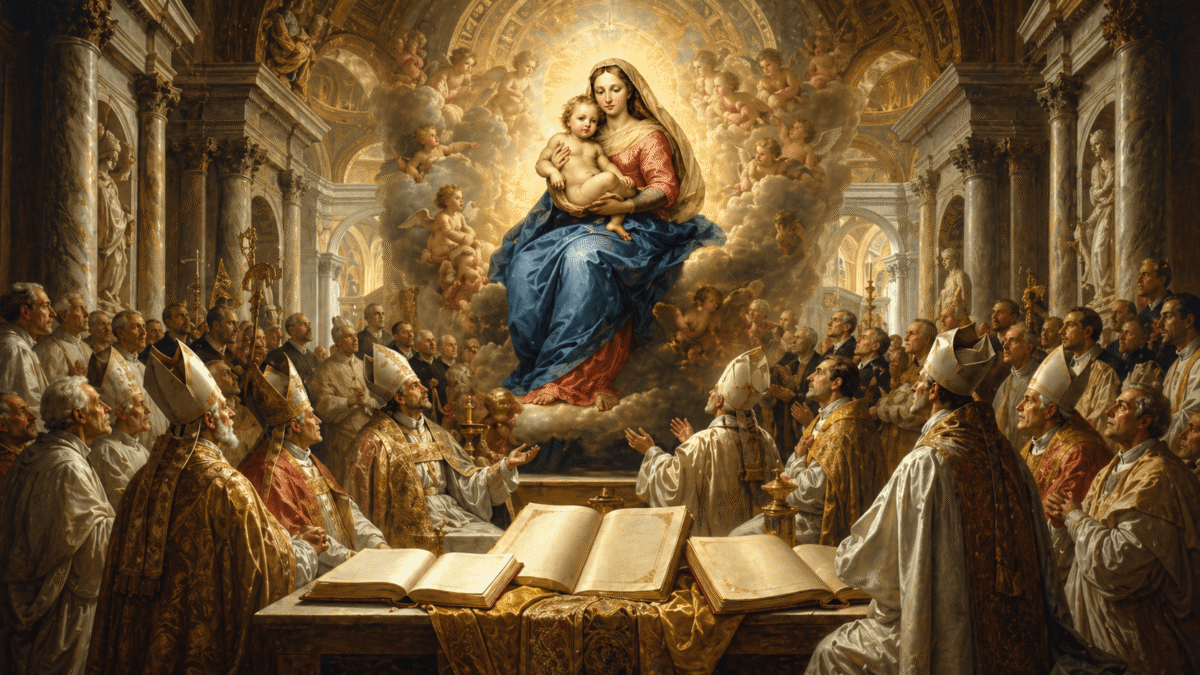
Chapter VIII of Lumen gentium (De Beata Maria Virgine Deipara in mysterio Christi et Ecclesiae) is the most important magisterial text on Mary produced in the twentieth century. Set within the dogmatic constitution on the Church, promulgated on November 21, 1964, it synthesizes Marian doctrine in the light of the history of salvation and inaugurates a new period of post-conciliar Mariology.
The conciliar debate
The central question that divided the council fathers was this: should the text on Mary be an autonomous document or a chapter of the constitution on the Church? On October 29, 1963, in a historic vote, 1,114 fathers voted for the integration of Mary into the document De Ecclesia and 1,074 voted for the autonomy of the Marian schema. The difference of only 40 votes reflects the deep tension between two Mariological currents: the Christotypical, which underscored the uniqueness and eminence of Mary as Mother of God, and the ecclesiotypical, which saw Mary as an eminent member and figure of the Church. Paul VI, in the closing address of the second session, indicated three guidelines for overcoming the impasse: to integrate Marian doctrine into the De Ecclesia schema, to state clearly Mary’s singularity within the Church, and to determine Mary’s mission in relation to Christ and to the Church. At the end of the third session, on November 21, 1964, the Pope promulgated Lumen gentium and proclaimed Mary Mother of the Church.
Structure of Chapter VIII
Chapter VIII unfolds in 18 numbers (nn. 52-69), distributed across a prologue (nn. 52-54), two fundamental parts, and a conclusion (n. 69). The first part, entitled The Role of the Blessed Virgin in the Economy of Salvation (nn. 55-59), presents Mary’s progressive union with Christ throughout the whole history of salvation, with an abundant biblical and patristic apparatus. The second part, entitled The Blessed Virgin and the Church (nn. 60-68), sets out Mary’s relation to the Church under two aspects: the theological (maternal role, typology of virginal motherhood, exemplarity, eschatological image) and the liturgical-pastoral (norms for the cult). The prologue expressly declares that the Council does not intend to exhaust the whole of Marian doctrine, nor to settle the questions still debated among theologians, but to offer the essential and pastoral synthesis (LG 54).
The methodology of the document
Four theological criteria guided the drafting of Chapter VIII. The biblical criterion requires fidelity to Scripture read within the tradition of the Church, with precise references to the Old and New Testaments instead of isolated texts used apologetically. The anthropological criterion brings out Mary’s personal values, the richness of her experience of faith, her obedience, and her free and responsible cooperation with the work of the Savior. The ecumenical criterion demands that Marian doctrine be set forth without triumphalist exaggerations or reductionisms, so that Mary may be a point of convergence and not of division with our separated brethren. The pastoral criterion directs toward a more existential and accessible theology, presenting Mary not as an abstract theological problem but as a person to be understood, loved, venerated, and imitated. The underlying perspective is that of the history of salvation, centered on the one mystery of Christ and of His Church.
Mary and Christ
Chapter VIII articulates the mystery of Mary in relation to Christ under three complementary titles. As Mother of the Savior, Mary is bound to Christ not only by biological motherhood, but by a constant maternal cooperation throughout the whole work of salvation. Her virginity is not a mere moral attribute, but a sign of the mother’s total consecration to the Son, from the conception to the Assumption. As Associate of the Redeemer, Mary cooperated with faith, obedience, suffering, hope, and love throughout her whole life, associating herself with the Son’s sacrifice for the salvation of humanity. The Council, for pastoral and ecumenical reasons, avoided the title of Co-Redemptrix and preferred that of Associate, stressing that this cooperation, being human and relative, takes nothing away from and adds nothing to the efficacy of the one Redeemer. As Handmaid of the Lord, the document highlights the spirituality with which Mary lived her mission: walking in the obscurity of faith, in the warmth of charity, and in the expectation of hope, always obedient to the will of God. This title, by which Mary herself defined who she was in her answer to the angel and in the Magnificat, expresses the whole moral and religious greatness of her cooperation.
Mary and the Church
The Council presents four dimensions of the mystery of Mary in relation to the Church. As to the maternal role, Mary cooperated with love in the birth of the faithful within the Church and continues, from heaven, to exercise this role of intercession and maternal solicitude until the last day. The Council deliberately avoided the titles of Mediatrix and Mother of the Church, specifying that Mary’s maternal role is not a necessary mediation between Christ and the faithful, but the promotion and facilitation of direct union with Him. As figure of the virginal motherhood of the Church, Mary is the prototype of the Church: Christ is born of her and continues to be born of the Church. Mary bore the Son virginally and physically. The Church bears Him mysteriously in the baptismal font and in the proclamation of the faith. As model of virtue, Mary, the first disciple and the perfect Christian, represents for the Church the model of the path of faith, hope, charity, and obedience to the will of God. As image and beginning of the eschatological Church, Mary’s Assumption means that the Church has already attained in Mary its final end and perfection, and that she is, for the historical Church still on its way, a sure sign of hope of the glory to come.
The cult of Mary
Numbers 66-67 of Chapter VIII set out the general principles of the Marian cult. The foundation of this cult is the threefold title of the divine motherhood, of association with the mysteries of Christ, and of Mary’s most excellent holiness. Its nature is essentially different from the cult of adoration due to the Persons of the Most Holy Trinity. Its purpose is to lead to the knowledge, love, and glorification of Christ. The Council distinguishes four expressions of this cult: love, veneration, invocation, and imitation. Imitation is indicated as the most important and the most expressive of an authentic devotion. Liturgical worship, because it preserves the relativity of the Marian cult with respect to divine worship, is the model par excellence. The devotional practices approved by the Magisterium over the centuries are recommended. Triumphalist exaggerations, sterile sentimentalisms, and vain credulities are clearly reproved.
Theological assessment
Chapter VIII defines no new dogma about Mary. The qualification of “dogmatic” given to the constitution is due to the fact that it gathers the dogmas already defined by the Church. Being part of a dogmatic constitution of an Ecumenical Council, it constitutes an act of the extraordinary Magisterium with doctrinally binding value for the whole Church. Its decisive contribution was to offer a theological synthesis of the most secure doctrine on Mary, deepened in the light of Revelation, guided by the perspective of the history of salvation, and presented with a pastoral sensibility responsive to modern times. Chapter VIII inaugurated post-conciliar Mariology, defining its methodological criteria and indicating the lines of future research.
Deepen your studies: explore Mariology, Marian Theology, Marian dogmas, and the Postgraduate Program in Mariology.
Magisterium of the Church
Sacra Synodus (…) non intendit novam doctrinam de Maria propone, sed vult ostendere quomodo ipsa sit inserta in mysterium Christi et Ecclesiae.
Second Vatican Council, Explanatory Note ad Const. Dogm. Lumen Gentium, chap. VIII (1964)
📚. Literal translation: The Holy Council does not intend to propose a new doctrine about Mary, but wishes to show how she is inserted into the mystery of Christ and of the Church.
Postgraduate Program in Mariology
Would you like to deepen your formation in Mariology? Discover the Postgraduate Program in Mariology of Locus Mariologicus – an academic formation that unites theological rigor, spiritual life, and the living tradition of the Church.
Would you like to study Mariology seriously?
This article grows out of the works in the Locus Mariologicus library. The Postgraduate Program in Mariology takes you to the same source, with academic guidance: Scripture, the Fathers of the Church, and the Magisterium, from the first dogma to contemporary questions.




Responses