Mary and God the Father: the beloved daughter of the Father
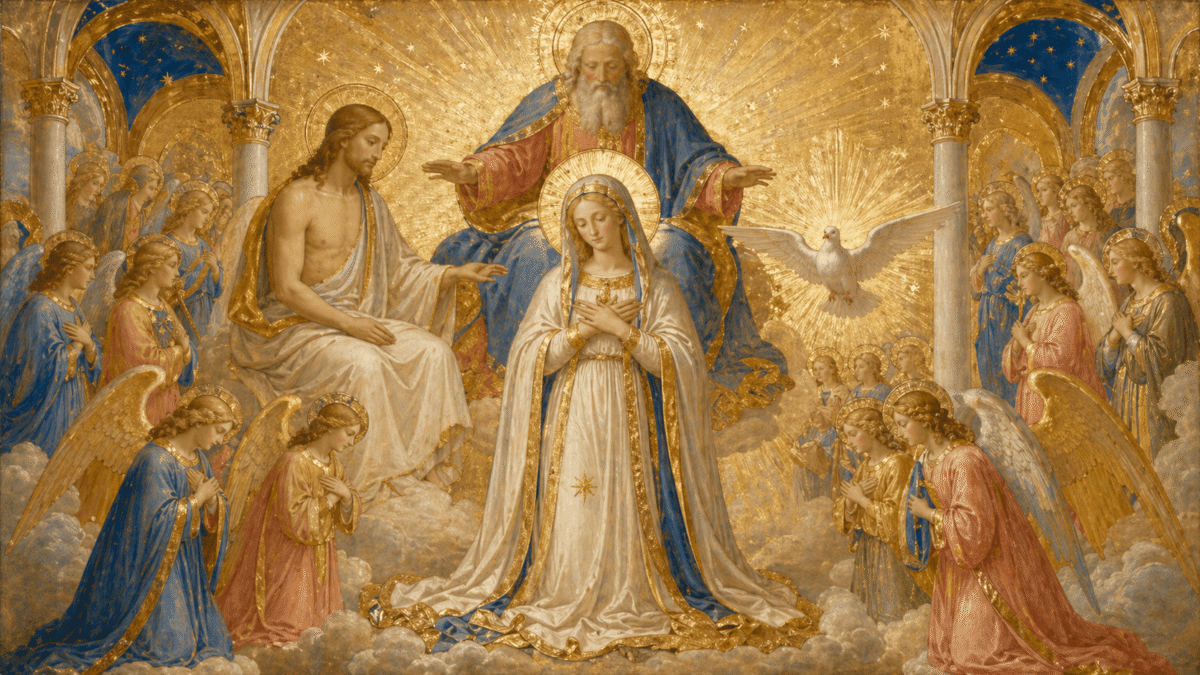
Mary and God the Father, the beloved daughter of the Father
The relationship of Mary with God the Father is one of the axes of Trinitarian Marian theology. The Second Vatican Council sums it up with precision: Mary is “truly the mother of the Son of God” and “therefore the beloved daughter of the Father and the temple of the Holy Spirit” (Lumen Gentium 53). The medieval tradition expressed the same thing with the formula: filia Patris, sponsa Filii, templum Spiritus Sancti.
The Father and Mary in the New Testament
The oldest Pauline text on this relationship is Galatians 4:4: “when the fullness of time had come, God sent His Son, born of a woman.” The Father takes the initiative of sending the Son into the world and chooses a woman to be His point of entry into history. Luke develops this relationship in the first two chapters of his Gospel: the angel is sent “by God” to Mary (Lk 1:26-27). Mary is acclaimed “full of grace, the Lord is with you,” a unique title that expresses the fullness of the grace of the Father placed in her. The virginity of Mary is, within this framework, a “sign of the newness of the kingdom,” which breaks the natural order by the sovereign action of the Father. With the fiat, Mary becomes the new temple of God, the new ark of the covenant, the new “dwelling place of the Lord” in the world.
The Magnificat as a hymn to the Father
The Magnificat (Lk 1:46-55) can be read as Mary’s hymn to the Father: the mercy of God extends from generation to generation, the Father scatters the proud, casts down the mighty, and exalts the humble. Mary thus appears as the “handmaid of the Lord” (Lk 1:38, 48), the only title she attributes to herself, and as “the first revolutionary of the new order,” proclaiming the rights of the Father over history. The Magnificat shows that God chose a poor and humble virgin for His saving design, making Mary a sign of the mercy of the Father for all peoples.
The ecclesiastical tradition: daughter and spouse of the Father
Tradition associates with the Father the initiative of the sanctification of Mary. Saint Cyril of Alexandria, Saint Francis of Assisi, and the French School of the seventeenth century (Bérulle, Olier) stress that Mary was “chosen by the most holy Father in heaven.” The Middle Ages gave preference to the titles of “daughter” and “spouse” of the Father: the first refers to the singular grace with which the Father adorned her. The second refers to the cooperation of Mary in the Incarnation. The Father, as spouse, offers His Son to Mary, asking her for her consent. Saint Thomas explains that filial adoption belongs to the Father as its author, to the Son as its model, and to the Holy Spirit as the one who imprints the likeness in us.
The Marian cult has a Trinitarian reference that terminates in the Father
The apostolic exhortation Marialis Cultus (Paul VI, 1974) stresses that the Marian cult has an essential Trinitarian structure: Christian worship is “a cult offered to the Father through Christ in the Holy Spirit.” Mary is the “ecclesial model of union with Christ, through whom the Church renders worship to the eternal Father” (MC 16). The purpose of the cult of the Virgin is to lead her children to the Father in the Son: “by honoring the one full of grace, Christians are led to cultivate in themselves the state of grace, friendship with God, communion with Him” (MC 57). For Vatican II, “the Father of mercies willed that the acceptance of the predestined mother should precede the Incarnation” (LG 56): Mary cooperated with the Father by obedience, faith, hope, and charity.
Deepen your studies: explore Mariology, Marian Theology, Magnificat, and the Postgraduate Program in Mariology.
Magisterium of the Church
Pater aeternus Mariam ab aeterno elegit in Matrem Filii sui, et gratia singulari praeordinavit eam ad hoc munus sublimissimum.
Second Vatican Council, Dogmatic Const. Lumen Gentium, no. 56
📚 Literal translation: The eternal Father chose Mary from eternity as the Mother of His Son, and with a singular grace preordained her for this most sublime office.
Postgraduate Program in Mariology
Would you like to deepen your formation in Mariology? Discover the Postgraduate Program in Mariology of Locus Mariologicus — an academic formation that unites theological rigor, spiritual life, and the living tradition of the Church.
Would you like to study Mariology seriously?
This article grows out of the works in the Locus Mariologicus library. The Postgraduate Program in Mariology takes you to the same source, with academic guidance: Scripture, the Fathers of the Church, and the Magisterium, from the first dogma to contemporary questions.



Responses