Melito of Sardis and Mary: The Peri Pascha and the Virgin in Second-Century Theology
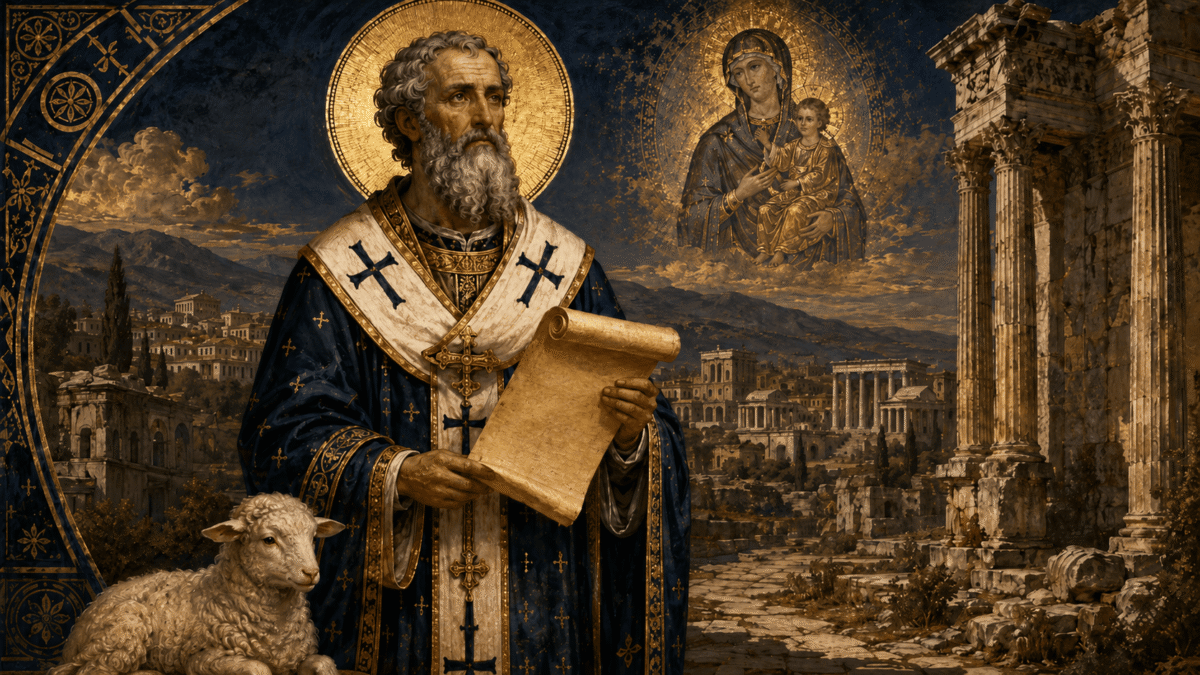
Melito of Sardis, bishop of ancient Sardis in Lydia, who died around the year 190 A.D., occupies a singular place in the history of Marian theology. His homily Peri Pascha, on the Pasch, rediscovered in 1940 from an Egyptian Greek papyrus, is recognized as the oldest complete Christian sermon known to us. Its mariological relevance lies in the way it situates the Virgin Mary at the center of the typological structure of the history of salvation, articulating with poetic rigor the indissoluble relation between the Incarnation and the Redemption.
I. Melito of Sardis and the Rediscovery of the Peri Pascha
The work of Melito of Sardis was known only through indirect references, notably the citations of Eusebius of Caesarea in the Ecclesiastical History. The rediscovery of the Peri Pascha in 1940, from Papyrus Bodmer XIII, restored to the Christian tradition a document of exceptional value: a paschal homily of high theological and literary density, composed to be proclaimed at the Easter vigil, probably in the Asia Minor of the second century.
The exegetical method of Melito of Sardis is typological: the Pasch of Israel prefigures the Pasch of Christ, and the events of the Exodus are read as figures of the New Testament. This method, which would dominate all later patristic exegesis, attains in the Peri Pascha a particularly elevated literary expression. The paradoxical antitheses that describe the paschal mystery, “He who created man was made man,” “He who is invisible was seen,” constitute one of the most striking texts of ancient Christian literature. It is within this typological structure that Mary appears as the indispensable protagonist of the history of salvation.
II. The Virgin at the Beginning of the History of Salvation According to Melito of Sardis
In the culminating section of the Peri Pascha, Melito of Sardis enumerates the paradoxes of the paschal mystery in verses of great poetic cadence. The point of departure is invariably the Incarnation: “born of a virgin.” This formula is not an incidental biographical datum, but the alpha of the history of salvation, the moment in which eternity enters time, the invisible becomes visible, the unlimited accepts the condition of human flesh. For Melito of Sardis, without the Virgin there is no Incarnation. Without the Incarnation there is no Redemption. Without the Redemption there is no Pasch.
This theological structure, in which Mary’s virginal motherhood inaugurates the history of salvation, is one of the most significant contributions of Melito of Sardis to early Mariology. The councils of the fourth and fifth centuries would translate into precise dogmatic definition the fundamental insight that the Peri Pascha expresses poetically: that the Virgin is not a narrative detail of Christology, but the condition of possibility of the Incarnation of the Son of God.
III. Mary as the Pure Ewe Lamb: The Image of Kalos in Melito of Sardis
One of the mariologically richest passages of the Peri Pascha is the one in which Melito of Sardis describes Mary with the image of the “beautiful ewe lamb.” The Greek word used is kalos, which does not mean only “good” in the moral sense, but “beautiful” in the sense of ontological and aesthetic perfection. It is the same word that the Evangelist John places on the lips of Christ: “I am the beautiful shepherd” (ho poimen ho kalos, Jn 10:11). Mary is, therefore, the beautiful ewe lamb of the Beautiful Shepherd, the immaculate mother of the immaculate Lamb.
Mary’s beauty, as Melito of Sardis conceives it, corresponds to her original integrity, to her full consonance with the will of the Father, to her capacity to be the perfect receptacle of the Incarnation. The ewe lamb is pure because the Lamb is pure. The mother shares in the perfection of the Son, not by autonomous merit, but by the grace of the divine election that precedes and conditions her whole existence. This anticipation of the doctrine of the Immaculate Conception, implicitly present in the imagery of Melito of Sardis, would be developed by medieval theology in all its speculative depth.
IV. Incarnation, Passion, and Motherhood: The Soteriological Unity in Melito of Sardis
The theology of Melito of Sardis insists on the indissoluble unity between the Incarnation and the Passion. He who was born of a virgin is the same who was hung upon the wood, buried in the earth, and rose from the dead. This identity between the Son born of Mary and the crucified Christ is the foundation of soteriology: only because Christ is truly human, born of woman, genomenon ek gynaikos (Gal 4:4), does His death have redemptive value for humanity. Mary guarantees the reality of the Redeemer’s humanity.
Within this framework, the Mariology of Melito of Sardis is entirely Christocentric: virginity is not an autonomous perfection, but the sign of the divine origin of the one who is born of her. Motherhood is not a transitory biological function, but the condition of possibility of the Incarnation. The logical chain, without Mary there is no real Incarnation, without a real Incarnation there is no real Redemption, is the nerve of all orthodox Christian Mariology, from Ephesus to Lumen Gentium.
V. The Mariological Legacy of Melito of Sardis
The Peri Pascha of Melito of Sardis is a threshold text: it stands at the moment when early Christian theology begins to find its own language, capable of articulating the absolute newness of the Incarnation. At this foundational moment, the figure of Mary already occupies a structural position: she is the link between creation and the new creation, between the history of Israel and the history of Christ, between humanity wounded by sin and humanity redeemed by the Son of God.
The fact that the Peri Pascha remained unknown for centuries and was rediscovered only in the twentieth century is a methodological lesson for Mariology: the tradition is richer than the documents available in each epoch allow us to perceive. Melito of Sardis confirms that the mariological insight is as ancient as the Christian kerygma itself. The phrase “born of a virgin” is not a Christological footnote; it is the point of departure of the whole narrative of salvation.
The in-depth study of Melito of Sardis and of the other Fathers of the second century is part of the program of the Postgraduate Program in Mariology of Locus Mariologicus, the only academic course in the Portuguese language entirely devoted to Marian science. Cf. Lumen Gentium, no. 55: “These Old Testament prophecies were fulfilled in her”.
Postgraduate Program in Mariology
Would you like to deepen your formation in Mariology? Discover the Postgraduate Program in Mariology of Locus Mariologicus – an academic formation that unites theological rigor, spiritual life, and the living tradition of the Church.
Would you like to study Mariology seriously?
This article is born of the works in the library of Locus Mariologicus. The Postgraduate Program in Mariology takes you to the same source, with academic guidance: Scripture, the Fathers of the Church, and the Magisterium, from the first dogma to contemporary questions.





Responses