Sonnet to the Immaculate Conception: divine motherhood as a theological argument
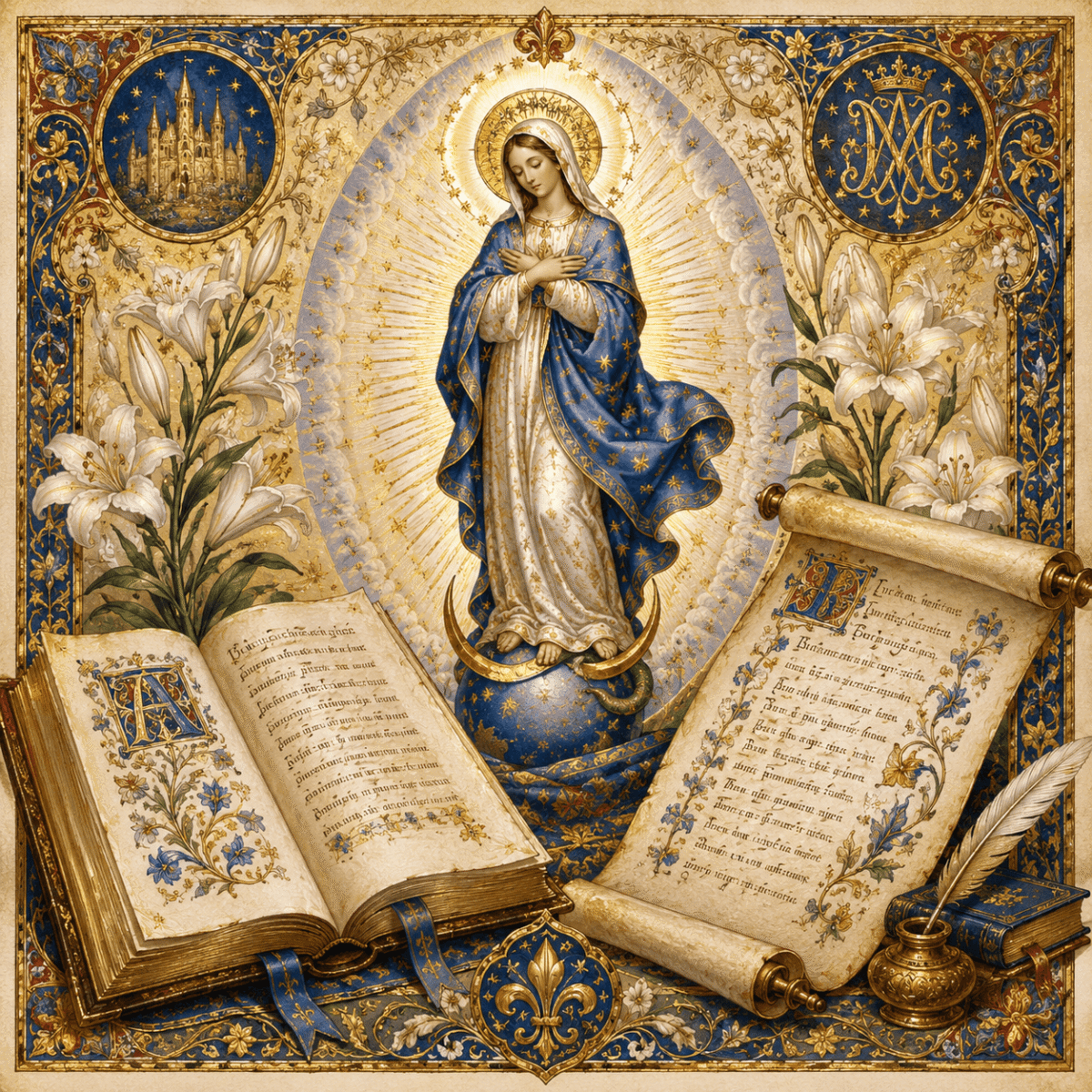
The sonnet, as a poetic form, possesses a structure of mathematical rigor: two quatrains and two tercets, which makes it a privileged instrument for condensed theological argumentation. In the Italian Mariological tradition of the early nineteenth century, an anonymous sonnet on the Immaculate Conception was discovered in the course of a beatification process and presented to the Pope as a theological testimony; he is said to have been moved by the reading. This small poetic document, written in popular and not academic Italian, contains one of the most elegant demonstrations of the ontological nexus between Mary’s divine motherhood and her original preservation from sin.
I. The sonnet as a theological instrument in the Marian tradition
The history of Marian theology is not exhausted in scholastic treatises and dogmatic definitions. There is a poetic way of Mariological thought which, far from being inferior to philosophical discourse, complements it by making accessible to intuition what discursive reason reaches only through long argumentative cadences. The sonnet on the Immaculate Conception is a paradigmatic example of this way: in fourteen lines, its anonymous author condenses a theological argument of extraordinary precision that more extensive treatises would need dozens of pages to develop.
The form of the sonnet, with its two quatrains and two tercets, imposes an argumentative structure in four moments: exposition, development, turn and conclusion. This structure is perfectly suited to theological demonstration, which obeys a similar logic: premise, analysis, synthesis and application. The sonnet on the Immaculate Conception is therefore not a literary adornment of faith, but faith thinking itself through with the utmost precision and economy of means.
II. The argument from divine motherhood and the Immaculate Conception in the sonnet
The theological core of the anonymous sonnet on the Immaculate Conception is a syllogism of rare beauty, formulated in the first person of Mary: “He is my Creator and He is my Son. I am His creature and I am mother”. This paradox of the divine motherhood, the creature who is the mother of her Creator, constitutes the starting point of the argument. The eternal Son, who exists from before all time, is born in time of the woman He Himself created. This circular relation between mother and Son, between creature and Creator, is the foundation of all subsequent reflection on the Immaculate Conception.
The syllogism of the sonnet proceeds with irresistible logic: “If the being of the Son had a mother, and if the Son is without stain, how shall it be said that the mother was stained”? The ontological premise is clear: in the relation between mother and son, there is a mutual participation in their respective beings. The Son took flesh from the mother. If the Son is immaculate, and if the flesh He took proceeds from the mother, then the origin of that flesh cannot be stained. The purity of the Son requires, by logical implication, the original purity of the mother. This is the theological heart of the argument of the Immaculate Conception expressed in the form of a sonnet.
III. The nexus between divine motherhood and the Immaculate Conception in the dogmatic tradition
The poetic argument of the sonnet converges with the theological way that the scholastic tradition and the later Magisterium followed in order to define the dogma of the Immaculate Conception. The fundamental principle is what scholasticism calls potuit, decuit, ergo fecit: God could preserve Mary from original sin, it was fitting that He should do so in view of the dignity of the divine motherhood, therefore He did so. The infinite dignity of the Son requires that the receptacle of His Incarnation be worthy of the divine presence. A mother stained by original sin would be an ontological contradiction in the logic of the Incarnation.
This nexus between divine motherhood and the Immaculate Conception was precisely the argument that the pontifical Magisterium privileged on the way to the dogmatic definition of 1854. The bull Ineffabilis Deus of Pius IX defines that “the blessed Virgin Mary was preserved immune from all stain of original sin in the first instant of her conception, by a singular grace and privilege of almighty God, in view of the merits of Jesus Christ”. The expression “in view of the merits of Jesus Christ” is the exact dogmatic translation of the sonnet’s argument: Mary’s purity is a function of the purity of the Son and of the dignity of the divine motherhood.
IV. The poetic way as preparation for the dogma: the sonnet in the beatification process
The fact that the sonnet on the Immaculate Conception was presented in a beatification process as a theological testimony is historically significant. The positio, that is, the document gathering all the documentation on the heroic virtues of the candidate for beatification, normally contains literary, epistolary and testimonial sources. The inclusion of a Mariological sonnet in this context reveals that the Church recognizes in poetic expression of quality a legitimate form of confession of theological faith, not inferior to scholastic formulation.
The emotion reported in the tradition concerning the papal reaction to the reading of the sonnet expresses precisely this recognition: a text that condenses with such exactness and beauty a fundamental theological argument cannot be the fruit of literary talent alone. It is the fruit of a faith that thinks, of an intelligence illumined by grace that finds in the rigor of the poetic form the most adequate means of expressing the Mariological intuition. The sonnet on the Immaculate Conception is, in this sense, a document of sensus fidei: the faith of the People of God anticipating, in popular and precise language, what the Magisterium would solemnly define decades later.
V. The theological legacy of the sonnet on the Immaculate Conception
The anonymous sonnet on the Immaculate Conception documents a fundamental aspect of the Mariological tradition: the theological intuition that precedes and prepares the dogmatic definition is not the exclusive property of academic treatises. It lives also in poetry, in liturgical hymns, in popular sermons, in sacred art. The history of the dogma of the Immaculate Conception is, in part, the history of an intuition that matured for centuries in the heart of the Christian people before receiving the definitive magisterial sanction in 1854.
The argument of the sonnet, the purity of the mother as a logical implication of the purity of the Son, remains today one of the most effective points of entry into the understanding of the dogma for those who have no formal theological training. The beauty of its formulation is inseparable from the truth it conveys. As John Paul II wrote in Redemptoris Mater, Mary’s divine motherhood is “the point from which every theological reflection on Mary sets out”. The sonnet, in this sense, is a testimony that the simplest faith can reach, by way of grace and poetic intuition, the heart of the mystery that theology expresses in more abstract categories. Cf. Ineffabilis Deus (Pius IX, 1854). The in-depth study of the Immaculate Conception and of the Mariological tradition is part of the curriculum of the Postgraduate Program in Mariology at Locus Mariologicus.
Postgraduate Program in Mariology
Would you like to deepen your formation in Mariology? Discover the Postgraduate Program in Mariology at Locus Mariologicus, an academic formation that unites theological rigor, spiritual life and the living tradition of the Church.
Learn more about the Immaculate Conception.
Would you like to study Mariology seriously?
This article is born of the works in the library of Locus Mariologicus. The Postgraduate Program in Mariology takes you to the same source, with academic guidance: Scripture, the Fathers of the Church and the Magisterium, from the first dogma to contemporary questions.




Responses