Mary and the evangelical counsels

Mary and the evangelical counsels: poverty, chastity, and obedience
Most Catholic institutes of consecrated life throughout the world welcome Mary as a prototype of life, of spirituality, and a model of service. Over the centuries testimonies have not been lacking, and the Magisterium has exhorted consecrated men and women to live this dimension more intensely, one that becomes indispensable to their spirituality in every aspect of their mission.
In post-conciliar society, and above all in contemporary society, there is a need to review all the inalienable traditions of the past. If on the one hand this is a challenge to the centuries-old stabilitas of the Church, on the other hand it is an opportunity, for it places Mariology on a path of rethinking, discussing the Marian references that must correspond to real images of the Virgin and not merely to the realm of disillusionment.
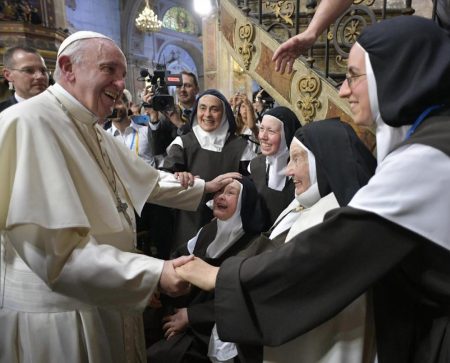
In communities that are making spiritual progress it is a common patrimony that the bond with Mary should be a fundamental presence. This panorama of Mary in the life of those who live the evangelical counsels has been the object of the Magisterium’s attention in recent decades. It is a lived experience of the mystery of Mary that is not solely mystical, of which we have little historical information; it is not merely a venerated Mother of Jesus in the primitive ecclesial community, but a presence that expresses itself, communicates, and exercises maternal functions, introducing us into the mystery of God that accompanies the mystical life, beyond a time along the course of history.
In the life of the evangelical counsels we can find an existential Mariology. It is common to find Marian events in the foundations of various forms of Christian life. This presence of Mary leads to the conclusion that the Mother is contemporary with us in all the religious choices of consecrated persons.
In order to understand the meaning of this fact we must avail ourselves of Mariology, for the current existential theology of consecrated life has offered new aspects concerning Mary’s identity. The first observation is that Mary is not mere historiography or Christian archaeology, but a mysterious presence in the contemporaneity of the Church. Mary offers a feminine perspective for the contemplation of the mystery of God in consecrated life, making us understand a peculiar form of vocation in community life, in mission, in consecration, and in spirituality.
Our postmodern and globalized age is rediscovering this Marian presence, which is beginning to be renewed above all on the basis of the liturgy. The Mystery of Salvation is deconstructing and reconstructing the Mariological substratum, more firmly grounded in the sources of revelation and in ecclesial Tradition, linking it to Christological, pneumatological, ecclesiological, and anthropological developments.
The evangelical counsels today are capable of assimilating the Christian to the virginal and poor way of life embraced by the Mother of Jesus. Mary’s life is a teaching for all, and her intercession will make this form of life grow. Saint Paul VI, in Evangelica Testificatio, proposes Mary as our example and our intercessor, presenting Mary’s life, united to the coming of Jesus, as the foundation of life in consecrated celibacy. Saint John Paul II, in Redemptionis Donum, presents Mary as the first and the most fully consecrated to God. She is a virgin, and her spousal-virginal love becomes fruitful through the divine maternity by the work of the Holy Spirit. She is stripped of everything both in Bethlehem and on Calvary, obeying at every moment with a persevering fidelity as Mother of the life according to the Gospel. This is the Marian paradigm of consecrated life.
The instruction of the Congregation for Institutes of Consecrated Life, from the Council until today, has been presenting Mary as the woman who receives within herself the Word of God, who conceives Him in full fidelity first in her spirit and afterward in her womb. For her faith and her charity she was the example of contemplative life, and a venerable ancient tradition applied to her in the sacred liturgy these words of the Gospel: Mary has chosen for herself the better part. It is clear that the contemplative and ecclesial aspect of Mary’s action and presence was also a strong element to be taken into account.
As regards the devotional dimension toward the Mother of God, we find this aspect to be an integral part of a need for deeper study. How many consecrated men and women have never received a solid formation regarding the charism in which they live, much less a Mariological one, so that there remains a life in which the heart is not united to the intellect. In this sense, Saint John Paul II, in 1999, with the apostolic exhortation Vita consecrata, summed up the relationship between Mary and the life of those consecrated by the evangelical counsels in this way: Mary in the Upper Room is the living image of the Church the Bride, without stain or wrinkle, attentive to the signs of the Bridegroom and ready to welcome the gift of the Spirit. Mary is the virgin who listens, who prays, who contemplates the Passion, standing at the foot of the Cross. In her, religious men and women will find the sure way that guides and strengthens the contemplative dimension of their lives. Mary is the perfect consecrated one from her Immaculate Conception onward. She reflects the beauty of God, she is the closest to Jesus, together with Joseph. She responds to God with a full and unreserved dedication. Mary teaches that every mission begins with the same attitude that she had at the Annunciation: Behold the handmaid of the Lord; let it be done to me according to your Word (Lk 1:38).
In reality, consecrated life follows her example and places itself at the service of the divine plan in the total gift of self. Mary’s example comes to the aid of human needs and brings the divinization of Jesus to those who are around us.
Within the Mariological meaning of those consecrated by the evangelical counsels, poverty, chastity, and obedience, how is Mary contemplated? And in what part of her life can we see the living out of these counsels?
To deepen Mary’s relationship with the evangelical counsels, consult the encyclical of John Paul II: Redemptoris Mater on Mary as a model of the life according to the Gospel and of discipleship.
Deepen your studies: explore Mariology, Marian Theology, Marian apparitions, and the Postgraduate Program in Mariology.
Postgraduate Program in Mariology
Would you like to deepen your formation in Mariology? Discover the Postgraduate Program in Mariology of Locus Mariologicus, an academic formation that unites theological rigor, spiritual life, and the living tradition of the Church.




Responses