The sealed book, the Lord’s tears, and the Lamb who reigns, immolated
By Prof. Dr. Daniel C. Afonso · Updated
“Do not weep: behold, the Lion of the tribe of Judah, the Root of David, has won the victory. He is able to break the seals and open the book.” (Rev 5:5, Vulgata)> There is a cry that precedes every victory, and there is a victory that wipes away every tear. The liturgy of this day, the memory of Saints Roque González, Afonso Rodríguez, and João de Castillo, Jesuit martyrs of the reductions in Paraguay, places side by side two tears that respond to each other throughout the entire span of revelation. In Revelation 5:1-10, the seer of Patmos weeps because no one is found worthy to open the sealed book of history. In the Gospel according to Luke 19:41-44, the Lord himself weeps over the city that did not recognize the time of his visit. Between the two tears lies the Lamb slain, who, having been slain, receives the book and reigns. The Church reads these texts at the end of the liturgical year, when the faithful’s gaze turns to the end of all things, and learns that the meaning of history is not deciphered by force, but by the blood offered.
I. The sealed book and the slain Lamb
John’s vision is a celestial liturgy that judges all earthly history. At the center of the scene is a book, librum scriptum intus et foris, signatum sigillis septem, “a scroll written inside and out, sealed with seven seals,” God’s entire design for the world, written on both sides because nothing is left outside of his rule. The drama arises from a question loudly posed by the mighty angel, quis est dignus aperire librum? “Who is worthy to open the book?” The answer is a silence that reverberates through all three levels of the cosmos, for no one in heaven, on earth, or under the earth is found worthy. In the face of this silence, John weeps bitterly, flebam multum, and his tears are not a sign of weakness, but the sorrow of the entire human race unable to give meaning to its own destiny.
Consolation comes from an elder who proclaims the Lion of Judah and the Seed of David, titles of regal strength and Davidic messianism. Yet what John then sees contradicts the expectation of the image. In place of the Lion appears a Lamb, and not a triumphant Lamb, but Agnum stantem tamquam occisum, “a Lamb standing as if slain.” The victory of the Lion is realized in the form of the slain Lamb who stands. The throne of the universe has at its center a living victim. The new song declares the reason for his dignity, quoniam occisus es, et redemisti nos Deo in sanguine tuo, “for you were slain, and by your blood you redeemed us to God,” from every tribe, language, people, and nation. Sovereignty over history belongs to him who bought it with his own blood, and from this redemption a kingdom of priests arises.
II. God’s tears over the city
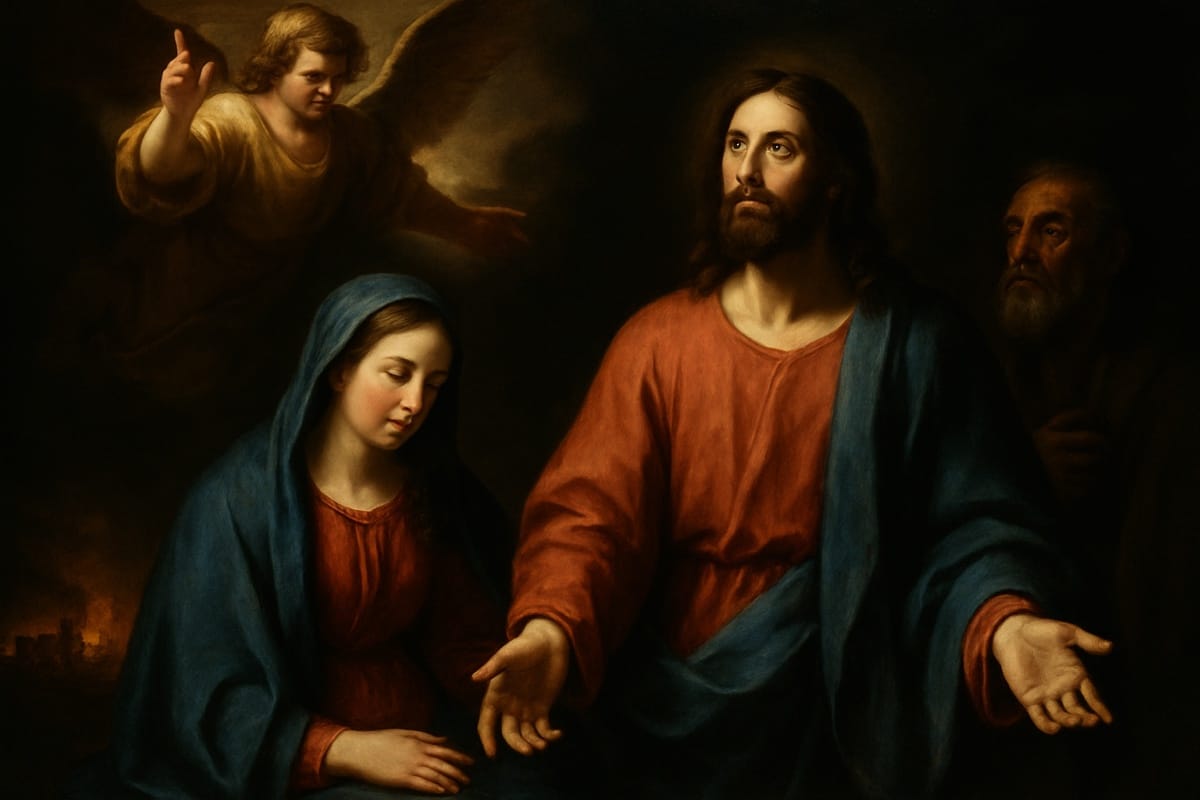
The Gospel takes us from the sky of Patmos to the road leading down to Jerusalem, and what is seen there is astounding. The one who in Revelation is surprised to weep over the city, Videns civitatem flevit super illam, “seeing the city, wept over it.”The Lucan verb is strong and does not describe a subtle emotion, but the open lament of one who grasps a dead body. God weeps over the creature He loves. The phrase that follows remains suspended, incomplete, broken by the emotion, si cognovisses et tu, et quidem in hac die tua, quae ad pacem tibi (if only you had known, on this very day of yours, what brings you peace).
The tragedy of Jerusalem has a precise name, and Luke delivers it in the final word of the text, eo quod non cognoveris tempus visitationis tuæ (because you did not recognize the time of your visitation). She was not punished for a vague sin, but for not having recognized the hour when God passed through her streets. The images of the siege, the trenches, the assault from all sides, the reduction to rubble, are not arbitrary vengeance, but the internal consequence of a heart that closed its eyes, abscondita sunt ab oculis tuis (they are hidden from your eyes). Blindness before the Visitor is the beginning of ruin. The Lord’s tears are not impotence, but love that anticipates the disaster and yet continues to offer peace.
III. The Visitation Deciphers the Book
The two readings form a single theological grammar when read in light of one another. The sealed book of the Apocalypse is the human story in all its opacity, and the inability to open it is precisely the inability of the city that did not recognize the time of its visitation. John weeps because the meaning is locked away. Jerusalem weeps, or rather is wept upon, because she had the meaning before her eyes and did not recognize it. What was lacking in both scenes is the same thing, the dignity of one who can open and the discernment of one who knows how to recognize. Both belong to the Lamb who was slain, for only the blood shed opens the seals, and only the rejected Visitor reveals what brings peace.
Here the memory of the three martyrs of Paraguay finds its place. Roque González and his companions did not conquer the peoples of the reductions with the sword, but offered their lives to the point of blood, and in this gift they repeated the logic of the Lamb who reigns immolated. Martyrdom is not an accident in the history of the Church, but the form in which the book continues to open in each generation. Whoever sheds blood for love participates in the only dignity that deciphers time. The peace that Jerusalem did not recognize is the same that the martyrs announced to the nations of the tribe, language, and people that Christ redeemed.
IV. Mary, Who Recognized the Time of the Visitation
Mary is the antithesis of the city that wept for not recognizing. Where Jerusalem did not know tempus visitationis (the time of visitation), the Virgin is precisely the one who welcomed the Visitation as the axis of her existence. The same Lucan word that condemns the city, visitatio, is the one that tradition has consecrated to name the mystery of Mary who hurried to see Elizabeth, carrying in her womb the Visitor. The city closed its eyes, the Virgin opened her womb and her song. Where one did not know how to read her day, the other proclaimed that all generations would call her blessed.
There is a second thread that links Mary to the immolated Lamb. The new song of Patmos celebrates the blood that redeems, and that blood was woven into the flesh of the Virgin. The victim standing in the center of the throne received from Mary the humanity that offered itself. That is why tradition contemplates her at the cross, on Calvary, associated in a unique way with the immolation that opens the book of history. The one who generated the Lamb is also the one who accompanied Him to immolation. Before the tears of John and the Lord’s tears, Mary appears as the creature in whom the tears have already turned into song, because she recognized the time when God visited her, and from that recognition was born, for all peoples and nations, the peace that the city did not know how to receive.
Postgraduate Program in Mariology
Would you like to deepen your formation in Mariology? Get to know the Postgraduate Program in Mariology from Locus Mariologicus, an academic formation that combines theological rigor, spiritual life, and the living tradition of the Church.
Join the waiting list for the 2027 class →
Would you like to study Mariology seriously?
This article draws on the works of the Locus Mariologicus library. The Postgraduate Program in Mariology takes you to the same sources with academic guidance: Scripture, the Church Fathers and the Magisterium, from the first dogma to contemporary questions.
Responses