How many angels are there? What does the Bible and the Church say
By Prof. Dr. Daniel C. Afonso · Updated
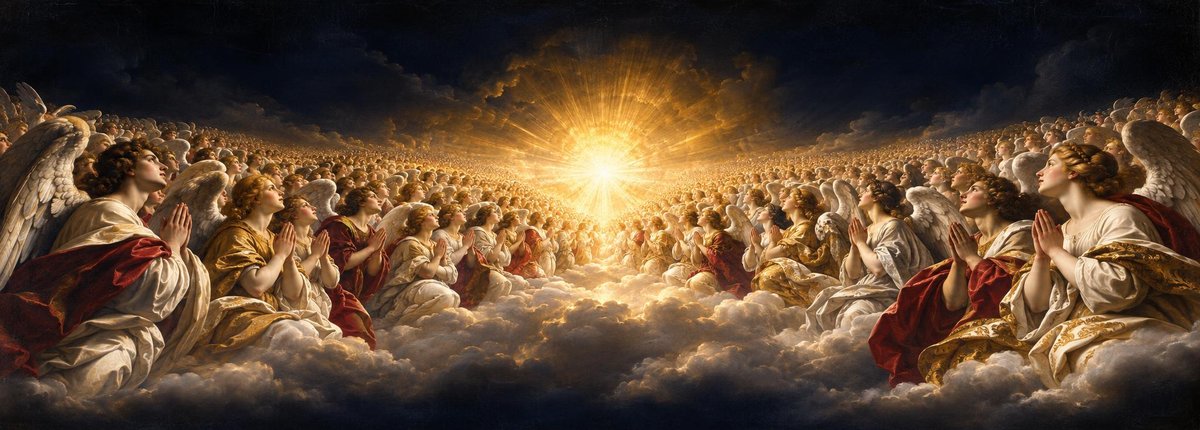
No one knows the exact number, and the Church has never defined one. Scripture speaks of “thousands of thousands” and “myriads of myriads” of angels, and the Catechism teaches that their existence is “a truth of faith” (no. 328). The thesis that they outnumber all material things is Saint Thomas Aquinas’, and should be read as a significant theological opinion, not as a dogma.
In summary
- The number is unknown, and the Church has not defined any.
- What the Bible says: Angels form a multitude that cannot be numbered: “thousands of thousands” (Dan 7:10), “myriads of myriads” (Rev 5:11).
- What faith requires: to believe that angels exist and that they are personal and immortal creatures (Catechism, nos. 328 and 330).
- St. Thomas’ Opinion: The multitude of angels surpasses every material multitude (Summa Theologica I, q. 50, a. 3).
- Beware of numbers: Biblical numbers speak of greatness, not statistics.
“He who seeks a number will be left without it”
The question is natural, but the honest answer is that no one knows. The Bible does not give the number of angels, the Catechism does not give it, and the Church has not defined it. To answer well, it is useful to separate three levels. First, what is true of faith: angels exist. Second, what the Scriptures say clearly: they are an immense multitude. Third, what is the reasoning of theologians: why would this multitude be so great. Mixing these three levels is the most common way to err on this subject.
# What does Scripture say about the multitude of angels?
The texts that refer to the number of angels always use the language of a multitude. The translations below are ours, made from the Nova Vulgata. In Daniel, the vision of God’s throne says:
“Thousands upon thousands served him, and ten thousand times a hundred thousand stood before him.” (Daniel 7:10)
The Apocalypse resumes the scene before the Lamb: “I saw and heard the voice of many angels around the throne, and of living beings and elders, and the number of them was myriads of myriads and thousands of thousands” (Rev 5:11). The Letter to the Hebrews tells Christians that they have approached the heavenly Jerusalem and “many thousands of angels” (Heb 12:22).
The Gospels follow the same style. At the time of His arrest, Jesus tells one of His disciples to sheathe his sword and asks, “Do you think I cannot pray to My Father, and He will provide Me with more than twelve legions of angels?” (Mt 26:53). On the night of His birth, the angel who announces the Savior is suddenly joined by “a multitude from the heavenly militia, praising God” (Lc 2:13). In Job 25:3 there is the rhetorical question, “Is there a limit to His host?” which speaks of God’s forces without explicitly stating they are angels. To see how the Bible treats angels in general, read Angels in the Bible.
These numbers do not aim to make a count. “Thousands of thousands” and “myriads of myriads” are ways to say that the multitude surpasses any reckoning. The image of the legions in Matthew has the same meaning: Jesus wants to show that he would not lack defense, and he is not providing the size of the heavenly army. Whoever tries to add up these figures has already left behind what the text intends to convey.
What does the Catechism teach, and what does it not teach?
The Catechism is precise on this matter. It opens its teaching on angels with the affirmation that the existence of the spiritual beings that Scripture calls angels «is a truth of faith» (n. 328). It then describes their nature: «As purely spiritual creatures, they are endowed with intelligence and will: they are personal and immortal creatures. They surpass all visible creatures in perfection» (n. 330). And it highlights their centrality: «Christ is the center of the angelic world. They are His: ‘When the Son of Man comes in His glory with all His angels…’» (n. 331).
In these numbers, no figure is given. The faith of the Church states that angels exist, who they are, and for whom they exist. It does not say how many there are. Whoever asserts a precise number, whatever it may be, is speaking on their own. Regarding the orders and choirs in which tradition distributes them, we treat in Hierarchy of Angels According to the Bible.
Saint Thomas: Why the Multitude of Angels is So Great
The theologian who most thoroughly addressed the question was Saint Thomas Aquinas. In the *Summa Theologica* (I, q. 50, a. 3), he raises the issue and begins by addressing the difficulties. Someone might say that number is a quantity that arises from the division of a continuous thing, and angels do not have a body. Another might argue that the closer one is to the One, the less multiplicity there is, and that angels are closer to God than any creature. A third person could point out that Aristotle sought to deduce the number of separate substances from the number of celestial motions, and that this number is small. Against all of these objections, Thomas appeals to the words of Daniel: “Thousands of thousands served him.”
His response has two parts. First, it presents Aristotle’s thesis, which counts separate substances by the movements of the heavens, and Maimonides’ attempt to reconcile it with Scripture, and rejects both. Then, it concludes:
“It must be said that angels, as immaterial substances, are in a certain maximum multitude, which exceeds every material multitude.” (Thomas Aquinas, *Summa Theologica* I, q. 50, a. 3, body, our translation)
To support his thesis, Thomas quotes the author of *Hierarchia Celeste*, whom he calls Dionysius. In Thomas’ formulation, this text says: “there are many blessed armies of the minds in heaven, which exceed the fragile and limited measure of our material numbers” (*Hierarchia Celeste*, ch. 14, cited in I, q. 50, a. 3).
The reason Thomas adds is one of analogy. God, in creating, willed the perfection of the universe, and the most perfect things are created with greater excess. In bodies, this excess is seen in size: Thomas observes that, in the astronomy of his time, celestial bodies far exceeded our sphere of corruptible things. In incorporeal realities, the excess is seen in number. Therefore, he writes, “it is reasonable that immaterial substances should exceed material substances in multitude, almost incomparably.” Astronomy has changed, and the argument holds true for the principle, not just the example.
Thomas also addresses the difficulties. To those who said that the number comes from the division of the quantity, he replies that in angels, the number comes from the distinction of forms. To those who said that the nearness of God requires few angels, he replies that this nearness requires the minimum of multiplicity in the composition of each, “not however that it be realized in few” (I, q. 50, a. 3, ad 2).
This is a theological reason. It has great authority, because it is from Saint Thomas, Doctor of the Church, and it agrees with the language of Scripture, but it has not been defined as a doctrine of faith.
A connected thesis: each angel, a species
In the following article (I, q. 50, a. 4), Thomas argues that angels differ from one another in species. For him, it is “impossible for there to be two angels of the same species,” because, without matter, nothing distinguishes two individuals of the same nature. Hence his formula: “The perfection of the angelic nature requires the multiplication of species, not the multiplication of individuals within a single species” (ad 4). The thesis belongs to Thomas’ system and does not appear in the teaching of the Catechism. It is appropriate to call it by its correct name: it is school theology, not revealed truth.
How many angels fell? An ancient curiosity
From an early age, he wondered how many angels had joined the rebellion. The Apocalypse describes the dragon whose “tail swept a third of the stars from the sky and cast them to the earth” (Rev 12:4). The text is a symbolic vision and speaks of stars. It does not provide any count of angels, and whoever seeks it there does so at their own initiative.
Thomas does not count, but he reasons. In I, q. 63, a. 9, he concludes that “more angels remained than sinned.” The reason is that sin is against the natural inclination, and what happens against nature happens in fewer cases. In *sed contra*, he quotes a phrase from the Fourth Book of Kings (chap. 6, according to Thomas’s numbering), which he understands of good and bad angels: “More are with us than with them.” This is again the opinion of a theologian, and it is not based on any counting.
What does this mean for us?
The multitude of angels is not a matter of curiosity. It reveals something about God and our place before Him. The Catechism reminds us that the Church, in her liturgy, “associates herself with the angels” to worship the Threefold Holy God (n. 335), and that human life, from beginning to end, is surrounded by angelic protection: “Every faithful person is accompanied by an angel as a protector and shepherd to guide them to life” (n. 336).
Therefore, the most useful question may not be “how many are there?”, but “for what purpose?”. As the Catechism states, quoting Saint Augustine, “angel” is a name of office, not of nature: it is a spirit by what it is, an angel by what it does (n. 329). The multitude of them serve God and serve us, and the Letter to the Hebrews asks if they are not all “ministering spirits, sent to serve those who are to inherit salvation” (Heb 1:14, cited in n. 331).
## Frequently Asked Questions
Quantos anjos existem?
Ninguém sabe. A Bíblia fala de «milhares de milhares» (Dn 7,10) e de «miríades de miríades» (Ap 5,11), expressões que indicam uma multidão incontável, e não uma cifra. O Catecismo afirma que os anjos existem (n. 328), mas não indica número.
A Igreja definiu o número de anjos?
Não. O Catecismo ensina como verdade de fé que os anjos existem (n. 328) e descreve a sua natureza (n. 330), mas nos números 328 a 336 não aparece nenhuma cifra. Qualquer número preciso é opinião particular.
O que São Tomás ensina sobre o número dos anjos?
Na Suma Teológica (I, q. 50, a. 3), ele sustenta que os anjos estão numa multidão máxima, que excede toda multidão material. É opinião teológica de grande autoridade, e não uma definição da Igreja.
O que significam «milhares de milhares» e «doze legiões de anjos»?
São modos bíblicos de dizer uma multidão que ninguém consegue contar. Em Mt 26,53, Jesus usa a imagem das legiões para mostrar que não lhe faltaria defesa, e não para informar o tamanho do exército celeste.
Quantos anjos caíram com Lúcifer?
A Escritura não diz. Ap 12,4 fala da «terça parte das estrelas do céu», numa visão simbólica que não traz contagem de anjos. São Tomás conclui que permaneceram mais anjos do que pecaram (I, q. 63, a. 9).
## References
- SACRED SCRIPTURE: Dn 7:10, Ap 5:11, Ap 12:4, Hb 12:22, Mt 26:53, Lc 2:13, Jó 25:3. Translations from the New Vulgata. Hb 1:14 and Mt 25:31 as cited in the Catechism, no. 331.
- Catechism of the Catholic Church, nos. 328-336.
- Thomas Aquinas. *Summa Theologiae* I, q. 50, a. 3 and 4, and I, q. 63, a. 9. Latin text: Corpus Thomisticum. Our translation.
- Dionysius. “On the Celestial Hierarchy,” ch. 14, cited by Thomas Aquinas in “Summa Theologiae” I, q. 50, a. 3.
Responses