Do angels have bodies? How do they appear to humans?
By Prof. Dr. Daniel C. Afonso · Updated
In a proper sense, no. The Church teaches that angels are purely spiritual creatures: the Catechism speaks of “spiritual beings, not corporeal” and affirms that their existence “is a truth of faith” (no. 328). When Scripture shows them dining at Abraham’s table or walking alongside Tobias, the classic explanation, as given by Saint Thomas Aquinas, is that they assume bodies to manifest themselves, without these bodies being their own bodies.
In summary
- Short answer: Angels do not have a body. They are spirits (Catechism, nos. 328 and 330).
- What is of faith: the existence of angels as spiritual creatures. The Fourth Council of Lateran distinguishes the spiritual, angelic creature from the corporal one.
- St. Thomas’ explanation: When angels appear, they assume bodies formed by divine power. It is a theological opinion regarding the manner, not a defined doctrine.
- These bodies do not live: the angel neither eats nor feels for them. They are signs of his spiritual action.
- The difference of Christ: The Resurrected One has real flesh and bones, which “a spirit does not have” (Lk 24:39).
# What the Church Teaches: Angels are Spirits
The Catechism treats of angels, affirming that the existence of “spiritual, non-corporeal beings” to which Scripture calls angels “is a truth of faith,” and that the testimony of Scripture regarding them “is as clear as the unanimity of Tradition” (n. 328).
Furthermore, it states what they are: “As purely spiritual creatures, they are endowed with intelligence and will: they are personal and immortal creatures” (n. 330). And it recalls a phrase from Saint Augustine, for whom “angel” is a term of office, not of nature: the angel “is spirit by what he is, is angel by what he does” (n. 329).
The same doctrine appears in the definition of faith of the Fourth Lateran Council (1215). The Council confesses one God, the creator of all visible and invisible things, who created from nothing, from the beginning of time, the two orders of creatures, spiritual and corporal, that is, angelic and mundane (DH 800, our translation). The central point of the definition was the creation of all by one God, but the distinction between the spiritual, angelic creature and the corporal one lies in the Council’s mode of expression.
Why an Angel Does Not Need a Body
Saint Thomas Aquinas questions whether angels have bodies naturally united to them and answers that they do not (Summa Theologica I, q. 51, a. 1). The reasoning is this: understanding is not an act of a body’s organ, and thus having a body does not belong to the nature of an intelligent being as such. The human soul is united to the body because it is imperfect and acquires knowledge through the senses, from sensible things. Now, in every genus where there is something imperfect, there must first exist something perfect. Therefore, there are intelligent substances separate from bodies, “and these we call angels.”
It is fitting to distinguish two levels. That angels are spiritual and non-corporeal is taught by the Catechism and the faith of the Church. The argument of Thomas, starting from the nature of knowledge, is a highly authoritative theological reasoning, but it is not a definition.
One of the objections he examines cites ancient passages that call demons aerial animals. Thomas responds that Augustine, at this point, “speaks not asserting, but using the opinion of the Platonists” (I, q. 51, a. 1, ad 1).
## Angels Who Are Seen: What the Scriptures Say
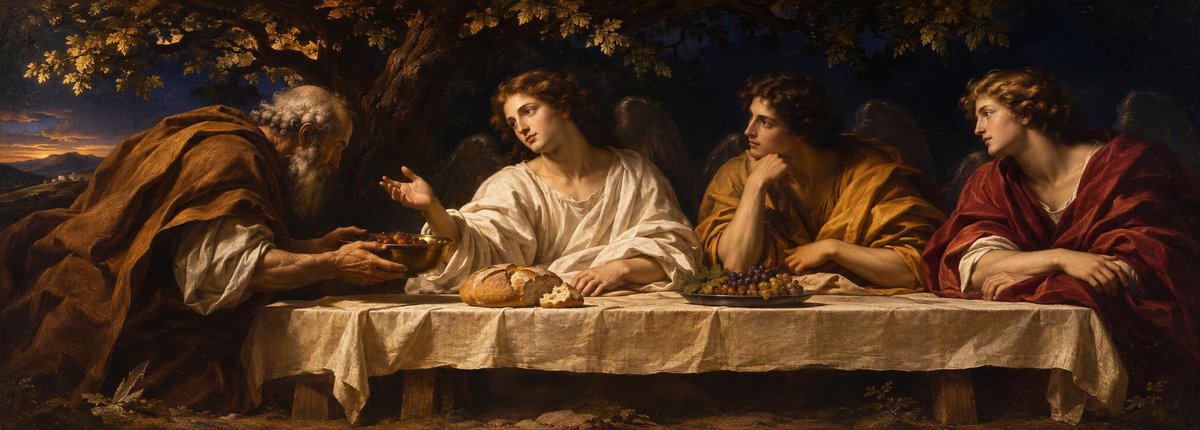
The Bible, however, does show visible angels. In the oak grove of Mamre, three “men” appeared to Abraham (Gn 18:2). He offered them bread, milk, butter, and a calf, and the text says: “and they ate” (Gn 18:8). In Sodom, two angels arrive at sunset. Lot prepares them a feast, baking unleavened bread, and “they ate” (Gn 19:1-3). The city’s men surround the house in search of them (Gn 19:4). Chapter 18 speaks of the visitors as men and also as the Lord, and the tradition that Saint Thomas collects, from Saint Augustine, sees in these visitors angels in assumed bodies (I, q. 51, a. 2, sed contra).
In the Book of Tobias, the angel Raphael accompanies the young Tobias on a long journey as a traveling companion, whom Tobias calls Azarias (cf. Tob 6,7). At the end, he reveals himself: “I am Raphael, one of the seven holy angels” (Tob 12,15). Regarding meals, he says that “he ate nothing” (Tob 12,19). Then he ascends to God, and the two “could no longer see him” (Tob 12,21). There is more about him on Archangel Raphael.
How do angels assume bodies, according to Saint Thomas?
St. Thomas asks whether angels assume bodies (I, q. 51, a. 2). Some said never, and that everything the Scripture recounts are visions of the imagination. He responds that this contradicts the intent of Scripture. What is seen only in imagination is seen only by him who imagines it, and the Bible shows angels seen by many: Abraham and his whole family, Lot, the citizens of Sodom, and in the case of Raphael, by all. “Now, by such a vision, one sees only a body,” he concludes. Since angels are neither bodies nor have bodies naturally united to them, “it remains that sometimes they assume bodies.”
Regarding the matter, he teaches that angels form these bodies of air. Thin air does not retain form or color, but “when it condenses, it can receive form and color, as is seen in clouds,” and angels condense it “by divine power” (ad 3). This is the point at which caution is in order. Neither the Catechism (nos. 328-336) nor Lateran IV (DH 800-802) delve into this detail. The matter of the assumed body and the manner of its formation are explanations from school, a theological opinion of Saint Thomas, and not a defined doctrine.
And why? Thomas says that angels “do not need a body assumed for themselves, but for us.” Speaking familiarly to men, they show the society we expect to have with them in the life to come. He adds that the appearances in the Old Testament were a figurative sign that the Word of God would assume a human body (1). This, too, is theological reading, not a definition.
Does this body live? Do they eat, feel, speak?
Thomas’ response is careful (I, q. 51, a. 3). Some works of living beings have something in common with works of inanimate things. Speaking, as sound, and walking, as motion, are such. In this regard, angels can do it through assumed bodies. But not in what is proper to living beings, because “nothing can have the work of life that does not have life.”
Therefore, strictly speaking, eating is not suitable for angels, since eating is to convert the food into the substance of the one who eats. For Thomas, the meal of the angels “was not true food, but a figurative meal of a spiritual food” (ad 5). He quotes Raphael in a different form of the text than the New Vulgata: “I seemed indeed to eat and to drink.” Nor is feeling the work of the assumed body: “feeling is entirely the work of life.” The eyes and the other parts of these bodies are formed to designate the virtues of the angel, “as by the eye the cognitive virtue of the angel is designated” (ad 2). And the angel speaks, forming in the air sounds similar to human voices (ad 4).
Would this be a deception? Thomas replies that it is not, for Scripture also describes spiritual realities with sensitive images. According to him, “it does not contradict the truth of the holy angels that the bodies assumed by them appear to be living men, though they are not” (I, q. 51, a. 3, ad 1). The body is a sign.
The Difference of the Risen Christ
Here is the decisive difference. In the evening of Easter, the frightened disciples thought they were seeing a spirit, and Jesus says to them: “Look at my hands and my feet, that I am truly human! Touch me and see, for a spirit does not have flesh and bones, as you see that I have” (Lk 24:39). Then he asks: “Do you have anything here to eat?” (Lk 24:41).
St. Thomas observes that the body of Christ’s Resurrection was of such a nature that the food consumed therein could be transmuted, and thus His eating was truly His (I, q. 51, a. 3, ad 5). The angel’s body is assumed and figurative. Christ’s body is His flesh, truly His.
Jesus says to the Sadducees, regarding the resurrection, “Men will neither marry nor be given in marriage, but will be like the angels in heaven” (Mt 22:30). The text deals with marriage and does not define the nature of angels, but it assumes for them a life that does not involve marriage.
What does this mean for us?
The Catechism speaks of a protection that accompanies the whole of life, not of apparitions: “From the beginning to death, human life is surrounded by its protection and intercession” (n. 336). Angels are, as the Letter to the Hebrews quotes them, “servant spirits, sent to minister to those who are to inherit salvation” (n. 331). This help does not depend on us seeing them. For the angel who accompanies each person, see Every human being has a guardian angel.
## Frequently Asked Questions
Os anjos têm corpo?
Não. O Catecismo os descreve como «criaturas puramente espirituais» (n. 330) e fala de «seres espirituais, não-corporais» (n. 328). Quando aparecem, assumem corpos de modo transitório, segundo a explicação de São Tomás de Aquino.
Como os anjos aparecem aos homens?
A Escritura os mostra sob forma humana, como em Gn 18-19 e no livro de Tobias. São Tomás ensina que os anjos assumem corpos, formados de ar condensado por virtude divina. Esse modo de explicar é opinião teológica, e não doutrina definida.
Os anjos comem de verdade?
Não, segundo São Tomás. Comer é converter o alimento na substância de quem come, e o corpo assumido pelo anjo não tem essa natureza. A refeição foi «figurativa de uma comida espiritual» (I, q. 51, a. 3, ad 5).
Quando um anjo aparece, é só uma visão da imaginação?
Para São Tomás, não. Nos relatos bíblicos o anjo é visto por várias pessoas, como Abraão, Ló e os habitantes de Sodoma, e «por tal visão não se vê senão um corpo» (I, q. 51, a. 2).
Qual é a diferença entre o corpo de um anjo e o de Cristo ressuscitado?
O Ressuscitado tem carne e ossos reais: «um espírito não tem carne nem ossos, como vedes que eu tenho» (Lc 24,39). O corpo do anjo é assumido e figurativo, e o seu comer, segundo São Tomás, não é verdadeiro.
## References
- HOLY BIBLE: Gn 18:2, 8 and 19:1-5, Tb 6:7 and 12:15-19-21, Mt 22:30, Lc 24:39-41, Hb 1:14. Translations from the New Vulgata (Libreria Editrice Vaticana, vatican.va).
- Catechism of the Catholic Church, nos. 328-331, 336, and 350.
- Fourth Lateran Council (1215), Chapter 1, On Catholic Faith. In: Denzerger, Heinrich, Hunermann, Peter. Enchiridion Symbolorum, no. 800. Our translation.
- THOMAS AQUINAS. *Summa Theologiae* I, q. 51, a. 1-3 (body and answers). Latin text: *Corpus Thomisticum, Textum Leoninum*, corpusthomisticum.org/sth1050.html. Our translation.
Responses