Angels at Mass: from the Gloria to the Sanctus and the “Supplices” prayer
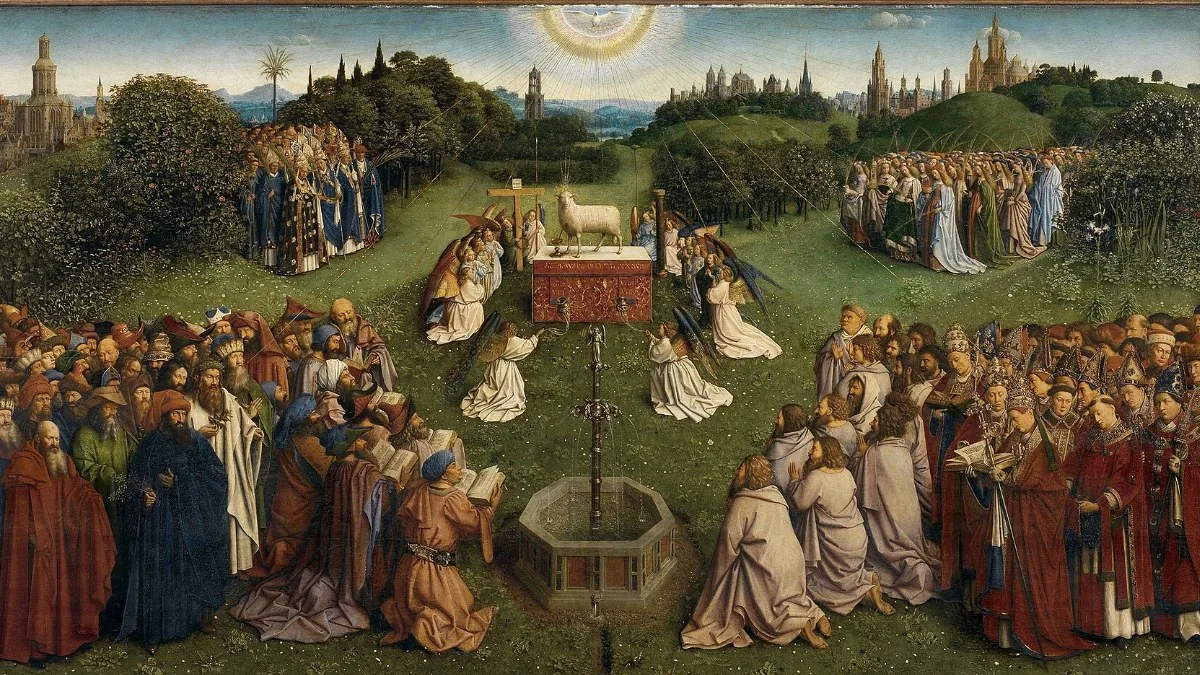
Et ideo cum Angelis et Archangelis, cum Thronis et Dominationibus, cumque omni militia caelestis exercitus, hymnum gloriae tuae canimus, sine fine dicentes (Therefore, with the Angels and Archangels, with the Thrones and Dominations, and with all the militia of the heavenly host, we sing the hymn of your glory, saying without end)
Roman Missal, concluding formula of the Preface
Why the liturgy of earth sings with the angels and what this reveals about Mary, Queen of Angels
Meditation on liturgical Angelology based on the Ordinary of the Mass
There is a sentence that the faithful hear at every Mass and almost never listen to. Before the Sanctus, the priest concludes the Preface by saying that the assembly sings “with the Angels and Archangels.” This is not a poetic image or a courtesy toward heaven. It is a theological affirmation: at the moment when the Church draws near to the sacrifice, she declares that she is not alone and that her voice joins another liturgy, older than her own.
The Catechism of the Catholic Church says this in a single line: “In the liturgy, the Church joins the angels in adoring the thrice-holy God” (CCC 335). Angelology, therefore, is not a curious chapter of theology, separate from the life of the faithful. It enters the Mass through three doors: the Gloria, the Sanctus and the prayer of the Roman Canon that begins with Supplices te rogamus (We beseech you). And each of these doors leads, discreetly but really, to the Mother of the Lord.
I. The Gloria: the first hymn the Church learned from the angels
The Gloria was not composed by a liturgist. Its first words were sung by the angels over the newborn child of Bethlehem: “Glory to God in the highest heaven, and peace on earth to those he loves” (Lk 2:14). The Catechism recalls that this song “has never ceased to resound in the praise of the Church” (CCC 333). The medieval tradition was fully aware of this. The scholar Gunilla Iversen shows how the Carolingian commentary Quotiens contra se explained the place of the Gloria at the very beginning of the Mass, and that the medieval tropes invited the priest to intone the hymnum angelicum (angelic hymn) (IVERSEN. Laus angelica. 2010, pp. 97-102).
It is worth not passing quickly over the scene of Lk 2. The angels sing over a child who has just been wrapped in swaddling clothes and laid in a manger by the hands of his mother (Lk 2:7). The first Gloria in history therefore resounded before Mary. When the Church repeats it on Sundays, she repeats a song that was born before the Virgin and her Son. The Gloria is not decorative: it is the memory of Christmas within every Mass.
II. The Sanctus: the liturgy of heaven enters the Canon
The Sanctus comes from the prophet Isaiah. In the Temple, Isaiah saw the seraphim calling to one another: “Holy, holy, holy is the Lord of hosts, the whole earth is full of his glory” (Is 6:3). The Apocalypse takes up the same cry before the throne of the Lamb (Rev 4:8). The Benedictine Cipriano Vagaggini recalls that this threefold acclamation was already used by the Jews in the liturgy of the synagogue, where it was called Kedushah (sanctification), that is, the sanctification of the name of God (VAGAGGINI. Il senso teologico della liturgia. 1965, p. 337).
By placing the Sanctus at the heart of the Eucharistic prayer, the Church says that her thanksgiving is united to the one the seraphim offer in heaven. Erik Peterson, in his classic study Das Buch von den Engeln (The Book of the Angels), devoted the second chapter to a detailed commentary on the Sanctus of the Alexandrian anaphora of Saint Mark and on the prayer that introduces it, as the historical and liturgical basis of his doctrine on the angels (Erik Peterson: la presenza teologica di un outsider. 2012, p. 453). The Letter to the Hebrews had already announced it to the faithful: you have drawn near “to the city of the living God, the heavenly Jerusalem, and to myriads of angels in festal gathering” (Heb 12:22). The Sanctus is not a musical pause: it is the moment when the assembly confesses aloud where it actually is.
III. The “Supplices” prayer: the angel who carries the offering to the altar on high
After the consecration, the Roman Canon has a prayer that surprises anyone who listens to it attentively. The priest asks God to command that the offering be carried “by the hands of your holy Angel to your altar on high, in the presence of your divine majesty”: iube haec perferri per manus sancti Angeli tui in sublime altare tuum (Roman Missal, Roman Canon). Peterson considers this text the most important proof that, in the faith of the Church, the angels not only attend the Eucharist but take part in the liturgical action itself. And he shows that the same idea appears in the Mozarabic liturgy, in the Gallican testimony attributed to Saint Germanus of Paris, and in the liturgy of Saint Mark, which asks that the gifts be carried to the heavenly altar “by the ministry of the archangels” (PETERSON. The Angels and the Liturgy. 1964, pp. 33-34).
Scripture gives this prayer its image. In the Apocalypse, an angel stands by the altar with a golden censer, and the smoke of the incense rises before God with the prayers of the saints (Rev 8:3-4). The Fathers drew from this the conviction that, during the Mass, the sanctuary fills with angels. Vagaggini and Peterson gather three testimonies: Saint John Chrysostom writes that, when the priest approaches the altar, “the angels surround the priest, and the whole sanctuary and the space around the altar are filled with heavenly choirs” (De sacerdotio VI, 4). Saint Ambrose affirms that the angel is present when Christ is present and is immolated. And Saint Gregory the Great asks which of the faithful could doubt that, at the hour of the immolation, the heavens open and the choirs of angels are present, and the earthly is united to the heavenly (Dialogi IV, 58) (VAGAGGINI. Il senso teologico della liturgia. 1965, p. 337. PETERSON. The Angels and the Liturgy. 1964, p. 34). The Benedictine explains the reason soberly: the angels are the court of God and are present where their King is, and eminently so in the most sublime act that exists on earth.
IV. Mary, Queen of Angels, and the liturgy that teaches us to adore
If the angels sing the Gloria over the Child whom Mary brought forth, if they cry out the Sanctus before the same Lord who became flesh in her womb, it is understandable why the Church invokes her as Queen of Angels. It is not a title of heavenly vanity. No creature stood closer to the mystery that the angels adore. The angels adore the Word, and Mary gave him a body. The Catechism says that the life of the incarnate Word, from the Incarnation to the Ascension, was “surrounded by the adoration and service of angels” (CCC 333). That life began in her.
There is a lesson here for the faithful who go to Mass distracted. Jean Daniélou wrote that the angels are really present in the depths of the visible liturgy (DANIÉLOU. Bible et liturgie. 1958, p. 179). This changes the way we enter the church, make the sign of the cross, and respond to the Preface. Whoever says “Holy, holy, holy” is speaking alongside the seraphim. Mary, who kept all these things in her heart (Lk 2:19), is the teacher of this attention: she heard the shepherds tell what the angels had sung and did not let the wonder be lost. Whoever sings with the angels learns, with her, to adore.
* * *
Angelology does not take us away from the altar: it leads us to it. The Gloria, the Sanctus and the Supplices prayer tell the faithful that the Mass is one single liturgy of heaven and earth, and that the creature closest to this liturgy is the Virgin who gave the Word the flesh that the angels adore. Locus Mariologicus invites the reader to live the next Mass with this awareness: to respond to the Preface as one who enters a choir, and to ask Mary, Queen of Angels, for the grace of adoring with the same attentive silence with which she kept the song of Bethlehem.
Prof. Dr. Daniel Cerqueira Afonso
President of Locus Mariologicus
Rome, October 22, 2026
Main references
CATECHISM OF THE CATHOLIC CHURCH, nos. 333-335.
DANIÉLOU, Jean. Bible et liturgie: la théologie biblique des sacrements et des fêtes. Paris, 1958. (Lex Orandi, 11).
ERIK Peterson: la presenza teologica di un outsider. 2012.
IVERSEN, Gunilla. Laus angelica: poetry in the medieval mass. Edited by Jane Flynn, translated by William Flynn. Turnhout: Brepols, 2010. (Medieval Church Studies, 5).
MISSALE ROMANUM. Preface and Roman Canon (Supplices te rogamus).
PETERSON, Erik. The Angels and the Liturgy. Translated by Ronald Walls. New York: Herder and Herder, 1964. Original: Das Buch von den Engeln. München: Kösel.
VAGAGGINI, Cipriano. Il senso teologico della liturgia: saggio di liturgia teologica generale. 4th ed. Roma: Edizioni Paoline, 1965.

Responses