Mary, Tent and Ark of the Covenant: Ex 40:34-35 and Lk 1:35
By Prof. Dr. Daniel C. Afonso · Updated
Χαῖρε, σκηνὴ τοῦ Θεοῦ καὶ Λόγου. Χαῖρε, κιβωτὲ χρυσωθεῖσα τῷ Πνεύματι.“Hail, tent of God’s Word. Hail, golden ark illuminated by the Spirit” (Hymn Akathist, stanza 23)
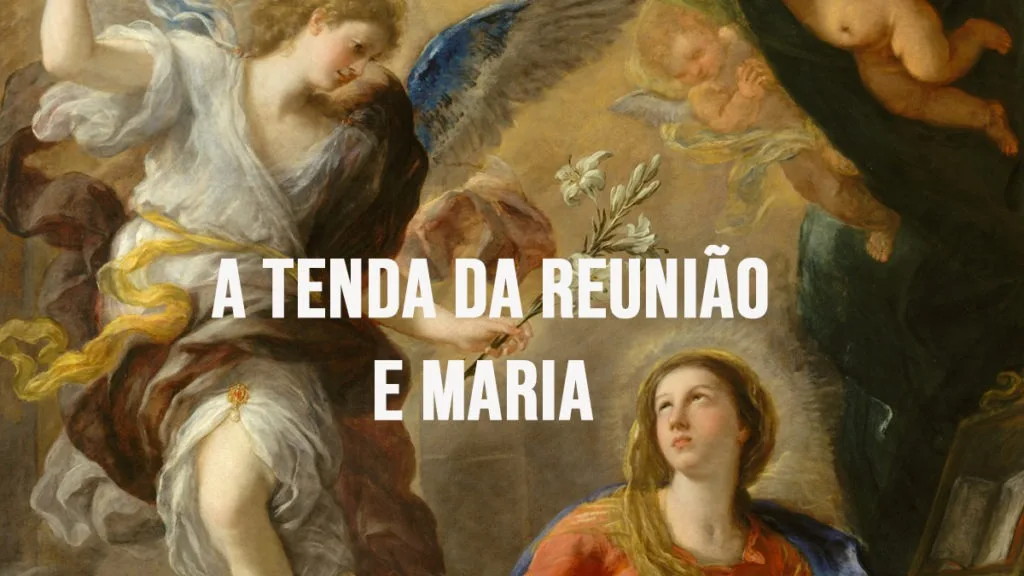
In the desert, God commanded Moses:facientque mihi sanctuarium et habitabo in medio eorum“They shall make me a sanctuary, and I will dwell among them” (Ex 25:8). When the tabernacle was completed,operuit nubes tabernaculum testimonii et gloria Domini implevit illud“A cloud covered the tent of testimony, and the glory of the Lord filled it” (Exodus 40:34-35), and Moses could not enter, for the cloud had settled upon it. In the Annunciation, the angel says to Mary:πνεῦμα ἅγιον ἐπελεύσεται ἐπὶ σὲ καὶ δύναμις ὑψίστου ἐπισκιάσει σοι· διὸ καὶ τὸ γεννώμενον ἅγιον κληθήσεται υἱὸς θεοῦ“The Holy Spirit will come upon you, and the power of the Most High will overshadow you; therefore, the child to be born will be holy, and he will be called the Son of God” (Lk 1:35). Christian tradition has seen in the juxtaposition of these texts one of the most beautiful figures of Mary: the tent and the ark of the new covenant.
The parallel between Exodus 40 and Luke 1:35
The Greek verb that Luke uses for the shadow of the Most High, επισκιάζω, is the same as the Greek translation of the Old Testament used for the cloud that rested upon the tabernacle in Ex 40:35. Aristide Serra, in the Nuovo dizionario di mariologia, presents the correspondence: the Holy Spirit, who is the power of the Most High, descends and covers Mary with his shadow, so that what is born of her will be called Holy, Son of God. The cloud, a sign of God’s presence, covers the meeting tent, so the dwelling is filled with the glory of the Lord. And he concludes: La punta degli accostamenti sopra rilevati sta nell’equivalenza tra «la Gloria di Jahve» da una parte e gli appellativi «Santo-Figlio di Dio» dall’altra, «the point of these approximations is in the equivalence between “the Glory of Yahweh”, on the one hand, and the titles “Holy, Son of God”, on the other» (SERRA, 1986, p. 809). The meaning is Christological: whoever is born of Mary is of divine nature, as was the divine glory that filled the tabernacle.
René Laurentin drew the same parallel: the divine shadow evoked the cloud, a sign of the Lord’s presence, which had covered the ark of the covenant while the glory of God filled it from within, and “Maria, around her, will be the object of this double manifestation,” “Mary, in turn, will be the object of this double manifestation,” the presence that covers her and the presence of the Lord within her (LAURENTIN, 1990, p. 37). The Italian Roman Missal collects this reading in the introduction to the feast of the Annunciation, calling Mary “nuova Tenda dell’incontro,” “a new Tent of Meeting,” on which the Spirit extends His shadow (cf. Lk 1:35, Ex 40:34-35, ROMAN MESSAL, 2020, p. 623).
Mary, new ark: the Visitation
The second parallel is in the Visitation, compared with the journey of the ark of the covenant to Jerusalem. David, in fear, asks: Quomodo ingredietur ad me arca Domini?, «How shall the ark of the Lord come to me?», and the ark remains «in domo Obededom Getthei tribus mensibus», «in the house of Obed-Edom, the getean, for three months» (2 Samuel 6:9.11). Elizabeth asks:πόθεν μοι τοῦτο ἵνα ἔλθῃ ἡ μήτηρ τοῦ κυρίου μου πρὸς ἐμέ;“How is it that the mother of my Lord should come to me?” (Luke 1:43), and Mary stayed with her.ὡς μῆνας τρεῖς“about three months” (Lk 1:56). Serra lists six points of contact between the two narratives, and concludes that, with Jesus in her womb, Mary is the ark of the new covenant, “with Jesus in her womb, Mary is the ark of the new covenant” (SERRA, 1986, p. 811).

What do exegetes say?
Serra presents these parallels with caution: “It is the opinion of no few exegetes,” (SERRA, 1986, p. 808). Others are not convinced. Raymond Brown acknowledges that the verb in Lk 1:35 has its roots in the Old Testament and that Luke envisions a divine presence covering Mary, but he judges that to identify Mary with the Tent based on this verb is “totally a guess,” because the same verb appears in the Transfiguration (Lk 9:34) and, in the Old Testament, it is the cherubim, not God, who cover the ark (BROWN, 1993, p. 327-328). He also considers the parallel of the Visitation weak: David’s question arises from fear of the ark’s mortal power, and Elizabeth has another motive, and a similar question appears in 2Sa 24,21, without any ark (BROWN, 1993, p. 344-345). A joint study by Catholics and Protestants coordinated by Brown concludes that there is no convincing evidence that Luke identified Mary with the ark (BROWN et al., 1985, p. 153).
The discussion concerns what Luke intended. The reading of Mary as a tent and ark does not depend on her, because it is a reading of the Church, made in the light of all Scripture and the faith in Jesus, God made man. John says that the Word (Logos)ἐσκήνωσεν ἐν ἡμῖνHe has pitched his tent among us (Joh 1:14), and the tent in which he first dwelt was the breast of Mary (cf. TONIOLO, 2017, p. 329).
The Tent and the Ark in the Fathers and in the Liturgy
The Fathers developed the image. Proclus of Constantinople, in the fifth century, writes that Mary is venerated as mother, servant, cloud, nuptial chamber, and ark of the Lord:Κιβωτός, οὐ τὸν νόμον βαστάσασα, ἀλλὰ τὸν νομοθέτην κυοφορήσασα“The ark, not because it carried the law, but because it brought forth the Lawgiver” (Proclus, Oratio 5, PG 65, 720, in Álvarez Campos, [1976], p. 93). And in another sermon, commenting on the tent that Peter wanted to set up at the Transfiguration, he calls the virgin womb the tent that Christ chose.Σκηνὴν τῷ λαβόντι σκηνήν, ἣν ἠρετίσατο γαστέρα παρθενικήν;“A tent for him who has made the virgin’s bosom his tabernacle, whom he has chosen as a dwelling place?” (Proclus, Oratio 8, PG 65, 767, in Álvarez Campos, [1976], p. 96). An ancient homily attributed to Saint Gregory the Wonderworker, but of uncertain authorship, states:Vere enim arca est sanctissima Virgo, intrinsecus et extrinsecus deaurata“Truly ancient is the most holy Virgin, golden within and without” (Pseudo-Gregory the Wonderworker, PG 10, 1152).
The Akathist Hymn, attributed to Toniolo in the second half of the 5th century (TONIOLO, 2017, pp. 83-85), greets the Mother of God with images of the sanctuary:Χαῖρε, σκηνὴ τοῦ Θεοῦ καὶ Λόγου, χαῖρε, Ἁγία ἁγίων μείζων. Χαῖρε, κιβωτὲ χρυσωθεῖσα τῷ Πνεύματι“Hail, tent of the God Word, hail, holy holier than the Holy of Holies. Hail, golden ark illuminated by the Spirit” (Akathist 23, in Toniolo, 2017, p. 326). Ermanno Toniolo comments that these salutations are based on the description of the Meeting Tent in Ex 25-26 and 36-37, taken up in Heb 9:1-4 (Toniolo, 2017, p. 328). He then cites Ex 40:34-35 along with Lk 1:35 and concludes: “It is obvious the parallel with the Annunciation.” (Toniolo, 2017, p. 329). In the Loretanean Litany, the Church invokes Mary as “Arca of the Covenant,” and the Second Vatican Council calls her “Mediatrix of All Graces.”sacrarium Spiritus Sancti“sanctuary of the Holy Spirit” (LG 53).
The Tent of God among Men
The tent in the desert was the place where God made himself present to his people, and the ark contained the tablets of the Law. In Mary, God did not dwell in a cloud or in a chest, but in a woman’s womb, and what she brought forth was not the written law, but the very Legislator, as Proclus says. That is why the Church calls her a tent and an ark: not because she is the center, but because God came to dwell among us in her. The same presence continues in the lives of the faithful, who receive within themselves, by grace, the God who first dwelt in Mary. This last application is not an exegesis of the text, but the fruit of Christian meditation upon it.
References
ÁLVAREZ CAMPOS, Sergio (ed.). Corpus Marianum Patristicum. v. 4. Burgos: Aldecoa, [1976]. p. 93, 96.
Brown, Raymond E. The Birth of the Messiah: A Commentary on the Infancy Narratives in the Gospels of Matthew and Luke. New ed. New York: Doubleday, 1993. pp. 327-328, 344-345.
Brown, Raymond E. et al. (eds.). Mary in the New Testament. Assisi: Cittadella, 1985. pp. 151-153.
Vatican Council II. Dogmatic Constitution Lumen Gentium, §53. Acta Apostolicae Sedis, Vatican City, vol. 57, pp. 58-59, 1965.
LAURENTIN, René. A Brief Treatment of the Virgin Mary. 8th ed. Cinisello Balsamo: Edizioni Paoline, 1990. pp. 37-38.
Roman Missal. 3rd ed. Rome: Foundation of Religion St. Francis of Assisi and St. Catherine of Siena, 2020. Solemnity of the Annunciation of the Lord (March 25), introductory note. p. 623.
Nestle-Aland. New Testament in Greek. 28th ed. Stuttgart: German Bible Society, 2012.
Pseudo-Gregory the Wonderworker. Homily I on the Annunciation. In: MIGNE, J.-P. (ed.). Patrologia Graeca. Vol. 10. Paris: [n.p., n.d.]. Col. 1151-1154.
SERRA, Aristide. Mother of God, I: Biblical Foundations. In: DE FIORES, Stefano and MEO, Salvatore (eds.). New Dictionary of Mariology. 2nd ed. Cinisello Balsamo: Edizioni Paoline, 1986. pp. 806-812.
TONIOLO, Ermanno M. Akathistos: prayers to the Mother of God. Rome: Marian Culture Center “Mother of the Church,” 2017. pp. 83-85, 326-330.
Deepen your studies: explore Mariology, Marian theology, Marian apparitions, and the Postgraduate Program in Mariology.
Postgraduate Program in Mariology
Would you like to deepen your formation in Mariology? Get to know the Postgraduate Program in Mariology from Locus Mariologicus, an academic formation that combines theological rigor, spiritual life, and the living tradition of the Church.
Would you like to study Mariology seriously?
This article arises from the works in the Locus Mariologicus library. The Postgraduate Program in Mariology takes you to the same sources, with academic guidance: Scripture, the Fathers of the Church, and the Magisterium, from the first dogma to contemporary issues.
Responses