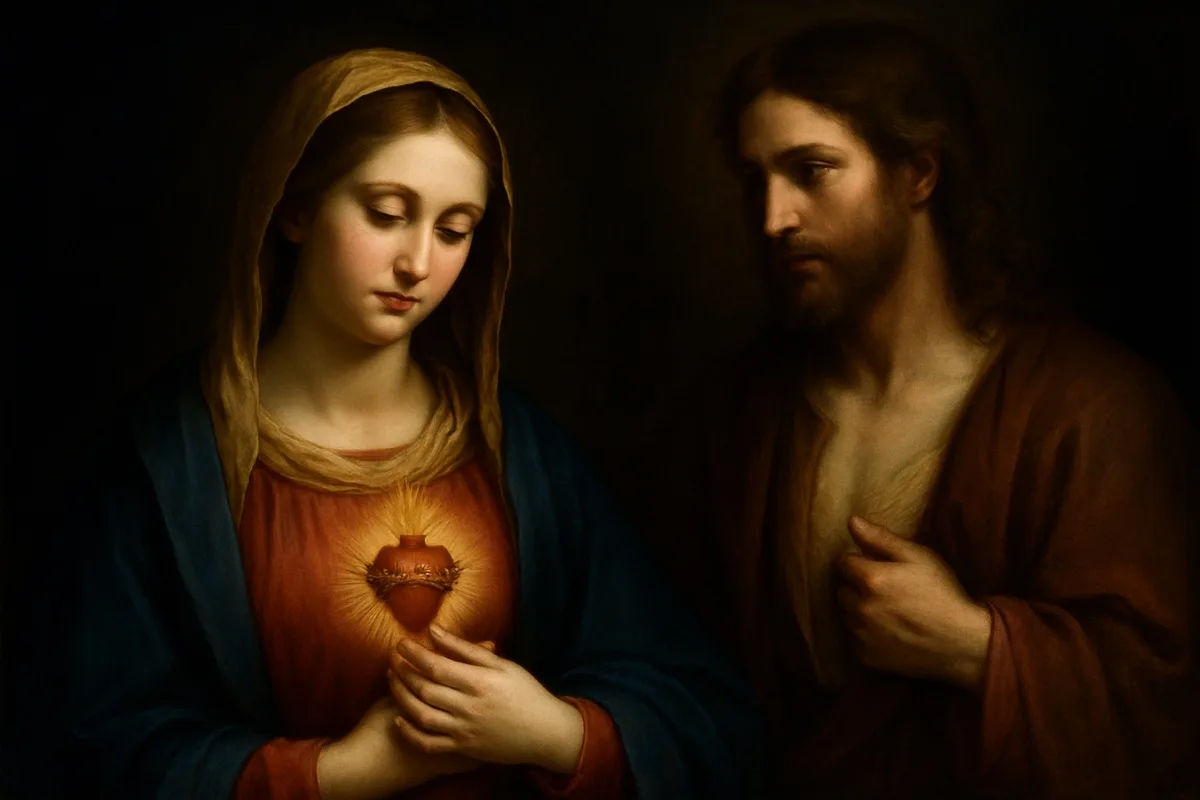
The immaculate heart of the Virgin Mary
By Prof. Dr. Daniel C. Afonso · Updated
«Beata es tu, Virgo Maria, et omni laude dignissima“. «”Blest art thou, Virgin Mary, and most worthy of all praise.“Behold, I will send to you the angel of my life, and he shall guard you on all your ways” (Judges 15:9)
Judith, crowned with praise for her integrity of heart
The blessing that Judith received from the people of Israel after she had delivered Bethulia is one of the most warm expressions of praise in all the Old Testament Scriptures. The high priest Joachim and the elders of Jerusalem hastened to behold her and bless her: «You are the glory of Jerusalem, you are the joy of Israel, you are the honor of our people.” (Jdt 15:9). This praise transcends the recognition of a heroic act of courage: it is the recognition that Judith embodies what is best in Israel, the faith that acts, the heart that trusts even when all invites despair, the integrity that does not yield to the most powerful enemy.

The liturgy applies these words to Mary because it recognizes in her the supreme fulfillment of what Judith foreshadowed: the woman whose heart is the most intact, the most pure, the most fully oriented toward God of all the history of humanity. TheImmaculate Heart“What this Mass celebrates is not merely the absence of sin: it is the positive presence of a love that filled every inner space of Mary, guiding her without deviation to God in every moment of her existence, making her capable of preserving and meditating on the most incomprehensible mysteries without losing either confidence or peace.”
II. The heart that guards: Mary’s interiority
The devotion to the Immaculate Heart of Mary has its biblical roots in Luke’s description of Mary as the one whoShe kept all these things, meditating on them in her heart.” (Lk 2:19, 51). The “heartThe Bible is not the sentimental organ of modern anthropology: it is the center of the person, the place where decisions are formed, where the most precious things are kept, where the relationship with God has its deepest source. Mary’s heart is the place where the whole history of salvation was kept and meditated: every word of the Son, every gesture of the Father, every breath of the Spirit found in this heart a space of welcome and reflection that no other human heart has equaled.
The Church consecrated itself to the Immaculate Heart of Mary because it understands that this Heart is the most perfect model of the Christian heart: a heart that receives the Word without resistance, that keeps it without deforming it, that meditates on it without impatience, that practices it without reserve. The consecration to the Immaculate Heart is not a sentimental devotion: it is the recognition that we need to learn from Mary how to direct the heart towards God, how to govern the inner space so that God may dwell in it with the fullness He desires.
“III. ‘…”Blest is she who believed.“A heart that did not doubt”
The proclamation of Lk 11:27-28, where Jesus defines blessedness not by biological motherhood but by listening to and practicing the Word of God, is the Gospel of this Mass because it illuminates the deepest reason for Mary’s blessedness: she is blessed not only because she gave birth to the Son of God, but because her heart was the most faithful guardian of the Word of God that history has known.Blessed are those who hear the word of God and keep it.» (Lk 11:28): Mary heard in the Annunciation, kept in Nazareth, meditated throughout her life, practiced on the Cross and in the Cenacle. The blessedness of her heart is the blessedness of perfect and steadfast fidelity.
The immaculate heart of Mary is the seat of this fidelity: a heart that never yielded to the temptation to keep something for itself instead of offering it to God, that never closed the doors to the Spirit out of fear or convenience, that never ceased to listen even when what it heard was disconcerting or painful. It is this heart that the Church venerates: not as a relic of a distant past, but as a living model of a path that every Christian is invited to follow, the path of a heart that guards, meditates on, and practices.
IV. Maria, a que foi toda para Deus
The twenty-eighth Mass in the Collectaneum proposes a contemplation of the Immaculate Heart of Mary as the highest form of all spiritual life: a heart that was entirely for God, that kept nothing back for itself, that surrendered without reserve to the love that preceded and surpassed it. Devotion to the Immaculate Heart is not a parallel path to following Christ; it is the proposal of a concrete model of how to live the following of Christ from within, of how the heart is oriented, of how freedom is surrendered, of how love remains faithful through all the vicissitudes of personal and ecclesial history.
Judith was praised for her integrity and courage. Mary is praised for her faithfulness and her purity of heart. And the Church celebrating this Mass is invited to ask the Lord for the same heart He gave to His Mother: a heart that listens, that keeps, that meditates, that practices, a heart that says:“I am a servant of the Lord”“In every moment of life, a heart that is worthy to be called immaculate is not by the absence of temptations, but by the fidelity that overcomes them through the grace that does not abandon it.”
Postgraduate specialisation in Mariology
Would you like to deepen your formation in Mariology? The Locus Mariologicus postgraduate programme is a specialisation that brings together theological rigour, spiritual life and the living tradition of the Church. The next class begins in 2027.
Responses