Dominus est: Mary, the Beloved Disciple, and the Recognition by the Sea
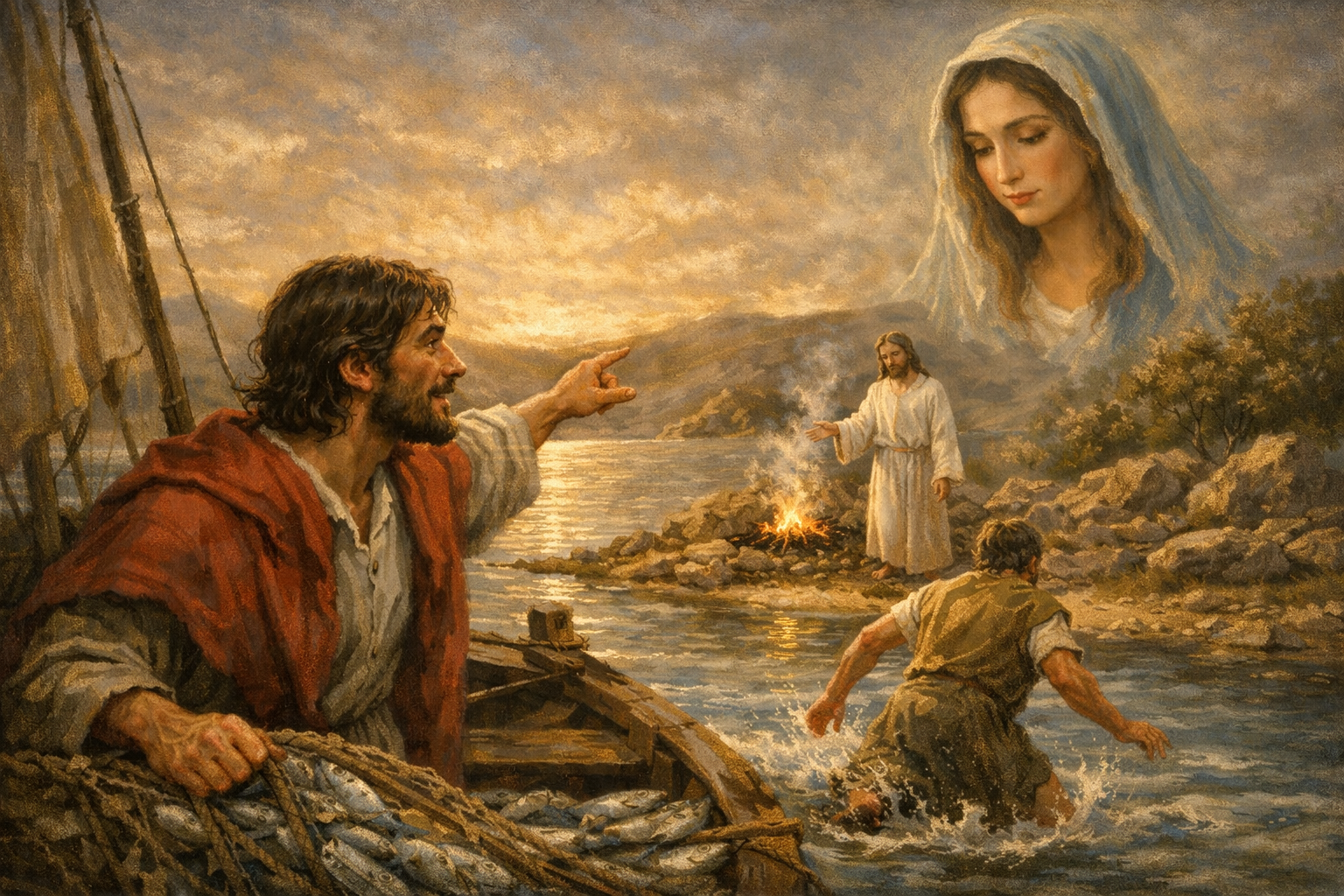
Dominus est!
Jn 21:7, Gospel for Friday within the Octave of Easter
A Mariological meditation on the readings for Friday within the Octave of Easter (Jn 21:1-14)
They fish all night and catch nothing. At daybreak, a Stranger on the shore: “Cast the net to the right side of the boat” (Jn 21:6). The net fills with fish. And then the Beloved Disciple recognizes Him: “Dominus est! [It is the Lord!]” (Jn 21:7). Not Peter, who is the first to go to meet Him, but the Beloved Disciple, who is the first to see and recognize. There is a Mariological logic in this primacy of recognition: the Beloved Disciple is the one who, at the foot of the Cross, was given to Mary as her son. Whoever dwells close to Mary grows accustomed to recognizing the Lord.
The liturgy of Friday within the Octave places before us a text of profound Mariological density, not because Mary appears in it, but because the figure most intimately linked to her is the one who first exclaims Dominus est. Mariology cannot pass over this connection in silence.
I. The Beloved Disciple: Son of Mary
In the scene on Calvary, the Risen One addresses to the Beloved Disciple the words that constitute the spiritual motherhood of Mary: “Woman, behold your son! and to the disciple: ‘Behold your Mother’” (Jn 19:26-27). From that moment on, “the disciple took her into his own home” (eis ta idia, into the innermost part of his life).
Ignace de la Potterie, in his Maria nel mistero dell’alleanza (1988), showed that this taking in is not logistical but spiritual: the Beloved Disciple receives Mary as teacher of faith, model of contemplation, companion in the mysterium fidei. Whoever lives with Mary learns to see with her eyes, and her eyes are the eyes of faith that recognize the Son.
That is why, on the morning at Tiberias, it is the Beloved Disciple who first exclaims Dominus est. It is not a narrative accident; it is a theological consequence. The pedagogy of Mary, she who “kept all these things in her heart” (Lk 2:19), formed in the disciple a Paschal sensitivity capable of recognizing the Risen One where others see only a Stranger on the shore.
II. The charcoal fire and the memory of the denial
The subtlest detail of the text is the charcoal fire (anthrakia, Jn 21:9). The same Greek term appears in only one other place in the Gospel of John: on the night of the betrayal, when Peter warms his hands at a charcoal fire and denies three times (Jn 18:18). John uses the same word to link the two moments: the denial and the rehabilitation. The fire at Tiberias is the space of mercy where the denial is reversed.
Where is Mary at this moment? The tradition of the Church, received in the Directory on Popular Piety (no. 157), describes Mary as the mother of mercy who, during the Paschal days, intercedes for the disciples who failed. The charcoal fire of Jn 21 is the concrete sign that this intercession was heard: the Risen One does not accuse; He prepares breakfast!
The Marian principle of the Church is the principle of mercy that welcomes before it judges. Peter, who denied, is the first to enter the sea and go to meet the Lord (Jn 21:7). Mary formed this impulse of confident boldness: not the merit of what he had done but the love of what he hoped for.
III. “Do you know who it is?”: the identity recognized
“None of the disciples dared to ask him who he was, because they knew it was the Lord” (Jn 21:12). A Johannine paradox: they know and do not ask, because the evidence of the presence surpasses the need for the question. Recognition does not come from a logical demonstration but from an experience of communion: the bread broken, the fish roasted, the fire kindled for them.
Paschal Mariology identifies here the pattern of Eucharistic recognition that Mary lived throughout her life. As John Paul II writes in Ecclesia de Eucharistia (2003, no. 55): “Mary is a woman of the Eucharist in her whole life”. The attitude of the disciples at Tiberias, “we know that it is the Lord”, without needing to ask, is the attitude of those who have been formed by Mary’s Eucharistic pedagogy.
The sub tuum praesidium, the oldest Marian antiphon (3rd century), invokes Mary as Theotókos precisely in this context: she who bore the Lord is the guarantee of the identity of the Risen One. In moments of doubt, to have recourse to Mary is to have recourse to the source of certainty about who Christ is.
IV. “Feed my sheep”: mission born of recognition
The text of Jn 21 culminates in the dialogue of Peter’s rehabilitation: “Simon, son of John, do you love me? […] Feed my sheep” (Jn 21:15-17). The pastoral mission is born of the recognition of the Risen One and of the love that confirms it. Only one who has recognized Dominus est can shepherd.
Redemptoris Mater (John Paul II, 1987, no. 45) states that “the Marian dimension of the life of Christ’s disciples is expressed in a special way in fidelity to the apostolic ministry”. Mary, who is in the Upper Room with the Eleven (Acts 1:14), is the mother of apostolic fidelity. Peter receives the mission to shepherd, and he receives it in a setting of mercy whose model is Mary.
We invite you today to contemplate the shore of Tiberias with the eyes of the Beloved Disciple, who learned from Mary to recognize the Lord where others see only a Stranger. May our life be a fishing guided by her fiat, at the dawn of each day!
Deepen your studies: explore Mariology, Marian Theology, Marian apparitions, and the Postgraduate Program in Mariology.
To explore Johannine Marian theology and the recognition of the risen Christ more deeply, consult Pope John Paul II’s Encyclical Redemptoris Mater.
Prof. Daniel Afonso
Rome, April 10, 2026
Postgraduate Program in Mariology
Would you like to deepen your formation in Mariology? Discover the Postgraduate Program in Mariology of Locus Mariologicus — an academic formation that unites theological rigor, spiritual life, and the living tradition of the Church.
Would you like to study Mariology seriously?
This article grows out of the works in the Locus Mariologicus library. The Postgraduate Program in Mariology takes you to the same source, with academic guidance: Scripture, the Fathers of the Church, and the Magisterium, from the first dogma to contemporary questions.



Responses