Tu es petrus: Mary, Peter, and the Church Against Which the Gates of the Abyss Shall Not Prevail
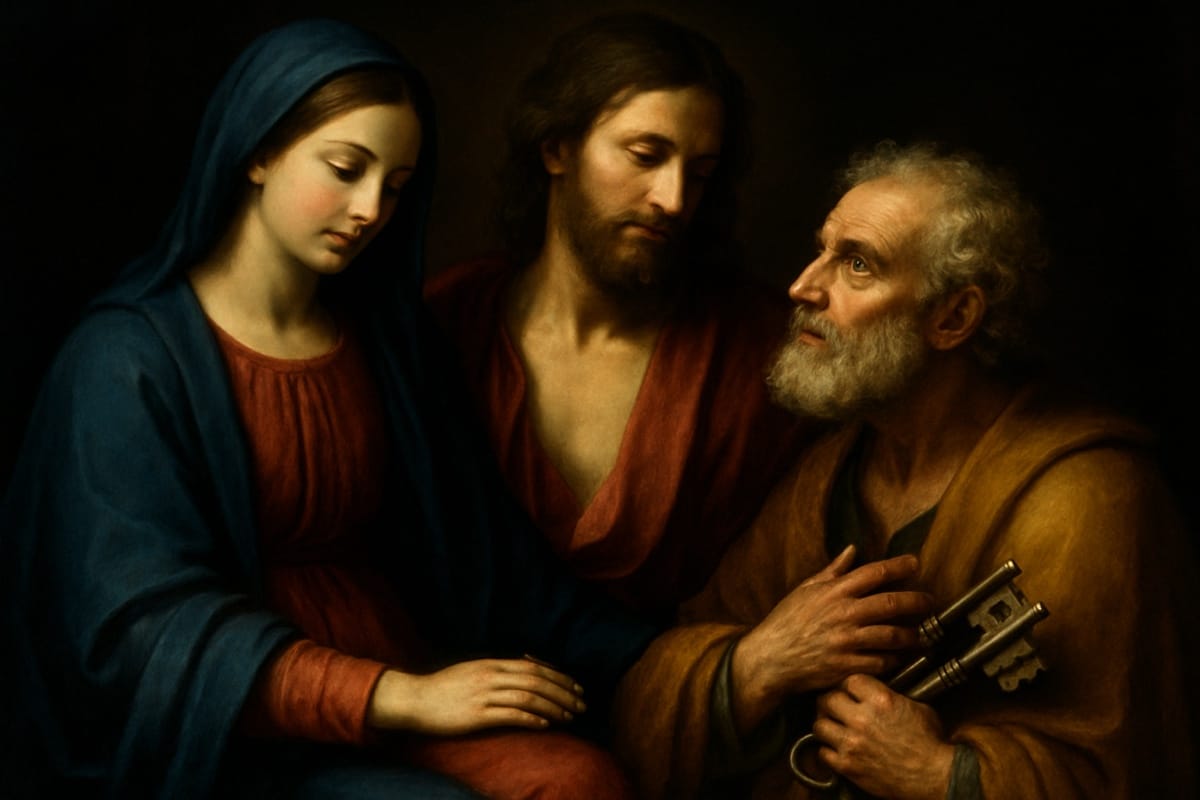
Et ego dico tibi quia tu es Petrus, et super hanc petram aedificabo Ecclesiam meam, et portae inferi non praevalebunt adversus eam.
Mt 16:18
The Solemnity of Saints Peter and Paul (June 29) is one of the oldest celebrations of the Roman calendar, already celebrated in Rome in the third century as the feast of the two “principes apostolorum,” the pillars on which the Church of Rome founds its authority and its mission. The Gospel text of this solemnity (Mt 16:13-19) is one of the most debated and most central texts of the New Testament: Jesus’ question about His identity, Peter’s confession (“You are the Christ, the Son of the living God”), Jesus’ reply giving Peter his new identity, and the promises He joins to it. This text, known as “the primacy of Peter,” is at once the foundation of Catholic ecclesiology and one of the densest knots of theological reflection on the nature of authority in the Church.
The Mariological connection of this pericope is not immediate, but it is profound: the same Matthew who narrates Peter’s confession is the one who narrates the annunciation to Mary (Mt 1:18-25) and the flight into Egypt. The Church that Jesus founds on Peter is the same community that Mary brought forth when she brought forth its Founder. The phrase “portae inferi non praevalebunt,” the gates of the Abyss shall not prevail against it, has its Mariological equivalent in the Immaculate Conception: Mary is the human being over whom the gates of the Abyss had no power, the anticipated icon of the victory of grace over evil that the Church promises to all who persevere in her.
I. “Who do men say that the Son of Man is?”: the founding question
Jesus begins with the question about public opinion, “Who do men say that the Son of Man is?” (Mt 16:13), and receives the conventional answers: John the Baptist, Elijah, Jeremiah. Public opinion has good intentions but does not reach what is essential: it places Jesus in the category of the prophet, the forerunner, the man of God, categories that are honorable but insufficient. Public opinion does not err out of bad faith: it errs because Jesus’ identity exceeds the available categories, and the available categories are the ones public opinion uses to classify what it does not understand.
“But who do you say that I am?” (Mt 16:15): the question in the plural, before Peter’s answer, underlines that what is at stake is the personal faith of each disciple, not only that of Peter. Peter answers in the name of the group, “You are the Christ, the Son of the living God,” but the question remains addressed to each one. The Christian confession of faith is not a sociological given inherited from one’s cultural milieu: it is a personal answer to a personal question. Tradition can supply the words. Faith is the act of taking them on as one’s own, of pronouncing them in the first person before Jesus, who asks.
Jesus’ identity as “Son of the living God,” not merely “Son of God” but “of the living God,” evokes the contrast with the dead gods of the surrounding religions. The “living God” is the God who acts, who intervenes, who calls Abraham and frees Israel from Egypt. The God whose life can be communicated, who can be the Father of a Son who is also living. Peter is not merely affirming an abstract theological category: he is affirming that Jesus shares in the life of the God of Israel, the life that does not yield to death and that Calvary will not overcome.
Mary was the first to answer this question, at the Annunciation, before Jesus was born. Mary’s “fiat” is, in its deep structure, a confession of faith prior to Peter’s confession: the acceptance that the one she would conceive was “Son of the Most High” (Lk 1:32), that His kingdom “would have no end” (1:33). Mary pronounced the “You are the Son of the living God” without words, with her body, by giving Him human flesh. Peter’s confession at Caesarea Philippi is the ecclesial verbalization of what Mary had accomplished bodily thirty years earlier.
II. “You are Peter, and on this rock”: the naming that transforms
“It was not flesh and blood that revealed this to you, but my Father who is in heaven” (Mt 16:17): before naming Peter, Jesus identifies the source of his confession, divine grace, not human shrewdness. The faith that Peter expressed was the product neither of his spiritual intelligence nor of the training he had received: it was a gift of the Father. This priority of the gift over the response is central to understanding the Petrine primacy: Peter is not the rock by his own merits but by the decision of the Father, who revealed to the Son the instrument He had chosen to found His Church.
“You are Peter (Petros), and on this rock (petra) I will build my Church”: the Greek wordplay (petros/petra) cannot be rendered in English, but it is audible in Aramaic: “You are Cephas, and on this cephas I will build my Church.” The change of name from Simon to Peter parallels the name changes of the Old Testament that mark new vocations: Abram → Abraham (Gen 17:5), Jacob → Israel (Gen 32:28). Peter’s new identity does not replace the previous one: it adds to it a mission that the previous one did not have. Simon the fisherman becomes Peter the foundation, not by abandoning the fisherman but by taking on the foundation.
“The gates of the Abyss shall not prevail against it”: the Church founded on Peter has an eschatological promise, that death is not the last word. “Gates of the Abyss” (hadou, “of Hades,” of the realm of the dead) evokes the threat of death and dissolution. Jesus’ promise is not that the Church will never suffer; she will suffer. It is not that she will never err; she will err. It is that she will never be definitively destroyed, that death will not have the last word over the community of the Risen One. This promise does not guarantee institutional infallibility in every act: it guarantees the unassailable survival of what Jesus founded.
“I will give you the keys of the kingdom of heaven. Whatever you bind on earth shall be bound in heaven” (Mt 16:19): the keys are the symbol of administrative authority in the Old Testament (Is 22:22: the keys of the house of David). Jesus transfers to Peter the authority to manage access to the Kingdom. This authority is not despotic: it is ministerial, at the service of everyone’s access to the Kingdom, not of arbitrary exclusion by the one who exercises it. The popes who invoke this authority to serve the unity of the Church exercise it legitimately. Those who invoke it for personal power betray the mandate.
III. Mary, Mater ecclesiae: the mother of the Church founded on Peter
The title “Mater Ecclesiae,” proclaimed by Paul VI at the close of the third session of the Second Vatican Council (November 21, 1964) and inserted into the Roman calendar by Francis (an Obligatory Memorial on the Monday after Pentecost), expresses the relationship of Mary with the Church founded on Peter. Mary is not the foundation of the Church in the sense in which Peter is; Peter is the visible, institutional, historical foundation. Mary is the Mother, the one who bore the Founder, the one who was in the Cenacle with the Twelve (Acts 1:14) when the Spirit descended and the Church was officially born as a missionary community.
The presence of Mary in the Cenacle alongside Peter is a theological detail of the first order in Acts 1:14: “All these persevered with one accord in prayer, with the women, and Mary, the mother of Jesus, and with his brethren.” Mary is in the same place where Peter presides (Acts 1:15: “Peter stood up in the midst of the brethren”). The Mother of the Church and the foundation of the Church are together at the origin of the mission. This coexistence is not hierarchical: Mary is not above Peter. Nor is it one of subordination: Peter is not above Mary as mother of the Founder. It is a complementarity: the apostolic authority that Peter exercises and the maternal love that Mary offers are two modes of presence that the Church needs and that complete each other.
Devotion to the “Madonna della Fiducia,” Our Lady of Confidence, venerated in Rome near the Roman College, captures this relationship between Mary and the Roman Church, the Church of Peter. The Jesuits who venerated her for centuries sensed that the apostolic mission, which has its visible foundation in Peter, needs Marian support so as not to become a mere institution. The “confidence” that Mary offers is not sentimentalism: it is the certainty that He who founded the Church on the rock of Peter is the same One who was born of her womb and who does not abandon what He has begun.
Paul VI, in proclaiming Mary “Mater Ecclesiae,” completed the cycle that Mt 16:18-19 inaugurates: if Peter is the visible foundation of the Church, Mary is the mother who bore the invisible Founder who sustains the rock. The Church against which “the gates of the Abyss shall not prevail” is the Church that has Peter as its foundation and Mary as its mother, the rock and the tenderness, authority and love, institution and communion, which together form the Church that Jesus built and promised not to abandon.
IV. Saint Paul and universality: from the rock to the horizon
The Solemnity of Saints Peter and Paul celebrates two complementary principles of the Christian mission: centrality (Peter, the rock, the fixed point from which everything sets out) and universality (Paul, the Apostle of the Nations, who carried the Gospel “to the ends of the earth”). Peter sustains unity. Paul drives the mission forward. Peter remains in Rome. Paul travels the Mediterranean. Peter founds. Paul expands. This complementarity is the missionary program of the Church: a firm center that sustains and a missionary impulse that reaches everyone.
Paul’s connection to Mary is less narrative than Peter’s, but no less real. The Pauline theology of spiritual motherhood, “my children, for whom I am again in the pains of childbirth until Christ be formed in you” (Gal 4:19), is an echo of Mary’s motherhood: she who “formed” Christ in her womb and who now “forms” Christ in each disciple through her intercession. Paul is the theologian of the spiritual motherhood of the Church. Mary is the model of this motherhood, she who suffered the pains of spiritual childbirth on Calvary (Jn 19:25-27) and who continues the formation of Christ in each baptized person through prayer.
“It is no longer I who live, it is Christ who lives in me” (Gal 2:20): the Pauline formula of the Christian life has its Marian equivalent in the “fiat”: not “let it be done as I will” but “let it be done to me according to your word.” The Christian whom Paul describes, in whom Christ lives, is the Christian whom Mary modeled at the Annunciation: one who offers his own life so that Christ may take form in it. Authentic Marian piety always has this Pauline dimension: it is not the veneration of a figure from the past but openness to the same process of the “formation of Christ” that Mary began and that each disciple is called to continue.
“You are Peter, and on this rock I will build my Church”: this saying of Jesus remains one of the founding texts of Western history. The rock of Peter, the mission of Paul, and the love of Mary, which begets, sustains, and intercedes: these are the three pillars on which the Church that was promised it would not be overcome continues on its way, in the twenty-first century as in the first, with the same eschatological promise, “the gates of the Abyss shall not prevail against it,” as its horizon and its hope.
Postgraduate Program in Mariology
Would you like to deepen your formation in Mariology? Discover the Postgraduate Program in Mariology of Locus Mariologicus, an academic formation that unites theological rigor, spiritual life, and the living tradition of the Church.
Would you like to study Mariology seriously?
This article grows out of the works in the Locus Mariologicus library. The Postgraduate Program in Mariology takes you to the same source, with academic guidance: Scripture, the Fathers of the Church, and the Magisterium, from the first dogma to contemporary questions.




Responses