Oportet exaltari: Mary and the Son Lifted Up
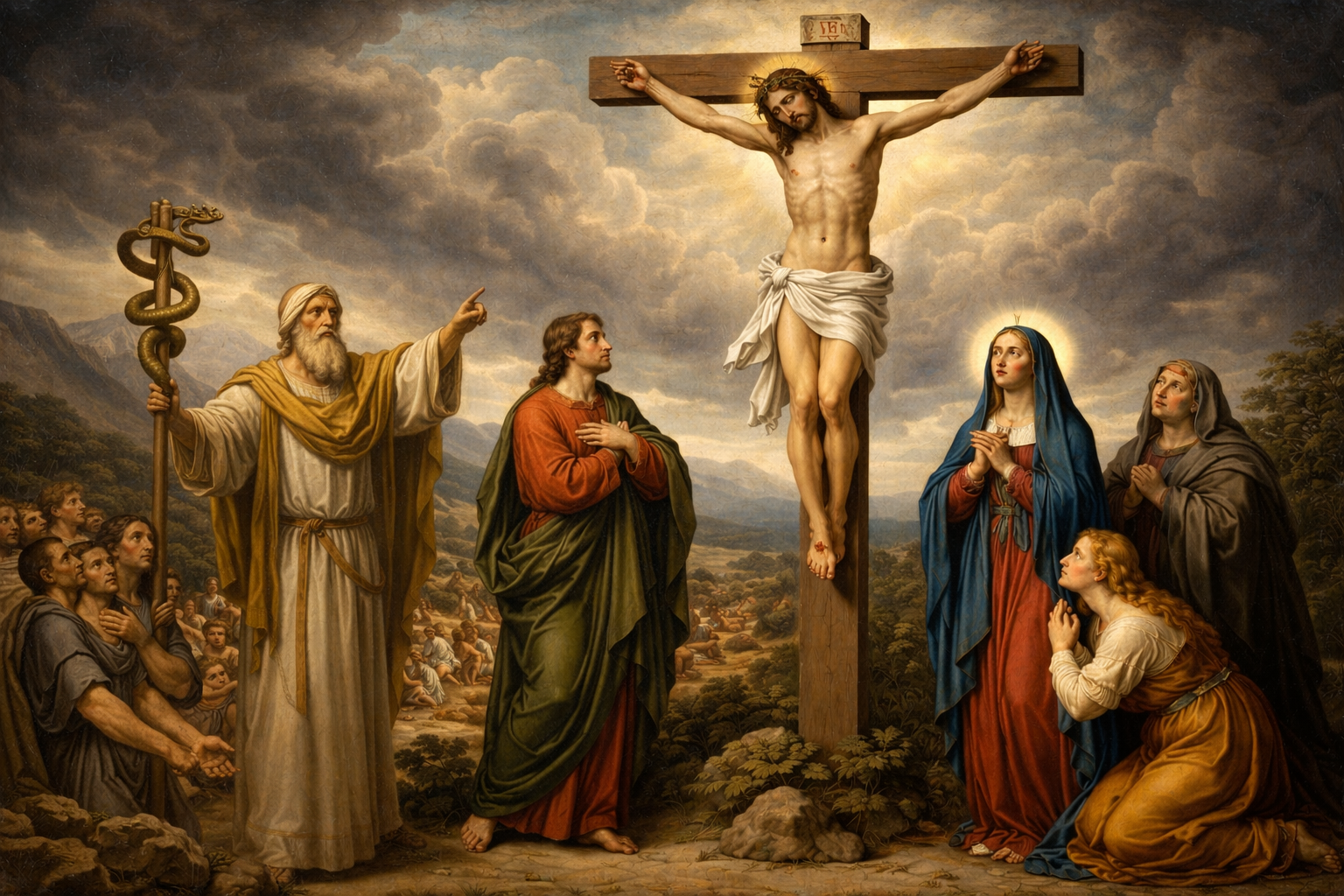
Oportet exaltari Filium hominis, sicut Moyses exaltavit serpentem in deserto.
Jn 3:14, Gospel for Tuesday after the Second Sunday of Easter
A Mariological meditation drawing on the readings for Tuesday after the Second Sunday of Easter (Jn 3:7-15)
“And as Moses lifted up the serpent in the wilderness, so must the Son of Man be lifted up, that whoever believes in Him may have eternal life” (Jn 3:14-15). This passage from the dialogue with Nicodemus carries us from the birth from above, yesterday’s theme, to the foundation of that birth: the Cross as the exaltation of the Son of Man. And it is here that Mariology finds its most dramatic core: Mary at the foot of the Cross is the mother of those who look upon the lifted-up Son and are healed.
The biblical typology is dense: in Num 21:4-9, the Israelites were bitten by venomous serpents. God commands Moses to make a bronze serpent and raise it on a pole; whoever looks at it will live. The lifted-up serpent prefigures the crucified Christ. And within this typological picture there is a place for the woman who stood at the foot of the pole, not as decoration but as co-offerer.
I. The typology of the lifting up
Johannine exegesis has identified with precision the link between Jn 3:14 and Jn 12:32-34: “And I, when I am lifted up from the earth, will draw all to myself”. The “lifting up” (hypsōthēnai) is at once the physical elevation on the Cross and the heavenly glorification. John unites the two meanings: the Cross is already the glorification. The oportet, “it is necessary”, indicates an inescapable divine design: salvation must necessarily pass through the lifting up of the Son.
Within the typological framework of Num 21, the pole (nēs in Hebrew, sēmeîon in the LXX, “sign”) anticipates the Cross as a sign of salvation. Whoever looks at the bronze serpent is healed. Whoever looks at the crucified Christ receives eternal life. Contemplation of the Crucified One is the fundamental saving act.
And Mary is at the foot of the pole. Jn 19:25: “By the cross of Jesus stood His mother, His mother’s sister, Mary of Clopas, and Mary Magdalene”. The Mother is the first to look upon the lifted-up Son, and to look with the eyes of a faith that is not scandalized. The Directory on Popular Piety (2002, no. 153) states that the “association of the Mother with the crucified Son” is the model for all Christian participation in the Cross.
II. The “Stabat mater” and the contemplation of the Crucified One
“Stabat Mater dolorosa / iuxta Crucem lacrimosa / dum pendebat Filius”. The famous sequence by Jacopone da Todi (13th century), sung in the liturgy of the feast of Our Lady of Sorrows (September 15) and on Good Friday, describes Mary’s posture at the foot of the Cross: stabat, “she was standing”. Not fallen, not fleeing: standing, in active contemplation of the lifted-up Son.
Paschal Mariology interprets Mary’s stabat as a “liturgical posture”, not a mere historical fact but a theological attitude: in John’s theological grammar, Mary’s stabat is a liturgical posture. Mary stands at the foot of the Cross as one who celebrates the definitive Liturgy: she offers the Son to the Father, unites her suffering to the redemptive suffering, and receives in return universal spiritual motherhood (“Woman, behold your son”, Jn 19:26).
Mary’s compassio is co-suffering, not as maternal sentimentality but as theological participation in Christ’s offering: Mary is not merely the mother who suffers as she sees her Son die; she is the co-offerer who unites her will to the will of the Son who gives Himself to the Father. This distinction is crucial: Mariology does not affirm a formal co-redemption, but a voluntary association with Christ’s oblation (LG 58).
III. “That whoever believes in Him may have eternal life”
“That whoever believes in Him may have eternal life” (Jn 3:15). The sight of the lifted-up Son begets faith. Faith begets eternal life. Mary, who contemplated the lifted-up Son with unshakable faith, is the first to receive this fruit. Her Assumption, dogmatically defined by Pius XII in Munificentissimus Deus (1950), is precisely this fruit: she who looked upon the lifted-up Son without turning her eyes away received eternal life in her whole body, without waiting for the end of time.
The link between the Cross (Jn 3:14) and the Resurrection is condensed in Mary: she lived the Son’s oportet exaltari and received the fruit of the lifting up before anyone else. The Assumption is God’s answer to Mary’s stabat: You stood at the foot of the Cross. I will lift you up with Me!
LG 58 states that Mary “advanced in her pilgrimage of faith and faithfully maintained her union with her Son unto the Cross”. This fidelity of the peregrinatio fidei reaches its highest, and darkest, moment at the foot of the Cross. And it is precisely from this fidelity that the Assumption is born.
IV. “Just as Moses”: the typology that Mary inhabits
The biblical typology that Jesus presents to Nicodemus has, in the patristic tradition, a Mariological reading. Irenaeus of Lyons (2nd century) formulated the Eve–Mary typology: just as Eve took part in the fall at the foot of the tree of paradise, Mary took part in the redemption at the foot of the tree of the Cross. The “pole” of Moses, the “tree” of paradise, and the “Cross” of Christ form a typological chain in which the woman always plays a decisive role.
Mary is not the bronze serpent; she is the one who contemplates it with perfect faith and who, by contemplating it, makes it possible for the Son to be looked upon by all. In the language of the sub tuum praesidium (3rd century), she is the Theotókos who shelters under her mantle those who look upon the lifted-up Son and need to be healed.
We invite you to conclude this week of the Easter Octave by contemplating Mary at the foot of the lifted-up Son: not the Mary of passive suffering, but the Mary of the active stabat, who looked upon the lifted-up Son and never turned her eyes away. May our Paschal faith be shaped by this silent and unwavering contemplation.
Prof. Daniel Afonso
Rome, April 14, 2026
Postgraduate Program in Mariology
Would you like to deepen your formation in Mariology? Discover the Postgraduate Program in Mariology of Locus Mariologicus, an academic formation that unites theological rigor, spiritual life, and the living tradition of the Church.
Would you like to study Mariology seriously?
This article grows out of the works in the Locus Mariologicus library. The Postgraduate Program in Mariology takes you to the same source, with academic guidance: Scripture, the Fathers of the Church, and the Magisterium, from the first dogma to contemporary questions.




Responses