Ut cognoscat mundus: Mary and the Love the World Can Recognize
Ut cognoscat mundus quia tu me misisti et dilexisti eos sicut me dilexisti.
Jn 17:23
“That the world may know that you sent me and that you loved them as you loved me.” Jn 17:23 presents one of the purposes of Jesus’ prayer for unity: that “the world may know,” that the unity of the disciples may be the sign that leads the world to the recognition of Christ and of the Father’s love. Mariology finds in this verse its most apologetic and most missionary dimension: Mary, figure of the unity of the Church and of the perfection of divine love received and lived, is the most eloquent “sign” through which the world can “know” that God has loved human beings with the same love with which He loved the Son.
I. “That the world may know”: the apologetic dimension of unity
Jn 17:21, 23 twice repeats the purpose of the unity that is asked for: “so that the world may believe” (v. 21) and “so that the world may know” (v. 23). The difference between “believing” and “knowing” in John is significant: the initial “believing” that v. 21 indicates is the first openness to revelation. The “knowing” of v. 23 is the deeper relationship, the knowledge of love that implies a personal experience. The unity of the disciples does not merely provoke the world’s intellectual “belief”; it leads to the loving “knowledge” of the God who sent the Son.
This logic has an immediate practical consequence: the division of Christendom is the greatest apologetic obstacle to mission. The world that sees divided Christians, who accuse one another and compete for members and resources, does not see the “sign” of Jn 17; it sees exactly the opposite. The force of the Christian argument, that the love among Christians bears witness to the truth of the Gospel, is neutralized by the historical division that the Churches have been dragging along for centuries.
Ecumenical Mariology, which looks to Mary as a figure of the unity that transcends historical divisions, has a direct apologetic relevance. The communities of Taizé and of Sant’Egidio, and the ecumenical movements of prayer and service that bring together Christians of various traditions, are signs of “the world’s knowing” that Jn 17:23 asks for: when the world sees Christians united around the figure of Mary, regardless of dogmatic differences, it can begin to “know” that the God who unites them is the God of love whom the Son revealed.
The great mission of the twenty-first century, the “new evangelization” that John Paul II and Benedict XVI proclaimed, has this apologetic aspect at its center. It is not enough to “announce” the Gospel; the Gospel must be “shown” through the unity and love of Christians. Mary, as the figure of perfect unity and love, is the heart of this living apologetics: she who “gathered” the Apostles in the Upper Room before Pentecost continues to “gather” Christians around herself so that the world may “know.”
II. “Dilexisti eos sicut et me”: Mary and the Father’s equal love
The second movement of ut cognoscat mundus is illuminated in Jn 17:23: “that you loved them as you loved me” (dilexisti eos sicut me dilexisti). This statement is one of the most daring in the entire Gospel: the Father loves the disciples with the same love with which He loves the eternal Son. Not a “lesser” love, not a derived or analogical love, but the “same love” (kathos). This equivalence is possible because the disciples are “in” Christ: the Father’s love reaches them through the Son, and insofar as they are “in” the Son, they receive the Father’s love in its Trinitarian fullness.
The Mariological implication is direct: if the Father loves the disciples “as He loves the Son,” and if Mary, of all redeemed humanity, is the one most completely “in” the Son, then Mary is the one most completely loved by the Father, the creature who most fully received the Father’s love—a love that Jesus, in Jn 17:23, compares to the very love the Father has for the Son. This statement is not devotional exaggeration; it is a logical consequence of dogmatic Mariology: she who was “full of grace” (kecharitomene) is the one who most fully received the love of the Father that grace communicates.
The spiritual tradition expressed this “predilection” of the Father for Mary with images of great beauty: Saint John Eudes, in the seventeenth century, developed devotion to the Heart of Mary as the “heart most loved by the Father” after the Heart of the Son. Saint Louis-Marie de Montfort contemplated Mary as God’s “masterpiece,” the creature in whom the creative love of the Father expressed itself most perfectly. It is not a matter of divinizing Mary, but of recognizing that the Father’s love, when it acts without obstacle, produces the most perfect work possible: and that work is Mary.
Christian eschatology, the hope that “we too” shall be loved by the Father “as the Son” in fullness, has in Mary its most visible anticipation. She who is already loved by the Father with this full love, who already lives in this communio of Trinitarian love, is the symbol of Christian hope: not an abstract promise, but a reality already made concrete in a human creature whom we know and love. The contemplation of Mary is not a distraction from eschatological hope; it is its most concrete visualization.
III. Mary as icon of the maternal love of God
The logic of ut cognoscat mundus also demands a concrete face of divine love. Is 49:15: “Can a mother forget her baby, have no compassion for the child she has borne? Even should she forget, I will never forget you.” The prophet uses the image of maternal love as a metaphor, incomplete but eloquent, for the love of God: a love that does not forget, that does not abandon, that persists even when this seems unlikely. This maternal love of God finds in Mary its most perfect expression in the created order.
Christian feminist theology, in its more balanced strands, has developed the “maternal” dimension of God on the basis of texts such as Is 49:15; 66:13; Hos 11:1-4. Mary, as the human mother of Jesus, visibly “incarnates” this maternal dimension of God’s love: she who never abandons, who remains “standing” by the Cross when all the others have fled, who receives sinners without condemning them, is the most accessible and most moving “icon” of the maternal love of God.
The Marian title “Mater Misericordiae,” Mother of Mercy, has its foundation in this logic: Mary does not merely “receive” God’s mercy; she “incarnates” it in the form most accessible to human frailty. Sinners who turn to Mary do not “prefer” the Mother’s mercy to the Son’s severity; they find in the Mother the most accessible face of the same mercy that the Son came to bring. Mary is the “icon” of the Father’s mercy precisely because she who “loved as the Father loves” makes accessible to the human heart what would be too intense to contemplate directly.
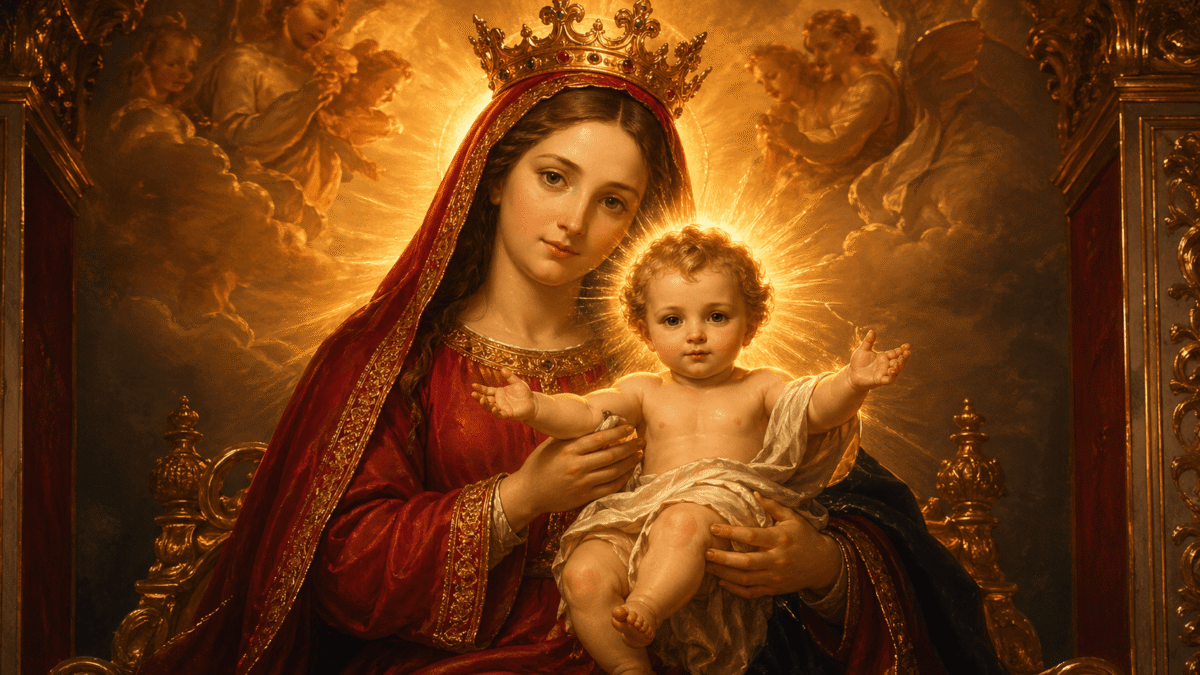
The face of Mary in artistic representations, from Duccio’s Madonna to the Orthodox icons of the Theotokos, has always combined the dignity of the Mother of God with the tenderness of a human mother. This combination is not accidental; it is theologically precise: Mary, who is at once the most exalted of creatures and the closest to human beings, is the most perfect visual symbol of the God who is at the same time infinitely great and infinitely near. To see the face of Mary is to see the face of the love that Jn 17:23 promises: the love of the Father who loved His children “as He loved the Son.”
IV. “That the love with which you loved me may be in them”: Mary and the transfusion of love
The climax of ut cognoscat mundus lies in Jn 17:26: “that the love with which you loved me may be in them, and I in them.” The conclusion of the priestly prayer is the petition that the intra-Trinitarian love, the Father’s love for the Son, may “be” in the disciples. This indwelling of divine love in the disciples is the definitive fulfillment of all Mariology: the goal of all sanctification, of all unity, of all mission is that the love with which the Father loved the Son may dwell in His adopted children.
Mary is, in the tradition, the icon of this “transfusion of divine love” to humanity. She who received the Father’s love more fully than any other human being is the model of the receptivity that every Christian is called to have: to open the heart to the Father’s love, to let oneself be indwelt by it, to become transparent to it so that others may, through us, “know” the God who “loved them as He loved the Son.”
Devotion to the Immaculate Heart of Mary, which Fatima placed at the center of twentieth-century Marian spirituality, is the devotional expression of this “transfusion of love.” The “Immaculate Heart” is not a sentimental image; it is a theological affirmation: the heart of Mary was the first human heart completely indwelt by the Father’s love, without obstacle, without resistance, without the hardening that sin produces. This heart is the model, and the means, by which the Father’s love reaches other hearts.
The last word of Jesus’ priestly prayer is “I in them” (kagō en autois): the Son dwelling in His disciples, as the Father dwells in the Son. This indwelling, which is the supreme promise of the Fourth Gospel, finds in Mary its fullest and most visible realization. She who was the “tabernacle” of the Son in the Incarnation is now the “tabernacle” of the Trinitarian love that the world can “know” through her. Mariology is not a detour from the way to the Father; it is one of its most direct paths: to see Mary is to see the love that the Father has for His children.
Mary, loved by the Father with the same love with which He loves the Son, is the most eloquent icon of the divine love that the world is called to “know” through the unity and charity of the disciples of Christ.
References
- John Paul II, Redemptoris Mater, nos. 45-47 (1987).
- John Paul II, Ut Unum Sint, nos. 97-99 (1995).
- Saint John Eudes, Le Cœur Admirable (1681).
- Saint Louis-Marie de Montfort, Treatise on True Devotion, nos. 14-21.
- H. U. von Balthasar, Mary for Today (1987).
Postgraduate Program in Mariology
Would you like to deepen your formation in Mariology? Discover the Postgraduate Program in Mariology at Locus Mariologicus—an academic formation that unites theological rigor, spiritual life, and the living tradition of the Church.
Would you like to study Mariology seriously?
This article grows out of the works in the Locus Mariologicus library. The Postgraduate Program in Mariology takes you to the same source, with academic guidance: Scripture, the Fathers of the Church, and the Magisterium, from the first dogma to contemporary questions.


Responses