Omnia quaecumque vultis: The Golden Rule and the Narrow Gate
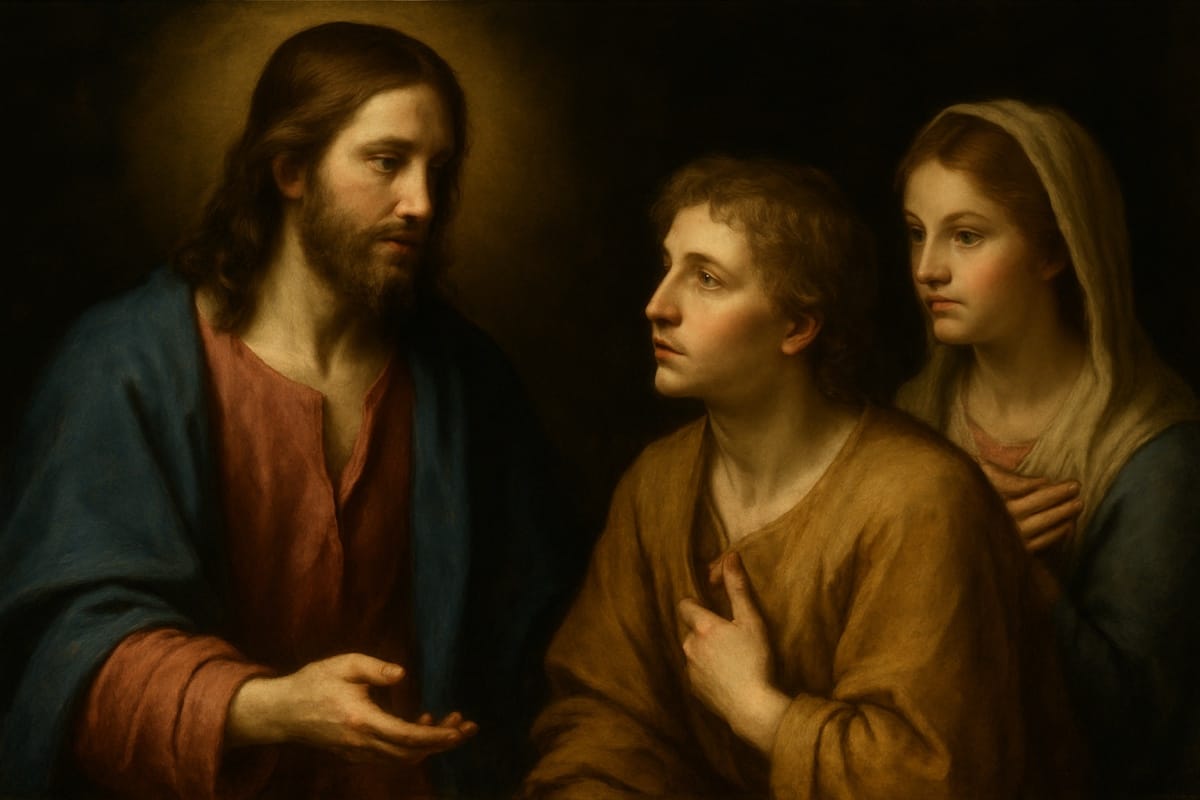
Omnia ergo quaecumque vultis ut faciant vobis homines, et vos facite eis: haec est enim lex et prophetae.
Mt 7:12
Verse 12 of chapter VII of Matthew, the so-called “Golden Rule,” is, according to Jesus, the synthesis of “all the law and the prophets.” This statement is extraordinary: the whole of Old Testament revelation could be condensed into a single principle of reciprocity: treat others as you want to be treated. The Golden Rule has parallels in practically all the great ethical traditions of humanity: in the negative formulations of Confucius (“do not do to others what you do not want done to you”) and of Hillel (“what is hateful to you, do not do to your neighbor; this is the whole Torah. The rest is commentary”), and in positive versions among the Stoics and Epicureans. What distinguishes Jesus’ formulation is its positive form (doing, not merely abstaining) and its theological context: the Golden Rule is set within the discourse on the “narrow gate” and is preceded by the promise that the Father gives good things to those who ask (Mt 7:7-11).
The pericope of Mt 7:6, 12-14 also includes the enigmatic logion about “not giving what is holy to dogs nor pearls to swine” (Mt 7:6) and the instruction about “the narrow gate and the constricted way” (Mt 7:13-14). These three elements—prudence in communicating the sacred, reciprocity in relationships, and the radicality of the Gospel path—form a thematic unity on the style of discipleship: attentiveness, reciprocity, and readiness for the demanding path.
I. The Golden Rule: Synthesis of the Law and the Prophets
Jesus’ statement that the Golden Rule contains “all the law and the prophets” parallels another statement of His about the double commandment of love (Mt 22:40: “on these two commandments depend all the law and the prophets”). These two syntheses—that of the Golden Rule and that of the double love—are not incompatible: the Golden Rule is the operational expression of love of neighbor, translated into terms of concrete action. “Love your neighbor as yourself” (Lev 19:18) is the theological version of what the Golden Rule expresses pragmatically: imagine what you wish others to do to you, and act that way toward the other.
The difference between Jesus’ positive formulation (“do”) and the negative formulations (“do not do”) of the other traditions is theologically significant. The negative version—refraining from harming the other—defines an ethical minimum of non-aggression. The positive version—actively working for the good of the other as if he were myself—defines a maximum of active solicitude. This difference reflects the passage from law as a limit (what one may not do) to love as an impulse (what one wants to do). In the context of the Sermon on the Mount, which systematically radicalized the negative commandments (“you shall not kill… but I say to you: not even anger”) into positive demands (love of enemies, active mercy), the Golden Rule is the synthesis of this radicalization.
Christian moral theology has used the Golden Rule as a founding principle of the natural ethics accessible to human reason, a point of convergence between revelation and the natural law. Thomas Aquinas saw in the Golden Rule the expression of the natural law, knowable by all human beings independently of revelation. This universality—the fact that the Golden Rule appears in analogous forms in all the great ethical traditions of humanity—is, for Christian theology, a sign that the law of God is written on the human heart (cf. Rom 2:14-15). Contemporary interreligious dialogue has found in the Golden Rule, precisely, one of the most solid points of ethical convergence among diverse traditions.
John Paul II, in his address to the European Parliament in 1988 and later in Veritatis Splendor (1993), used the Golden Rule as the foundation of a common public ethic that transcends confessional boundaries. From this perspective, the Golden Rule is not merely a private norm of interpersonal conduct but the foundation of an ethic of citizenship and of institutions: legal and social systems are the more just, the more closely they approach the principle that the norms one lays down for others should be the norms one accepts for oneself.
II. The Narrow Gate: The Radicality of Discipleship
The instruction about the “narrow gate” (Mt 7:13-14; cf. Lk 13:24) introduces a note of demand that contrasts with the human inclination toward the easy way: “Enter through the narrow gate, for wide is the gate and spacious the way that leads to perdition, and many are those who enter by it. Narrow is the gate and constricted the way that leads to life, and few are those who find it.” The interpretation of this image has historically oscillated between a quantitative reading (most people go to perdition), which gave rise to some of the most disturbing texts on predestination and salvation in Christian history, and a qualitative reading (the way that leads to life is the way of the radical Gospel, not that of the ethical minimum).
The spiritual tradition has favored the qualitative reading: the “narrow gate” is the mortification of the ego, the renunciation of self-sufficiency, the surrender to God that the Sermon on the Mount describes in its many demands. The Beatitudes opened the Sermon with “blessed are the poor in spirit,” the interior poverty that recognizes its own insufficiency and opens itself to God’s gift. This poverty of spirit is the “narrow gate”: narrow not because God wishes to exclude, but because the ego resists the self-emptying that love demands.
The parallel text in Luke (13:23-24) places the question “whether those who are saved are few” in an eschatological context: the banquet to which people from all nations are invited (Lk 13:29). Luke’s “narrow gate” does not lead to the exclusion of the majority, but to the urgency of entering now, before the door is shut. This temporal dimension—the urgency of the nunc, the now of decision—is central to the theology of discipleship: conversion cannot be postponed indefinitely, because the moment of grace has its own opportune time.
Mariology presents the “narrow gate” made flesh in the fiat. Mary’s “yes” at the Annunciation is the entrance through the “narrow gate” par excellence: in a moment of perplexity, of immense social risk, of likely incomprehension on the part of Joseph and her family, Mary said yes to an invitation that human reason would have had a thousand reasons to refuse. The fiat is the model of the evangelically radical decision: not calculated, not conditioned by human guarantees, entrusted to the God who “fulfills what He promises” (Lk 1:45).
III. Mary and the Golden Rule Lived Out
The Visitation is the most eloquent example of the Golden Rule as lived by Mary. Mary “imagined” what Elizabeth needed—presence, support, companionship in an unexpected pregnancy in old age—and she went. She did not calculate the cost of a journey of several days, she did not wait to be called, she did not attach conditions to her help. The Golden Rule, in its positive version (“do to others what you would have them do to you”), demands precisely this capacity to imagine the other’s need as if it were one’s own, and to act accordingly, without waiting to be asked.
This aspect of the Golden Rule—the initiative that does not wait to be asked—is one of its most demanding dimensions. It is easier to respond to requests than to anticipate needs. It is easier “not to harm” than to “go out to meet” the other. The active form of the Golden Rule requires moral imagination: the capacity to step outside one’s own point of view and to inhabit the point of view of the other deeply enough to perceive what he needs. This moral imagination—the empathy that informs ethical action—is what the Visitation exemplifies: Mary imagined Elizabeth, inhabited her situation, and went.
The liturgical tradition of Saturday as a Marian day (cf. Art73) has a deep connection with the Golden Rule: it is the day on which Mary is contemplated as a model of gratuitous service and of availability to others. Authentic Marian devotion is not turned only inward, toward the spiritual consolation of the devotee, but outward, toward the world, in the logic of the Golden Rule: as Mary served Elizabeth, the devotee of Mary is invited to serve those in need. The Salve Regina, which implores Mary’s help, is also a reminder that Mary’s love is directed to all the “wretched,” and that her devotee should look upon the wretched around him with the same eyes.
John Paul II, in Redemptoris Mater (1987), described Mary as the one who “feels all human needs as her own,” a formulation that is precisely the Golden Rule lived in its fullness: feeling the needs of others as if they were one’s own. This capacity to identify with the suffering of the other—Mary’s com-passion—is not merely a devotional attribute: it is the exact application of the principle that Jesus formulated in Mt 7:12. Mary is the model of the Golden Rule because she lived the moral imagination of love to its ultimate consequences.
IV. The Way That Leads to Life
The “constricted” way that leads to life (Mt 7:14) is, ultimately, the way of love that the Golden Rule describes. It seems paradoxical—love as a “constricted way”—but spiritual experience confirms the paradox: it is much easier to live for oneself than for others. It is much easier to judge than to serve. It is much easier to avoid harming others than to actively imagine their good. Love in its Gospel form—love of enemies, service without return, forgiveness without conditions—is the most demanding way there is, and that is why few find it.
The Christian spiritual life is described by tradition as a via, a way, not a state. The Via Crucis, the Via Purgativa, the Via Illuminativa, and the Via Unitiva of the mystical tradition are all expressions of the awareness that life with God is a process, a movement, a journey. The “narrow gate” is not a single moment but a continual disposition: the ongoing discernment that chooses demanding love over the ease of selfishness. This disposition is sustained by prayer, by the sacraments, and by the community—the resources that Jesus Himself made available throughout the Gospel of Matthew.
Mary’s role on this way is manifold: she is model (she showed how to enter through the narrow gate), companion (she walks with those who follow the way), and intercessor (she pleads with her Son for those who falter on the way). Authentic Marian devotion does not replace the disciple’s effort; it provides the resources to sustain it. The Rosary, Lectio Divina, and the contemplation of the mysteries of Mary’s life are ways of accustoming the heart to the Golden Rule: contemplating someone who lived it fully gradually trains the heart to do the same.
The synthesis of the Sermon on the Mount that the Golden Rule represents points toward the horizon of chapter 25 of Matthew: “what you did to one of these least brothers of mine, you did to me” (Mt 25:40). Jesus’ identification with “the least” turns the Golden Rule into a theology: to treat the other as I want to be treated is to treat Christ as I want to be treated. The “narrow gate” that leads to life passes through the faces of the poor, the sick, strangers, and prisoners, “the least” in whom Christ is present. Mary, who identified herself with the poor in the Magnificat (“he has filled the hungry with good things”), is the guide on this way.
Postgraduate Program in Mariology
Would you like to deepen your formation in Mariology? Discover the Postgraduate Program in Mariology of Locus Mariologicus, an academic formation that unites theological rigor, spiritual life, and the living tradition of the Church.




Responses