Quod vultis ut faciant: The Golden Rule, the Narrow Gate, and Mary
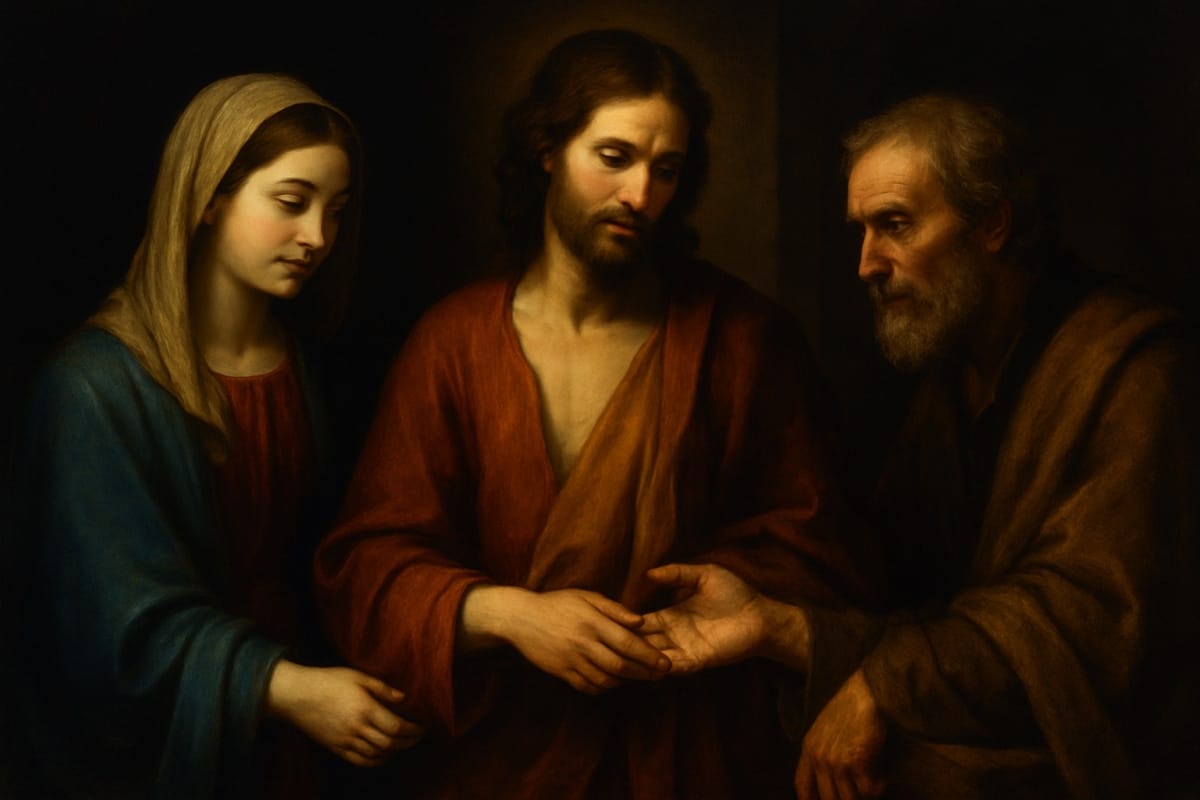
Omnia ergo quaecumque vultis ut faciant vobis homines, ita et vos facite eis. Haec est enim lex et prophetae.
Mt 7:12
The pericope of Mt 7:6, 12-14 brings together three apparently disparate teachings that the context of the Sermon on the Mount weaves into a thematic unity. “Do not give what is holy to dogs” (7:6): discernment about what is sacred and to whom it may be entrusted. “Whatever you wish that men would do to you, do so to them as well; this is the Law and the Prophets” (7:12): the Golden Rule as the synthesis of all Jewish and Christian ethics. “Enter by the narrow gate: wide is the gate and broad the way that leads to destruction” (7:13-14): the demand for a radical decision. The thread that unites them is the demand that distinguishes authentic discipleship from what is religiously comfortable: discernment, reciprocity, and the difficult decision.
The Golden Rule occupies the center of this pericope and holds a singular position in the teaching of Jesus. In Mt 7:12, Jesus states explicitly that this rule “is the Law and the Prophets”, the same expression He used to sum up the two greatest commandments (Mt 22:40). The Golden Rule is not an addition to biblical revelation: it is its practical distillation. What all the prophets preached, justice, love of neighbor, care for the poor, can be formulated positively in this maxim: act toward others as you would like them to act toward you. This positive formulation is more demanding than the negative version (do not do to another what you do not want done to you) that appears in Hillel and in other ancient ethical traditions.
I. The Golden Rule: Universality and Reciprocity
The Golden Rule in Mt 7:12 has an active formulation that distinguishes it from the parallel negative versions. Rabbi Hillel (first century BC) formulated the principle negatively: “do not do to your fellow what is hateful to you; this is the essence of the Torah”. Jesus formulates it positively: “do… whatever you wish that others would do to you”. The difference is not merely semantic: the positive formulation implies initiative, not only avoiding evil but actively doing good. It is not enough to refrain from hurting. One must go out to meet the other with what he needs.
The Golden Rule has parallels in practically all the ethical traditions of humanity: Confucius, Greek Stoicism, Buddhism, Islam, Hinduism. This universality suggests that the Golden Rule touches something in the fundamental structure of human relationships: reciprocity as the foundation of life in common. But the specifically Christian character of the Golden Rule lies in its theological foundation: acting toward others as I would like them to act toward me is not merely a social strategy for living together; it is the imitation of the way God acts toward us. God treats us as He would like to be treated, with love, patience, and mercy, and invites us to do the same for others.
Mary’s Visitation to Elizabeth (Lk 1:39-56) is the most perfect narrative expression of the Golden Rule in the New Testament. Mary, who had just received her own extraordinary grace (the Annunciation), did not shut herself up in the contemplation of her new condition. She learned, through the angel’s revelation, that Elizabeth “is also with child, she who was called barren” (Lk 1:36), and she “went with haste” (Lk 1:39) into the hill country of Judea. The logic is precisely that of the Golden Rule: “if I were pregnant in a difficult situation, I would want someone to come to me”, and Mary went. She did not wait for Elizabeth to come to her. She went herself, because that was what the other needed.
The reciprocity of the Visitation is also the reciprocity of the Golden Rule: Mary went to Elizabeth, and Elizabeth received Mary with the recognition that Mary needed: “blessed are you among women” (Lk 1:42). The relationship of mutual service (Mary serves Elizabeth in her advanced pregnancy; Elizabeth confirms and praises Mary’s grace) is the Gospel model of the Christian community that the Golden Rule proposes: not the rigid hierarchy of those who serve and those who are served, but the reciprocity of a love that serves and is served, that gives and receives.
II. The Narrow Gate and the Difficult Way
“Enter by the narrow gate” (Mt 7:13-14): the image of the narrow gate and the difficult way has been read as an invitation to ascetical rigorism: the harder, the holier. This reading is incorrect. The “narrow gate” is not suffering as an end in itself; it is the choice of priorities that radical discipleship demands. The “wide gate” is accommodation to what culture, comfort, and social pressure ask for: a faith that does not disturb, a discipleship that demands no renunciation, a spirituality that adapts to the criteria of the world. The “narrow gate” is the opposite: the decision to let the Gospel dictate one’s priorities, even when this clashes with the expectations of one’s surroundings.
The particular form of the image in Luke 13:23-24 (the parallel version) is illuminating: “Lord, will those who are saved be few?” Jesus does not answer directly but issues an invitation: “strive to enter by the narrow gate”. The “narrow gate” is not a fatality but an active invitation; “strive” implies decision, commitment, persistence. The question is not how many arrive but whether I strive to enter. Salvation is a universal offer, but discipleship demands a personal decision.
Mary chose the “narrow gate” at the moment of her fiat. Her answer to the angel, “let it be done to me according to your word” (Lk 1:38), was the choice of a path that exposed her socially (pregnancy before her marriage to Joseph), that placed her in a situation misunderstood by her family and her surroundings (how could she explain what had happened?), and that involved the mission of the Son of God with all that Simeon would prophesy (“a sword will pierce your soul”, Lk 2:35). The “wide gate” would have been a respectful refusal, a request for clarification, a postponement. Mary entered by the narrow gate, and the way that followed was indeed the “difficult” one that Mt 7:14 describes.
The spiritual tradition has identified the “narrow gate” with the core of Ignatian discernment: the “election” that Ignatius places at the heart of the Spiritual Exercises. The election, the life decision toward which the Exercises are directed, is precisely the entrance through the “narrow gate”: the decision to place Christ at the center, to align the priorities of one’s life with the Gospel rather than with social expectations, to follow the movement of the Spirit rather than the flow of the “multitude” of Mt 7:13. Mary is the model of this election that the Ignatian tradition proposes: she who “was chosen” and responded with the fullness of her freedom.
III. Mary and the Golden Rule: Service as a Way of Being
Mary’s life in the Gospel is structurally organized around service, around the Golden Rule lived as a way of being, not as an external obligation. The Visitation (Lk 1:39-56), Cana (Jn 2:1-11), and the Upper Room (Acts 1:14) are the three great Marian scenes of the New Testament, and in all of them Mary is at the service of others: at the service of Elizabeth in her advanced pregnancy, at the service of the bride and groom at Cana who had run out of wine, at the service of the community of disciples in the prayer that prepared for Pentecost. None of these services was explicitly requested of Mary; they were initiatives born of attention to what the other needed.
Cana is the most revealing example: “they have no wine” (Jn 2:3). Mary observes without judging and acts without being asked. The logic is that of the Golden Rule reversed: she does not wait for the bride and groom to ask her; she acts because she has put herself in their place and knows what the situation requires. This loving initiative, which acts before being asked because it has first placed itself in the other’s perspective, is the Golden Rule in its highest degree: not reactive (I respond when asked) but proactive (I see what the other needs before he asks).
The patristic tradition read Mary as the “new Eve” in contrast with the Eve of Genesis. The Eve of Gen 3 took for herself (the forbidden fruit) without sharing with God. Mary gave (her body, her life) without keeping anything for herself. The Golden Rule, “do to others what you wish them to do to you”, is the reversal of the logic of Gen 3: instead of taking what is not mine, I give what is mine. Instead of appropriating what does not belong to me, I offer what I have. Mary, who offered her womb to the Word of God, embodies this reversal of the logic of possessiveness into a logic of gift.
The intercession of Mary as a perpetual extension of the Golden Rule has a precise theological coherence: Mary intercedes for sinners because she knows what she would want others to do for her if she were in the same situation. “Treat others as you would like to be treated”, and Mary, who knew God’s mercy in a singular way, intercedes for that same mercy on behalf of those who need it. Popular Marian devotion has always sensed this: it turns to Mary because she “knows what it is to be in need”, knows what it is to be vulnerable, knows what it is to wait for God’s mercy.
IV. “Do Not Give the Holy to Dogs”: Discernment of the Sacred
Mt 7:6, “do not give what is holy to dogs; do not throw your pearls before swine”, is disturbing in its apparent elitism. But the correct reading is not exclusivist: the teaching distinguishes between indiscriminate and discerning sharing of the sacred. The “holy” and the “pearls” are realities of value that require a recipient capable of welcoming them as such. Giving the “holy” to someone who will despise it is not generosity; it is imprudence that harms both the giver and the receiver.
The historical context sheds light here: Jesus is teaching about discernment in ministry, about what to share with whom, at what moment, and in what language. The parable of the sower (Mt 13) develops the same theme: the same seed falls on different soils and produces different fruit, not through a defect in the seed but because of the condition of the soil. The sower does not discriminate in sowing, but he recognizes that the results vary. The “do not give the holy to dogs” is not a refusal to evangelize everyone, but wisdom about the manner and the time of sharing what is most precious.
Mariology contributes to this reflection with the image of Mary who “kept all these things in her heart” (Lk 2:19, 51). “Keeping in the heart” is the opposite of hasty and indiscriminate sharing: Mary discerned what was to be shared and what was to be kept in contemplative silence. She did not tell everyone what the angel had said to her. She did not immediately explain to Joseph what had happened. She “pondered” (Lk 2:19, symballousa, “putting together”, “interpreting”) before speaking. This silent contemplation that precedes sharing is the model of the discernment that Mt 7:6 suggests.
The Golden Rule, the narrow gate, and the discernment of the sacred converge in a single teaching on mature discipleship: acting toward others as one would like to be treated (reciprocity), taking the way that fidelity to the Gospel demands even when it is difficult (decision), and discerning what to share, with whom, and when (wisdom). Mary lived these three principles in an exemplary way, not as a calculated program but as the natural expression of a heart wholly oriented toward God and toward others.
Postgraduate Program in Mariology
Would you like to deepen your formation in Mariology? Discover the Postgraduate Program in Mariology of Locus Mariologicus — an academic formation that unites theological rigor, spiritual life, and the living tradition of the Church.
Would you like to study Mariology seriously?
This article grows out of the works in the Locus Mariologicus library. The Postgraduate Program in Mariology takes you to the same source, with academic guidance: Scripture, the Fathers of the Church, and the Magisterium, from the first dogma to contemporary questions.




Responses