She built her house upon a rock: Mary is the foundation of faith.
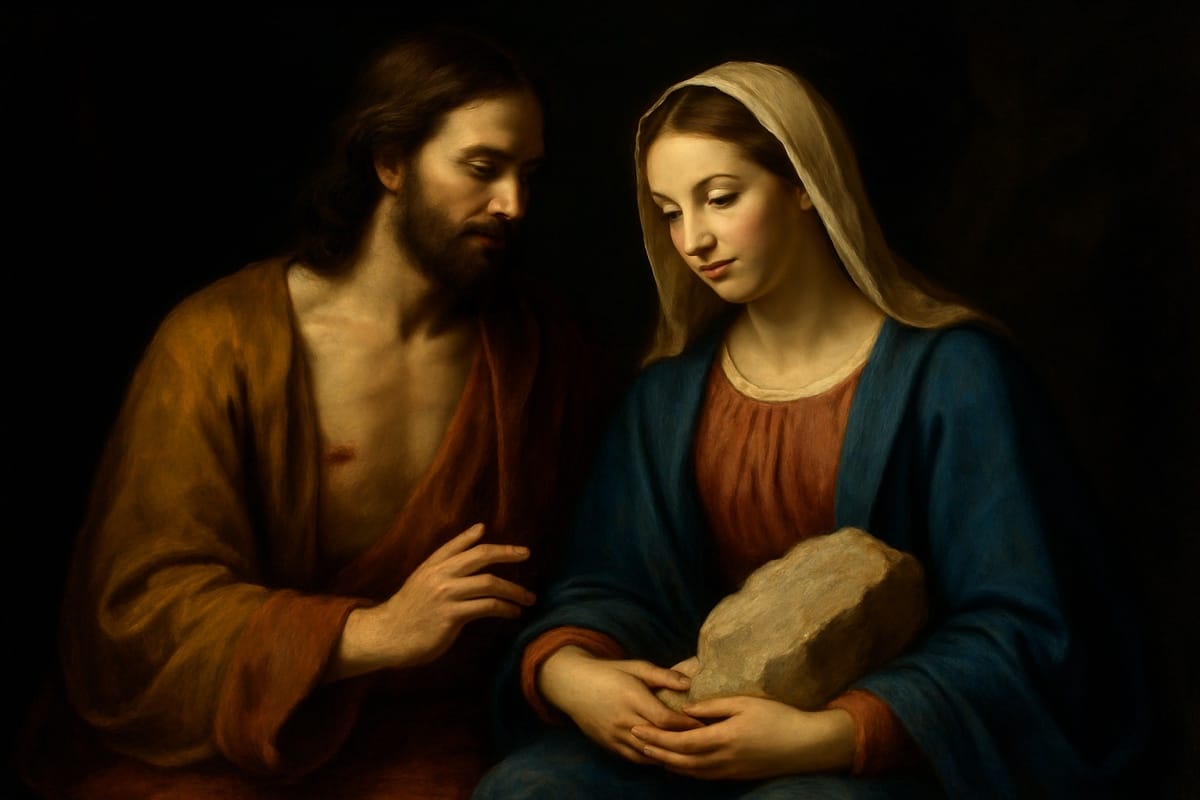
Therefore, everyone who hears My words and does them will be like a wise man who built his house on rock. (Matthew 7:24)
The conclusion of the Sermon on the Mount (Mt 7:21-29) ends with two symmetrical images, the house built on the rock and the house built on the sand, which condense the central demand of the Sermon: it is not enough to hear or declare the faith, but one must do it. The distinction between the “house built on the rock” and the “house built on the sand” symbolizes the difference between genuine faith that bears fruit in good works, and a superficial faith that lacks substance.to hear“and”to make“, between the verbal confession (“Lord, Lord“) and concrete obedience (“What does the will of the Father do?“It is the line that separates the two houses. Both houses appear solid while the weather is fair: the difference reveals itself in the storm.”Storm“Life’s trials, difficulties, suffering, persecution, and death reveal the true foundation of one’s faith.”
The immediate context is the warning against those whoThey say, “Lord, Lord”“They prophesy, cast out demons, and perform miracles in the name of Jesus, but they do not”The will of the Father“For those who have heard and done, this warning is disturbing: it is not atheists or unbelievers that Jesus warns, but those who have an active religious relationship with Him, who perform seemingly powerful works in His name, and who will not be recognized at the final judgment. The criterion is not religious activity, nor fervor, nor extraordinary gifts: it is the ‘ (Mt 7:21-23).”The will of the Father“In the context of the Sermon, it is concrete love, mercy, justice, and service.”
I. Not who saysLord, Lord‘: faith and works
The tension between faith and works, between the confession of faith and moral life, is one of the most debated in the history of Christianity. The Protestant Reformation of the 16th century placed in radical opposition the “justification by faith alone” (sola fide) against the traditional Catholic understanding of justification by faith and good works.faith“and”works“based on Rom 3:28”Man is justified by faith, without the works of the law.») e Gal 2:16. O Concílio de Trento respondeu afirmando que a justificação pela fé não exclui as obras de caridade mas as inclui como fruto e expressão da fé viva. A leitura mais equilibrada da tradição, e aquela mais fiel ao conjunto do Novo Testamento, distingue entre «Works of the Law(as a criterion of merit in itself) andWorks of Charity(as a fruit of faith working through love, cf. Galatians 5:6)
Matthew 7:21-23 is on the side of James.Faith without works is dead“and as John says in chapter 15 (John 15:17)”o que permanece em mim e eu nele esse dá muito fruto“Faith that ‘I am the vine, you are the branches’ (Jo 15, 5).”remains“and that”Bears fruit“It is not contrary to Rom 3:28, but its active aspect: the faith that justifies is the faith that operates through love (Gal 5:6), which produces fruits of the Spirit, manifested in works of mercy. The warning in Mt 7:21 is not against faith, but against faith separated from moral conversion and concrete love: verbal confession disconnected from.”The will of the Father“. (No translation needed as per instructions)”
The distinction between a house on the rock and a house on the sand has a direct mariological parallel: the “Let it be” Of Mary was not merely a verbal confession («Let it be done to me according to your word.»), but a metaphysical commitment that determined all her subsequent life. Mary’s house was built on the rock of “fiat”: every subsequent moment, the “let it be” (Luke 1:38) resounded in her heart, shaping her entire existence. Visitation Bethlehem, the Flight into Egypt, the thirty years in Nazareth, the Cross, the Cenacle, was a manifestation of the solid foundation laid in… AnnunciationThe storm on the Cross did not destroy the house because its roots were in the rock of loving obedience.
The spiritual tradition has often used the image of a house on a rock to describe the life of prayer: regular and profound prayer is the foundation that sustains spiritual life in storms. Whoever builds a life of faith on emotional experiences, on the feeling of consolation, on community enthusiasm without root in personal prayer, in the Word, and in the sacraments, will see his house crumble when consolation disappears.RockIt is the personal and lasting encounter with Christ in prayer and the sacraments, the spiritual equivalent of the deep foundations that resist the flood.
II. The house on the rock: perseverance in following
Perseverance, the virtue that sustains following through time, especially in difficulties, is the central theme of the parable of the two houses. The two houses do not distinguish themselves in calm times; only in the storm does the true foundation reveal itself. This temporal structure, the need to pass the test of difficulty to reveal the solidity of the foundation, is central to the spirituality of following. Tradition describes this crossing as «the passage through trial».Dark Night“, “Passive purification“, “Spiritual desertMoments when consolation vanishes and faith must stand firm in its deep roots.Having heard and done“. (without further context, the original phrase cannot be accurately translated or interpreted)”
Psalm 22,Deus meu, Deus meu, por que me abandonaste“Father, into your hands I commit my spirit!” (Luke 23:46) is the biblical text most revealing about the solidity of the foundation in a situation of apparent complete destruction. The psalmist, in the midst of the abandonment experienced, continues to pray («I cry out by day, and thou dost not answer; by night, there is no rest for me.(Ps 22:3), and concludes with the certainty of divine response.He did not despise or refuse the misery of the poor. He did not hide His face from him, but when he cried out to Him, He heard.“A house built on the rock (Ps 22:25) is the one that continues to pray even when it does not experience an answer.”
Mary is the model of perseverance in following in conditions of misunderstanding and suffering. From the sword that Simeon prophesied (Lk 2:35) to the silence of the three days in which Jesus remained in Jerusalem (Lk 2:41-51), to the episode where Jesus seemingly refuses access to his family («Who are my mother and my brothers?»?, Mk 3:33), até ao Calvário, Maria perseverou. Não porque compreendesse sempre, não porque não sofresse, mas porque a casa estava construída sobre a rocha do «“Let it be”“Original, which was more solid than any subsequent storm.”
The liturgy of the Church reads Lk 2:19 (“”)Mary kept all these things, pondering them in her heart(“”) as a description of contemplative perseverance: Mary did not resolve the conceptual difficulties, but she kept them in her heart, allowed them to ripen, trusted that the Father would “work all things for good” (Romans 8:28).What is seen in secret“was present in what she did not understand. This disposition, to keep in the heart what is not understood, entrusting to the Father what transcends understanding, is the”House built on a rock“In spiritual terms: not complete understanding, but faithful trust.”
III. Mary, foundation and model of faith
Mariology develops the image of theHouse built on a rock“In tradition, Mary is not only the model of those who built well, but also the ‘…”place“where the Church finds its foundation. Marian devotion understands Mary as” Mater Ecclesiae Mother of the Church, precisely because she is the model of the “fiat” that founds faith: all authentic faith has the structure of the Marian fiat, an opening to the gift, trust in the promise, and availability for the mission.
The parallel between Mary and Peter as foundations of the Church has been developed by contemporary ecumenical theology. Peter is the rock (Mt 16:18) on which Jesus builds the institutional Church. Mary is the model of personal faith that sustains the spiritual Church. Both dimensions are necessary: without the petrine institutional foundation, the Church loses unity and continuity. Without the Marian spiritual foundation, the Church lacks the depth of living faith and radical following. The house built on the rock of the Church is constructed on the conjunction of both.
John Paul II, in Mother of the Redeemer developed the distinction between the dimensionPetrine“and the dimension”Mariana“From the Church, following an intuition of Hans Urs von Balthasar. The Petrine dimension is that of the ordained ministry, the magisterial authority, and the apostolic succession. The Marian dimension is that of holiness, contemplative faith, and love that precedes and surpasses the ministry. This distinction does not oppose the two dimensions, but recognizes that the Church cannot be reduced to its institutional dimension: its deeper life is the holiness of its members, the concrete love that is manifested in service, and the faith that…”Do the will of the Father.“. (without further context, no translation provided)”
The conclusion of the Sermon on the MountThe crowd was amazed at his teaching, for he taught with authority, not like the scribes.“You have heard that it was said, ‘You shall not take the Lord’s name in vain.’ But I tell you, every idle word that people speak is a violation of the law.” (Matthew 7:28-29)This passage is a statement of Jesus’ authority, contrasting it with the authority derived from tradition. Jesus does not teach that the traditional commandments, such as not taking God’s name in vain, are unnecessary or invalid. Rather, He emphasizes the importance of every word spoken, highlighting that even seemingly minor or idle words can be a breach of the law.As it is written in Moses“, but “I tell you“It is His own authority, not that of a tradition that precedes Him.”Admiration“A multitude is the ultimate foundation on which the disciple’s house is built. Mary was the first to recognize and embrace this authority: before the Sermon on the Mount, before the public proclamation, she said, ““sim” (yes)“to the word of the angel who announced the bearer of this authority”
IV. Jesus’ authority and the conclusion of the sermon
A «authority» (AuthorityThe authority of Jesus, which impressed the crowd, is a central theme in Matthew: Jesus acts and teaches with an authority that the scribes did not have, because it was derived, not original. The scribes cited tradition (Matthew 15:2-9).“It is written… says Rabbi Fulano”Jesus affirmed with his own authority («I tell you“This authority is not arrogance, but the authority of the Son who knows the Father from within, not from without. The crowd feels this difference, even if they cannot articulate it: there is something in Jesus’ teaching that sounds different from anything they have heard before.”
The criterion of authority is relevant to the discernment of prophets of which Matthew 7:15-20 speaks: false prophets have an authority derived from gifts, followers, reputation, which may impress but is vulnerable to the test of fruits. Jesus’ authority is of another kind: it does not impress by performance, but by truth.
“Never has anyone spoken like this man” (John 7:46) is the admiration of the guards sent to arrest Jesus, a spontaneous recognition of an authority that does not use human power to impose itself.
Mary recognized this authority before the crowd: at the moment of the Annunciation, she welcomed the word of the angel as the word of God, not because it brought a verifiable credential, but because it resounded as true in a heart that lived “in the secret place” with God. This ability to recognize the authority of the Spirit, which does not impose itself by force but by resonance with the deepest of hearts, is the fruit of a life of prayer, Lectio Divina, and fidelity to the tradition of Israel. Mary recognized the Son because she knew the Father. She welcomed the Word Incarnate because she knew how the Word of God sounds.
The Sermon on the Mount does not end with an invitation to admiration but with an invitation to building: “Whoever hears these words and does them.” Admiration is not enough. Discipleship demands construction. The house on the rock is not contemplated, it is built, brick by brick, decision by decision, act of love by act of love, over the course of an entire life. Mary is the model of this patient building: not the spiritual brilliance of a single moment, but the daily fidelity that, over the course of an entire life, built a house that no storm, the sword of Simeon, or the Cross could destroy.
Postgraduate Program in Mariology
Would you like to deepen your formation in Mariology? Get to know the Postgraduate Program in Mariology from Locus Mariologicus – an academic formation that combines theological rigor, spiritual life, and the living tradition of the Church.
Would you like to study Mariology seriously?
This article arises from the works in the Locus Mariologicus library. The Postgraduate Program in Mariology takes you to the same sources, with academic guidance: Scripture, the Fathers of the Church, and the Magisterium, from the first dogma to contemporary issues.




Responses