A fructibus eorum cognoscetis eos: Mary and the Fruits of the Spirit
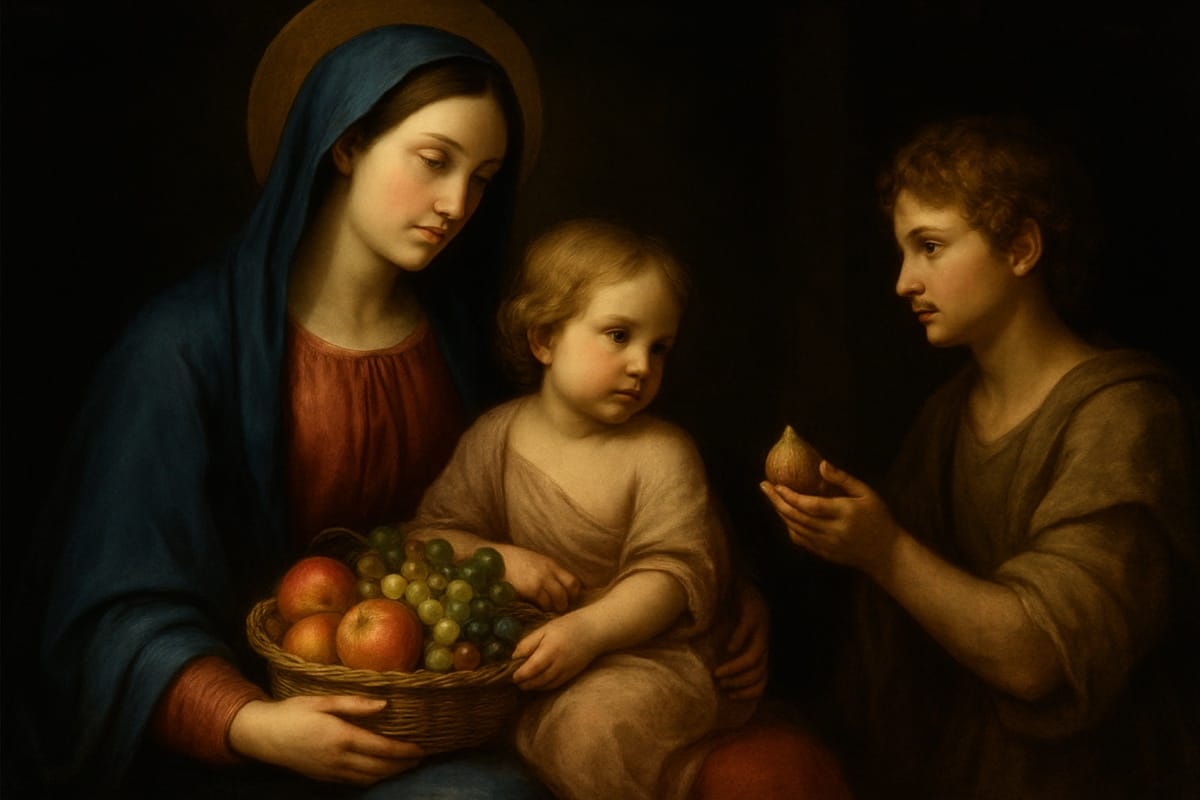
A fructibus eorum cognoscetis eos. Numquid colligunt de spinis uvas aut de tribulis ficus?
Mt 7:16
The criterion of fruits—“by their fruits you will know them”—is one of the most practical hermeneutical principles of the Gospel. Set in the context of the warning against false prophets (Mt 7:15-20), the criterion of fruits offers a method of discernment that does not depend on access to a person’s interior but can be verified externally: the effects of action over time, the quality of relationships, the consistency between what one preaches and what one lives. It is a criterion at once humble (it does not judge intentions, which are inaccessible from the outside) and demanding (the fruits reveal what the tree is).
The botanical image is simple but precise: grapes do not grow on the vine by decree. The fig tree does not produce figs by an effort of will. Fruits are the natural expression of what the tree is, determined by its roots, by its nature, by the soil in which it is planted. The metaphor applies to the spiritual and moral life: the acts people perform over time, their consistent choices, their relationships, and the effects of their influence on others reveal what they are inwardly more reliably than words or appearances do. A long series of bad fruits reveals a tree with a problem in its roots. A long series of good fruits indicates a healthy tree, regardless of its outward appearance.
I. False Prophets: The Criterion of Fruits
The “false prophets” to whom Mt 7:15 refers are described as “wolves in sheep’s clothing,” an image of disguised danger that resonates with particular force in settings where religious appearance does not correspond to interior reality. In the original context, it probably referred to religious leaders whose teaching or conduct was leading the community away from the path of the Gospel. The history of the Church has shown again and again that the problem of false prophets—charismatic leaders, influential teachers, prophets of novelty—is a permanent one and not exclusive to any one age.
The criterion of fruits as a method of discernment contains an invaluable practical wisdom: it makes it possible to evaluate without having access to a person’s interior and without presuming to know his intentions. “Judge not” (Mt 7:1) and “you will know them by the fruits” (Mt 7:16) are complementary instructions: do not judge the interior (which is inaccessible), but observe the fruits (which are verifiable). This complementarity avoids two opposite extremes: hasty judgment of intentions and naivety in the face of documented effects. A leader whose teachings systematically produce fear, dependence, family breakdown, and isolation from the wider ecclesial community reveals, by his fruits, a problematic “tree,” regardless of his declared intentions.
Ignatius of Loyola applied the criterion of fruits specifically to the discernment of spirits: the spirit that at first brings “consolation” but, when followed over time, leads to desolation, rigidity, and isolation is identified by its fruits as an “evil spirit.” The Ignatian criterion is not the initial enthusiasm, which both the good and the evil spirit can arouse, but the trajectory over time. This temporal perspective is crucial: fruits need to ripen in order to become visible. A fig tree may look healthy in March and reveal in August that it has produced no fruit. The patience of discernment by fruits is part of the method.
The Second Vatican Council, in Lumen Gentium 12, recognized charisms as gifts of the Holy Spirit for the building up of the Church, but stressed that these gifts must be discerned “by its pastors.” The criterion of discernment is precisely that of fruits: authentic charisms build up the community, serve the poorest, and promote ecclesial unity. Pseudo-charisms that divide, that create dependence, that replace the sacraments with emotional experience are revealed by their fruits, even when they are accompanied by extraordinary phenomena that deceive superficial discernment.
II. Fruits of the Good Tree: Gal 5 and Mt 7
Paul, in Gal 5:22-23, listed the “fruits of the Spirit”: “love, joy, peace, patience, kindness, goodness, faithfulness, gentleness, self-control.” This list serves as a key for reading the criterion of fruits in Mt 7: knowing what good fruits are makes it possible to apply the method of discernment. The fruits of the Spirit have in common a relational quality (they are all expressions of love directed toward the other) and a quality of durability: they are not passing emotional states but stable dispositions that show themselves in difficult situations as much as in easy ones.
The contrast with the “works of the flesh” (Gal 5:19-21), “fornication, impurity, lust, idolatry, sorcery, enmities, quarrels, jealousies, fits of anger, intrigues, dissensions, factions, envies, drunkenness, orgies,” is revealing: the works of the flesh are essentially divisive and self-referential. The fruits of the Spirit are unitive and other-referential. The “good tree” produces fruits that build up relationships and community. The “bad tree” produces fruits that destroy relationships and fragment the community. This ecclesial criterion (do the fruits build up or destroy the community?) is a practical application of the principle of Mt 7 to pastoral discernment.
The spiritual theology of the Carmelite tradition identified interior peace, detachment, and active charity toward others as “fruits of the Spirit” specific to the contemplative life. John of the Cross stressed that authentic mystical states always produce greater humility, greater charity, and greater fidelity to ordinary obligations, never spiritual arrogance, contempt for the “simple,” or neglect of everyday responsibilities. Extraordinary states (visions, locutions, ecstasies) are the least reliable as a criterion of authenticity. The ordinary and lasting fruits of charity are the surest.
The Franciscan tradition, in keeping with the spirituality of its founder, insisted on the fruits of joy and fraternity as signs of the Spirit. Francis of Assisi, whose fruits included a universal fraternity that went beyond the social and religious boundaries of his time, is one of the most eloquent examples of a “good tree recognized by its fruits.” It was not the stigmata (the most spectacular sign) that were the principal criterion of the authenticity of his charism. It was the friars who were converted, the lepers who were embraced, the Church that was renewed. Lasting fruits are the most reliable criterion.
III. Mary, the Good Tree: The Fruits of the Fiat
Mariology applies the criterion of fruits in a paradoxical and fascinating way: Mary’s fruits are the fruits of someone whose “yes” brought forth the Fruit par excellence, Christ Himself. The image of Mary as the “good tree” that produced the most perfect fruit in human history is used by the patristic tradition: Bernard of Clairvaux described Mary as the virga of Isaiah (Is 11:1: “a branch shall come forth from the root of Jesse, and a flower shall spring up from its roots”), the tree that sprang from the stock of Jesse and brought forth the Flower who is Christ. In this image, Mary’s “fruits” are not merely human virtues but the fruitfulness of the fiat: the Son of God who entered history through her availability.
The fruits of Mary’s life, visible in the Gospels and in the history of the Church, are precisely the fruits of the Spirit that Gal 5 lists. The Magnificat is a poem of joy (“my soul exults with joy in God”). The Visitation is an act of love and of service without calculation. Her presence beneath the Cross is faithfulness and gentleness in extreme suffering. Her intercession at Cana is patience and goodness toward the weakness of the hosts. Her presence in the Upper Room is peace and faithfulness to the community of the disciples. Each Gospel scene involving Mary is a verifiable “fruit”: concrete behavior, not merely declared intention.
Popular devotion to Mary is, ultimately, an intuitive recognition of her fruits: not the uncritical acceptance of hagiographical narratives, but the recognition that her influence on the lives of millions of people over two thousand years has produced verifiable fruits of love, peace, conversion, and service. The Marian shrines (Lourdes, Fatima, Guadalupe, Czestochowa) are collective fruits: places where the memory of Mary has given rise to communities of faith, works of charity, and pilgrimages of hope. The criterion of fruits also applies to Marian devotion: when it produces active love, conversion, and service, it is a sign of a good tree. When it produces superstition, passivity, or the displacement of Christ, it is a sign of deviation.
The Marian theology of John Paul II, especially in Redemptoris Mater (1987) and in Mulieris Dignitatem (1988), applied the criterion of fruits to Marian devotion as a criterion of authenticity: devotion to Mary is authentic when it leads to Christ, when it stirs charity into action, when it sustains discipleship. The “fruit” that Marian devotion should produce is the disciple who follows Jesus, the same fruit that the tree of Mary produced: the Son whom she showed to the world in the grotto of Bethlehem, at Cana, and on Calvary.
IV. Spiritual Discernment in the Church
The criterion of fruits has an urgent application today in the context of the religious and cultural polarization that runs through the Christian Churches. Charismatic movements, prayer groups, new communities, and diverse theological currents all lay claim to Gospel authenticity, and they frequently come into tension with one another. The criterion of fruits offers a method of discernment that transcends ideological preferences: not “is this group aligned with my theology?” but “what fruits does this group produce in the lives of its members and in the wider Church?”
Discernment by fruits requires time and humility. Time, because fruits take time to ripen. Initial enthusiasm can be deceptive, and only perseverance reveals the nature of the tree. Humility, because the criterion of fruits can be applied to oneself: “what are the fruits of my life of faith? Am I becoming more loving, more merciful, more available? Or more rigid, more judgmental, more self-referential?” Authentic spiritual discernment begins in the mirror of one’s own life, not in the evaluation of the lives of others.
The figure of Mary serves in ecclesial discernment as a stable point of reference: in the tradition, she is the model of the believer who bears fruit because of the One whom she received in her heart, not through her own effort. Mary’s fruitfulness, her capacity to bear fruits of grace for the world, does not result from her own initiative but from her availability: she was “the vessel of election” that God filled, the “tree” whose roots were sunk deep in God’s promise to Israel and in her welcoming of the Holy Spirit. Discernment by fruits, applied to Mary, confirms that the source of good fruits is always union with God: not human capacity, but human availability to the divine gift.
Jesus’ instruction, “by their fruits you will know them,” is, ultimately, an instruction of hope: fruits are verifiable, reality is not completely opaque, grace leaves its marks. In times of confusion and polarization, when religious discourses multiply and contradict one another, the simple and demanding question about fruits, “what does this produce in love, in peace, in unity, in service?”, is a criterion that Jesus Himself offered and that the Marian tradition confirms: the good tree produces good fruits, and those fruits are the most reliable sign of the presence of the Spirit.
Postgraduate Program in Mariology
Would you like to deepen your formation in Mariology? Discover the Postgraduate Program in Mariology of Locus Mariologicus—an academic formation that unites theological rigor, spiritual life, and the living tradition of the Church.
Would you like to study Mariology seriously?
This article grows out of the works in the Locus Mariologicus library. The Postgraduate Program in Mariology takes you to the same source, with academic guidance: Scripture, the Fathers of the Church, and the Magisterium, from the first dogma to contemporary questions.




Responses