Nolite timere: the Marian Saturday, fear, and Mary who did not fear
Et nolite timere eos qui occidunt corpus, animam autem non possunt occidere. Sed potius timete eum qui potest et animam et corpus perdere in gehennam.
Mt 10:28
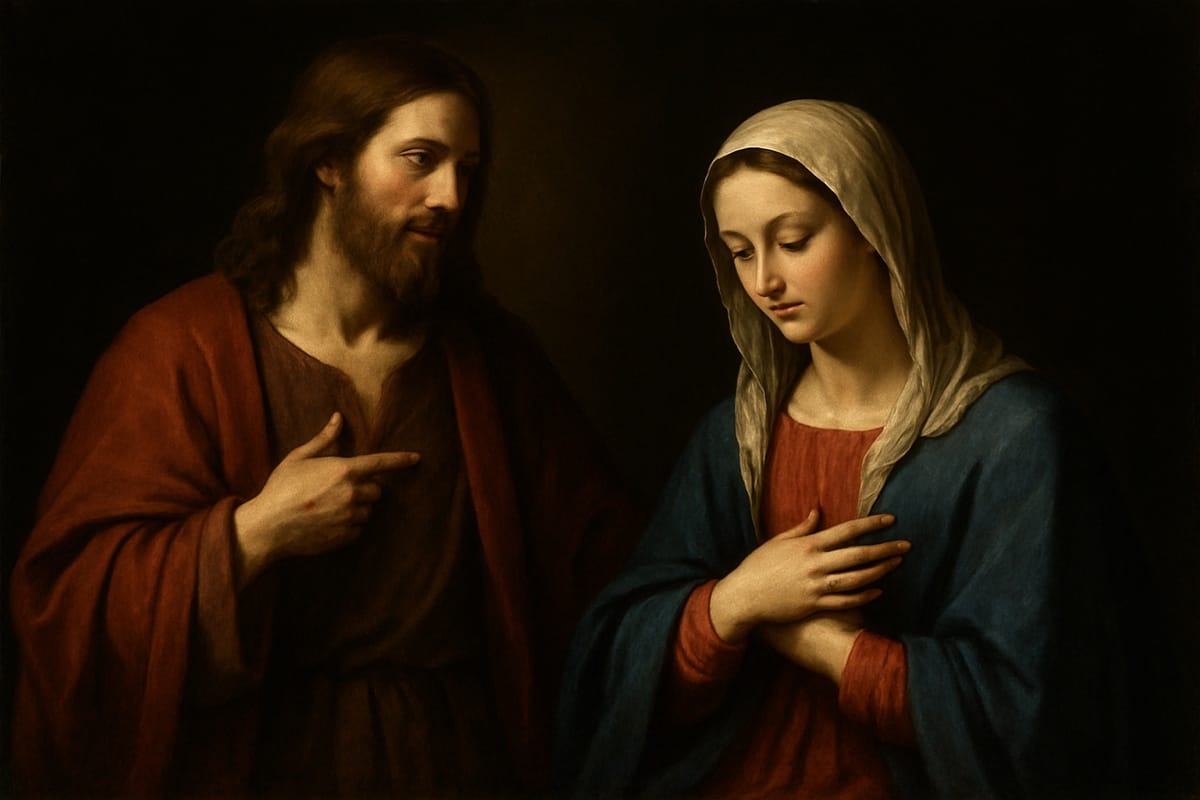
The Saturday of the Fourteenth Week in Ordinary Time is, in the liturgical tradition, the Saturday of Our Lady, the day of Marian memorial par excellence. The Gospel pericope of the ferial liturgy of this Saturday, Mt 10:24-33, the section of the missionary discourse on fear, offers an unexpectedly precise key for the Marian contemplation of the day: Mary as the one who received the most radical “noli timere” of sacred history and who lived it to the end. The discourse of Jesus on fear is, on this Marian Saturday, an indirect portrait of the woman who did not fear.
Mt 10:24-33 articulates three distinctions concerning fear: what it is legitimate to fear, what it is not legitimate to fear, and the foundation of Christian courage. The disciple is not above the Master (Mt 10:24-25): if they called the master of the house Beelzebul, they will call those of his household worse things. But he must not fear: “do not be afraid” appears three times in this short section (Mt 10:26, 28, 31), which makes this passage the most concentrated catechesis on fear in the whole Gospel of Matthew.
I. “There is nothing covered that will not be uncovered”: the courage of truth
“So do not be afraid of them. For there is nothing covered that will not be uncovered, and nothing hidden that will not be made known” (Mt 10:26): the first foundation of Christian courage is eschatological: the truth will be revealed. What is calumny will come to be unmasked as calumny. What is true will come to be recognized as true. The disciple’s fear, of being misunderstood, of being falsely accused, of having his reputation destroyed, is relativized by the certainty that the final judgment is the judgment of God, not the judgment of public opinion.
“What I say to you in the darkness, say it in the light. And what you hear in the ear, proclaim it from the housetops” (Mt 10:27): the imperative to proclaim publicly what has been received in private is exactly the opposite of fear. Fear leads back to silence. Evangelical courage leads back to proclamation. The disciple who heard the message “in the ear”, in the intimacy of his personal relationship with Jesus, cannot keep it to himself out of fear of the consequences of proclaiming it. What is received privately must become what is proclaimed publicly.
Mary received privately, “in the ear” of the Annunciation, the most radical message in all of sacred history: “you will be the mother of the Son of the Most High”. This message, received in private by an unknown young woman in an obscure town of Galilee, did not remain locked away in silence: Mary’s Magnificat at the Visitation is the “proclaim it from the housetops” of the message received, “from now on all generations will call me blessed, because the Mighty One has done great things for me” (Lk 1:48-49). Mary transformed what she heard in private into a proclamation that crosses the centuries.
The courage of Marian proclamation is not spiritual self-centeredness: the Magnificat speaks of God (“the Mighty One”), not of Mary as protagonist. Mary announces what God has done, not what she is. The “proclamation from the housetops” of the Christian disciple has this same structure: to announce what God has done, not one’s own spiritual experiences. Christian witness is theocentric, not egocentric, and Mary’s Magnificat is the model of this proclamation that does not appropriate what it has announced.
II. “Do not fear those who kill the body”: the hierarchy of fears
“Do not fear those who kill the body but cannot kill the soul. Rather fear Him who can destroy both soul and body in Gehenna” (Mt 10:28): Jesus establishes a hierarchy of fears: there is a legitimate fear (the fear of God) and an illegitimate fear (the fear of persecutors). The fear of persecutors is illegitimate not because persecution is not real or painful, but because the power of persecutors is limited: they can kill the body, they cannot destroy the soul. The power of God is total: He can destroy both soul and body.
The “fear of God” that Jesus recommends is not servile fear, the fear of the slave before a cruel master, but filial fear: the recognition that God is God, that His judgments are definitive, that no human power is comparable to divine power. This “fear” is the root of Christian freedom before human powers: whoever fears God need fear no one else. The hierarchy of fears is the basis of freedom: the disciple who has placed God in the place of the greatest fear has been set free from all lesser fears.
Mary knew the fears that Jesus enumerates: the fear of human judgment (the unexplained pregnancy before Joseph and the community of Nazareth), the fear for her Son’s safety (the Flight into Egypt, the trial before the Sanhedrin, Calvary), the fear of her own sorrow (the sword that Simeon prophesied). That Mary did not succumb to these fears, that she remained faithful to the “fiat” in all circumstances, bears witness that she had placed the “fear of God” above all other fears. “Noli timere, Maria” (Lk 1:30) was the angel’s invitation. “fiat mihi secundum verbum tuum” was the answer, the freedom of one who fears only what deserves to be feared.
III. “The hairs of your head are all numbered”: the providence that overcomes fear
“Are not two sparrows sold for a penny? And yet not one of them will fall to the ground without the will of your Father. As for you, even the hairs of your head are all numbered” (Mt 10:29-30): the most intimate foundation of Christian courage is the providence of the Father: the God who knows the number of the hairs knows every threat and every vulnerability. The courage that Jesus asks for is not the stoic courage of indifference to suffering; it is the filial courage that rests in the certainty that the Father knows.
“So do not be afraid. You are worth more than many sparrows” (Mt 10:31): the logic of the “a fortiori” argument is characteristic of Jesus’ reasoning: if God cares for the sparrows, He will care all the more for His children sent on mission. This logic does not guarantee the absence of suffering; the Christian martyrs were put to death, Jesus Himself was crucified. But it does guarantee that the Father knows, that suffering is not abandonment, that the death of the body is not the last word. The “a fortiori” of providence is the foundation of courage in the face of martyrdom.
Marian piety throughout history has consistently integrated this trust in providence: the rosaries prayed in situations of danger, the promises of protection attributed to the Scapular of Mount Carmel, the trust in Mary’s intercession in situations of extreme fear, these devotional practices are concrete ways of living the “do not be afraid” of Mt 10:28-31. Mary who did not fear is invoked by those who fear as the one who can transmit, through her intercession, the peace that she herself lived throughout her life, the filial peace of “you are worth more than many sparrows”.
IV. “Everyone who confesses Me before men”: the witness that sets free
“Everyone who confesses Me before men, I also will confess him before My Father who is in heaven” (Mt 10:32): the counterpart of the “do not be afraid” is the promise of the confession of Jesus before the Father. The disciple who confessed Jesus before the tribunals, the synagogues, the hostile crowds will be confessed by Jesus at the final judgment. The courage of witness has an eschatological reward: whoever was not ashamed of the name of Jesus will not be put to shame by Jesus before the Father.
“But whoever denies Me before men, I also will deny him before My Father who is in heaven” (Mt 10:33): the symmetrical threat is that of “denial”: what Peter did on the night of the Passion, before the servant girl and the guards of the high priest. Peter’s denial was real, “I do not know the man” (Mt 26:72), and the reaction of Jesus was real: “Peter remembered the words of Jesus […] and he went outside and wept bitterly” (Mt 26:75). But Peter’s denial was not definitive: the restoration of Jn 21 shows that the mercy of Jesus is stronger than the weakness of fear.
The Marian Saturday is the day to pray with Mary, she who never denied, she who remained at the foot of the Cross when all had fled. Her intercession for those who are afraid, for those who fear to confess, for those who have been ashamed of the name of Jesus in the difficult circumstances of life, has a particular efficacy: she who did not fear intercedes for those who fear, she who confessed intercedes for those who denied, she who remained intercedes for those who fled. The “nolite timere” of Jesus in Mt 10:28 is transmitted by the voice of Mary who lived it, and who, in living it, became a model and an intercessor for those who are still learning not to fear.
Postgraduate Program in Mariology
Would you like to deepen your formation in Mariology? Discover the Postgraduate Program in Mariology of Locus Mariologicus – an academic formation that unites theological rigor, spiritual life, and the living tradition of the Church.
Would you like to study Mariology seriously?
This article grows out of the works in the Locus Mariologicus library. The Postgraduate Program in Mariology takes you to the same source, with academic guidance: Scripture, the Fathers of the Church, and the Magisterium, from the first dogma to contemporary questions.





Responses